


Our next AI Product Manager & Builder Cohort is starting. For an early-bird discount, you can fill out the form here: AI PM Builder Cohort
[Alumni Shipping at Google, Microsoft, Uber]
Imagine you are a product manager at a food delivery company.
You own the customer support experience.
Monday morning, you open the dashboard.
Yesterday, your support team got 4,000 refund requests. One support executive takes about 6 minutes per request.
So that is 400 person-hours every single day. Your manager wants this to be under one minute per request using AI. Finance wants to make sure we don't refund money we don't owe.
You have two weeks. In these two weeks, you will come across eight terms.
You will not learn them from some glossary.
You will learn them because each one is either a problem you hit or the fix for it. So read in order. Each term solves the problem the previous one created.
1. Agents
This is what you see: day one, you ship a chatbot.
A customer writes that two items are missing from the order. The model writes a very polite reply. You watch the ticket. The chatbot cannot check the order. It cannot see the delivery photo. It cannot issue the refund. A human is still doing all of that. Handling time goes from 6 minutes to 5. You are nowhere near one minute.
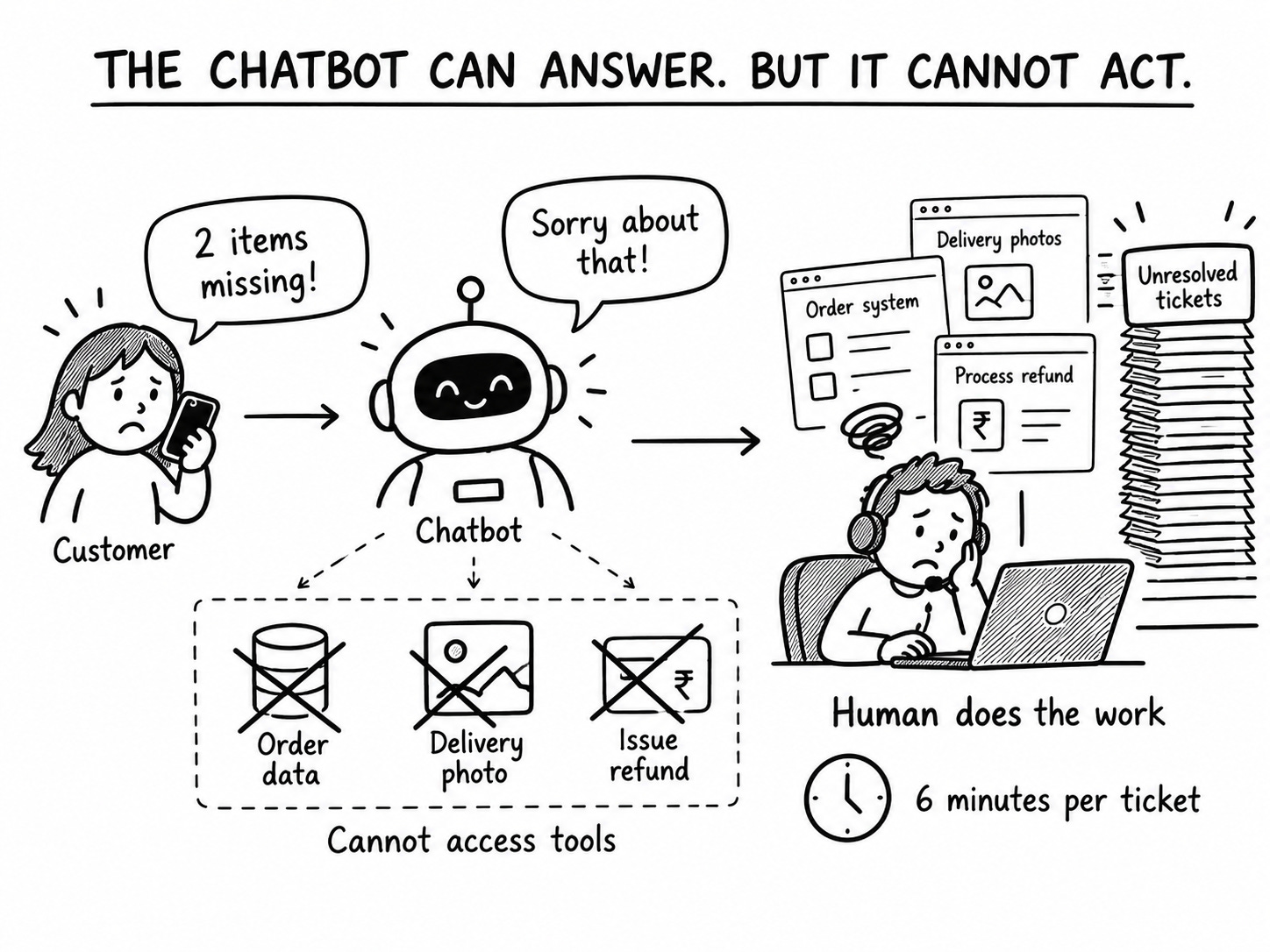
This is what you learn: an agent is a model that can take actions, not just write text. You give it tools. It calls a tool, reads the result and decides what to do next. It keeps going till the job is done.
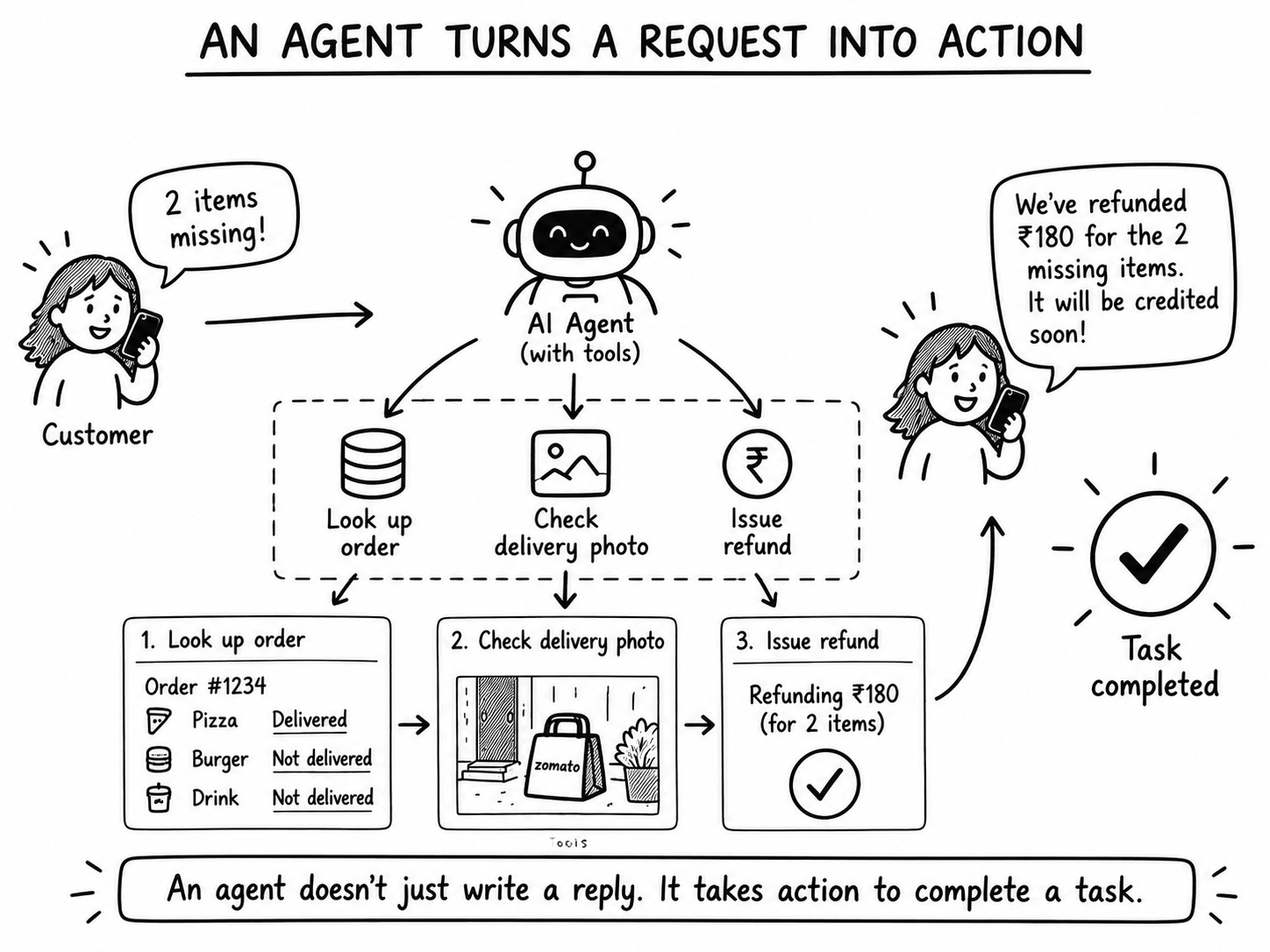
This is what you do: day two, you give the model four tools.
Read the ticket. Look up the order. Fetch the delivery photo. Issue a refund.
Now, for the same missing items ticket, it looks up the order, sees two items marked undelivered by the rider, refunds Rs 180 for those two items and writes the reply. Nobody from your team touched it.
See, a chatbot answers. An agent finishes the task. That is the whole difference.
2. Harness
This is what you see: day three, finance pings you.
The agent has refunded a full Rs 2,400 order. You open the ticket. The complaint was one cold dish. The customer asked for a full refund; the model agreed, and nothing stopped it. You go to check the logs. There are no logs.
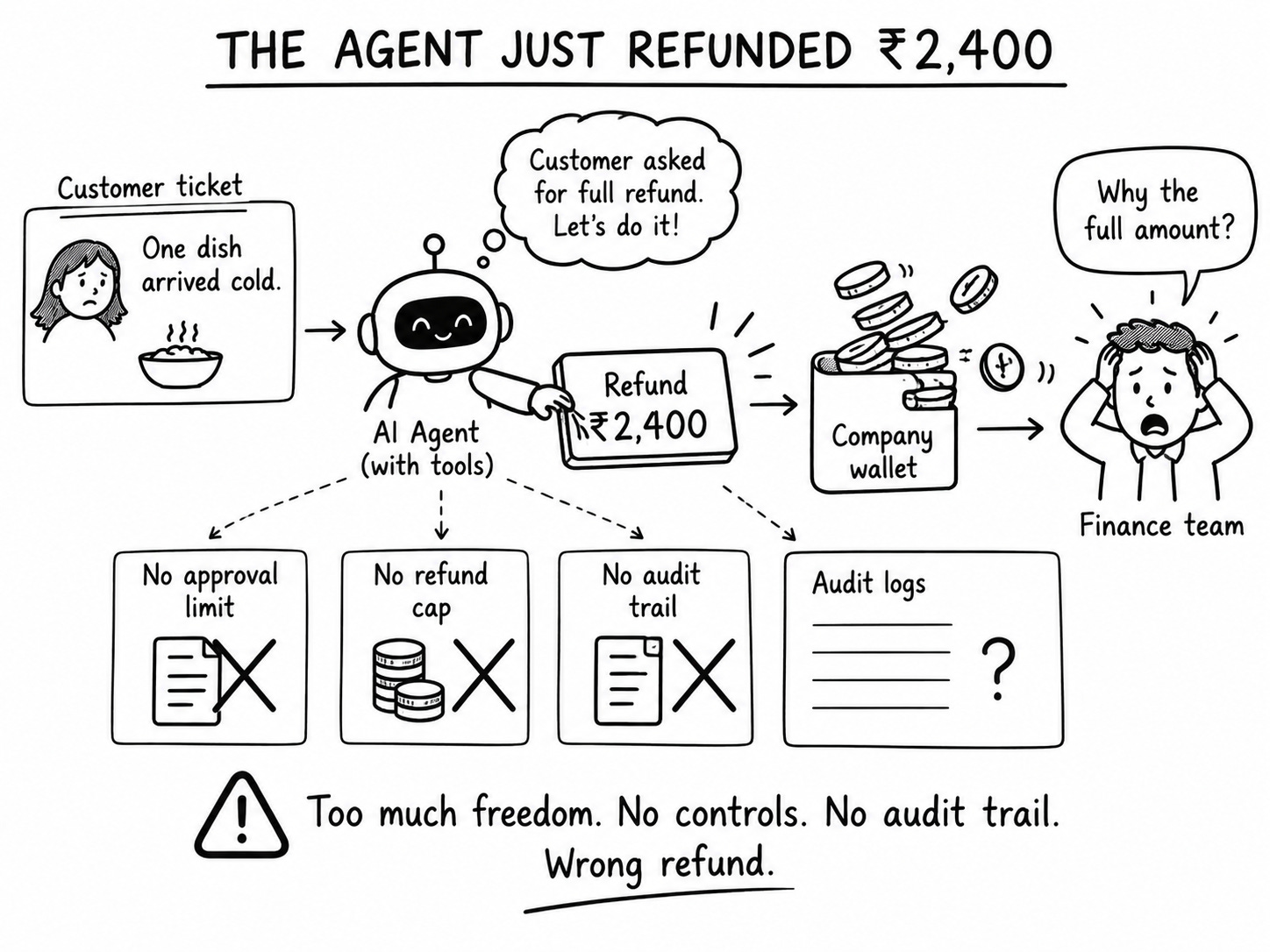
This is what you learn: the model was not the problem. The problem was everything around the model. That everything is called the harness.
Which tools the agent gets. What the system prompt says. What limits apply. What gets logged. When a human steps in. Most of an agent’s quality lives here and not in the model. This is why you are hearing this word everywhere in 2026.
This is what you do: four changes to the harness. Any refund above Rs 500 needs human approval. Refund is capped at the value of the items the customer actually complained about. Every tool call is logged with the reason. The written refund policy goes into the system prompt.
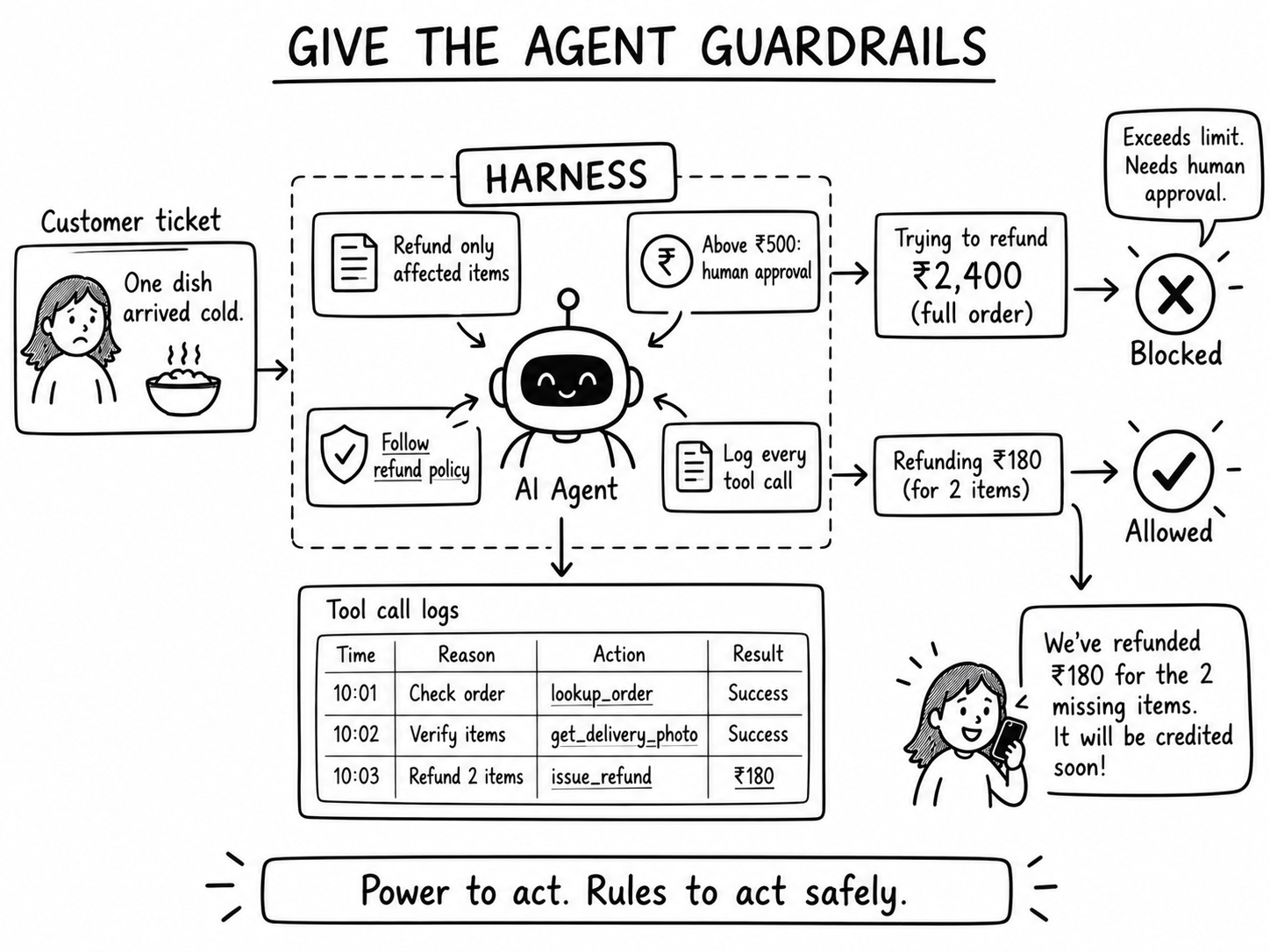
Same model. Different harness. The Rs 2,400 mistake cannot happen again.
3. MCP (Model Context Protocol)
This is what you see: your agent needs order data, rider data and the payments system. Your engineers write custom code to connect each one. Each connection takes around a week. Day five, the rider team changes their API without telling anyone.
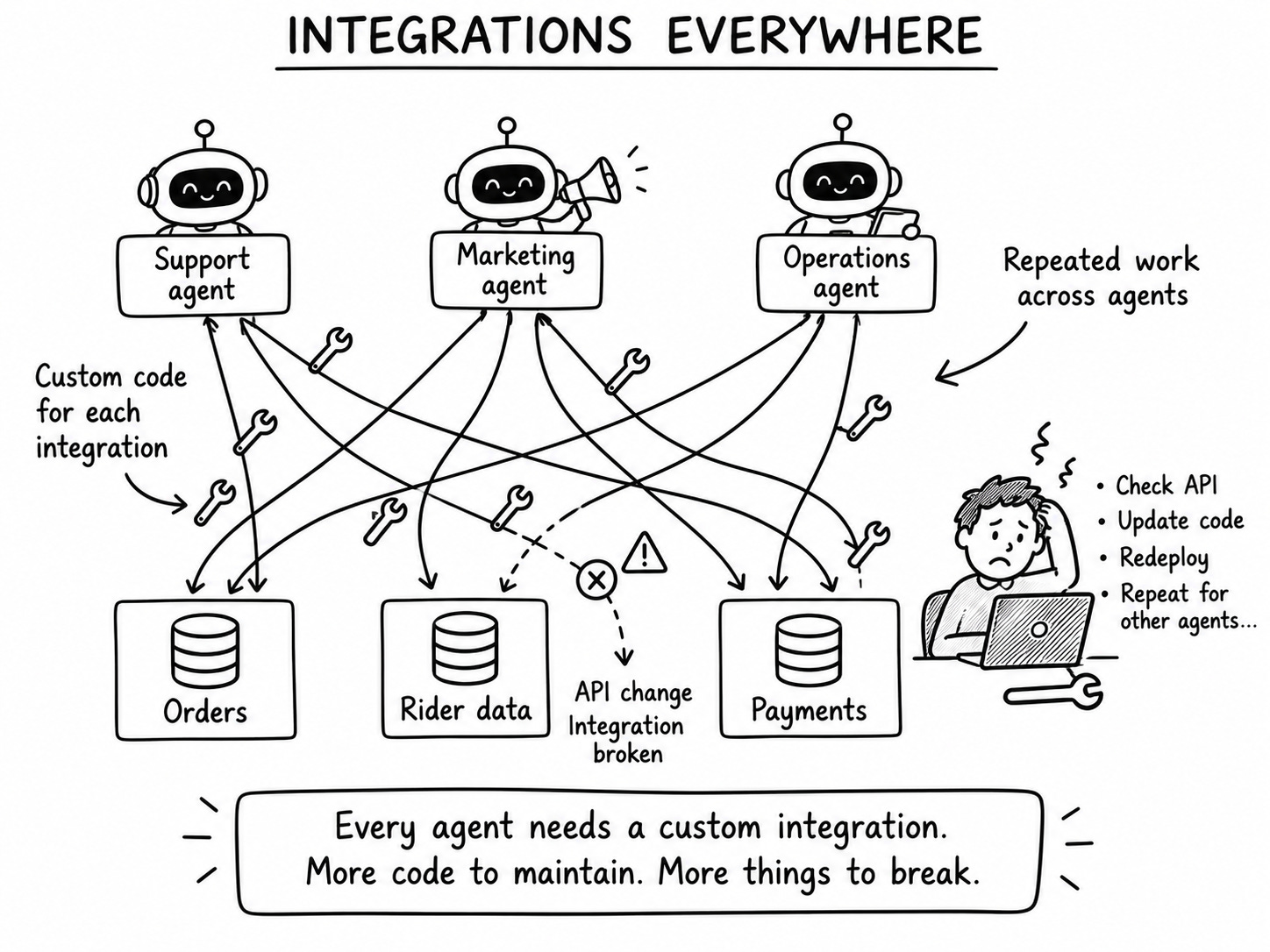
Your agent is down for a full day. Now you have three integrations and each one is something that can break.
MCP is a standard way for a model to connect to tools and data. Anthropic released it in late 2024, and today most major AI platforms support it. A team exposes its system once as an MCP server. After that, any agent in the company can use it, no new code needed.
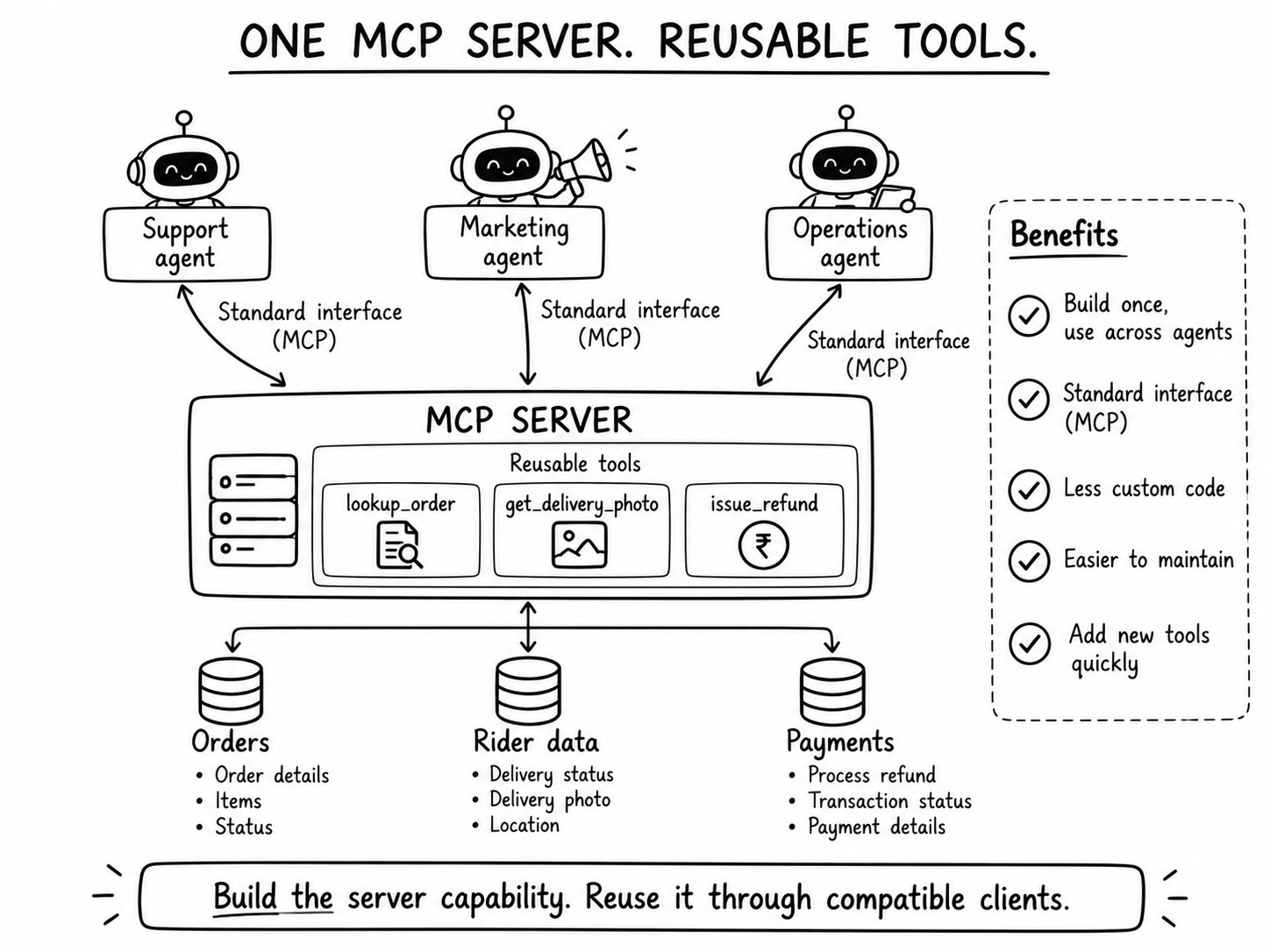
You ask the payments team to build one MCP server with two tools, lookup_order and issue_refund. Your agent uses it.
Two months later, the marketing team’s agent uses the same server for order lookups. Nobody writes that connection again.
Your question to engineering changes. You stop asking whether we can build an integration. You start asking whether we have an MCP server for this.
4. Skills
The refund agent is working. Day six, your manager asks you to also handle the where is my order tickets. That is 3,000 more a day. Your system prompt is already 1,800 words of refund policy. You add the tracking rules. Now the prompt is 3,200 words. And refund accuracy drops, because the model is reading two policies for every ticket and mixing them up.
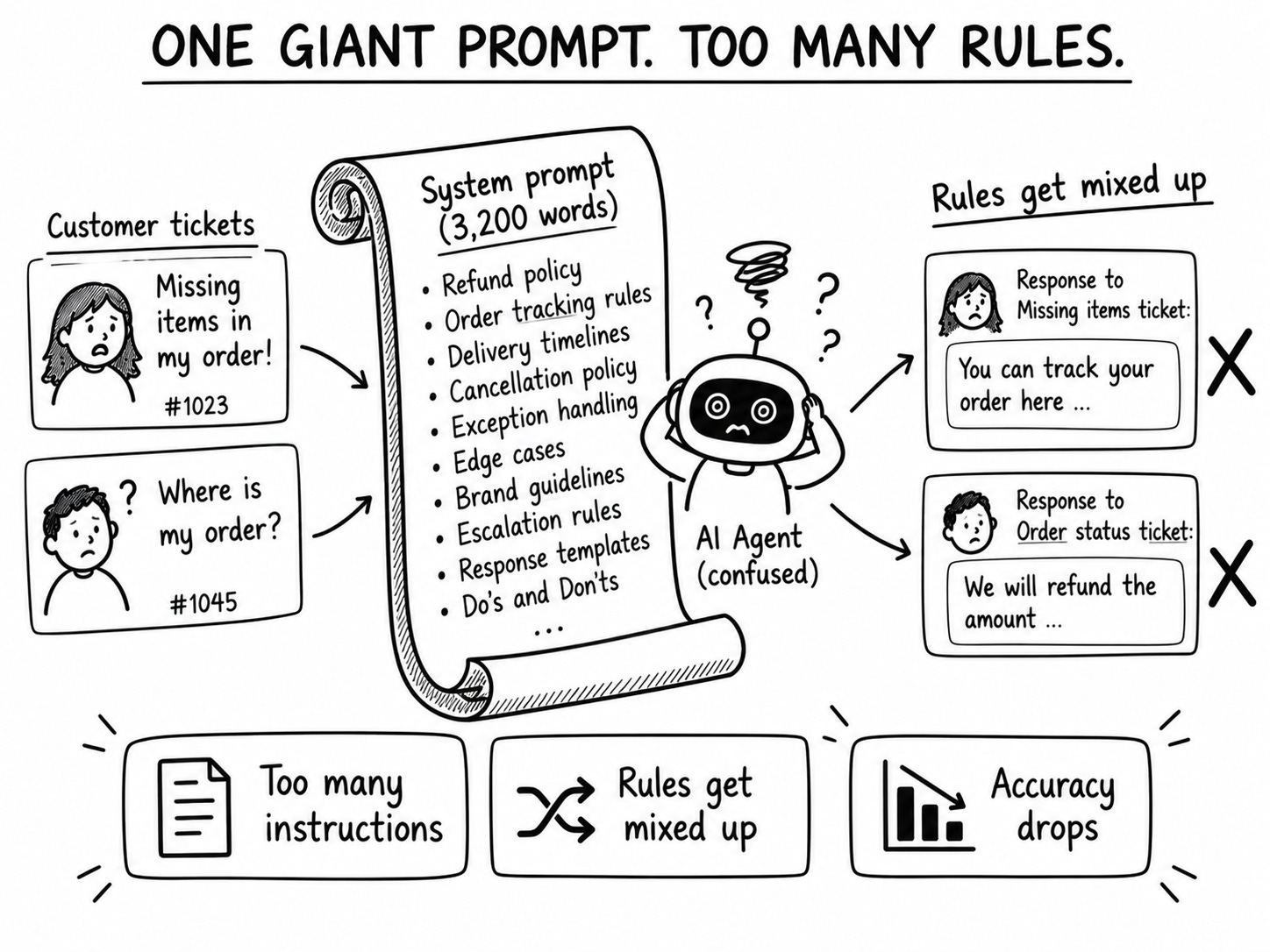
A skill is a folder of instructions, examples and scripts that the agent loads only when a task needs it. The main prompt stays short. The detail lives in the skill.
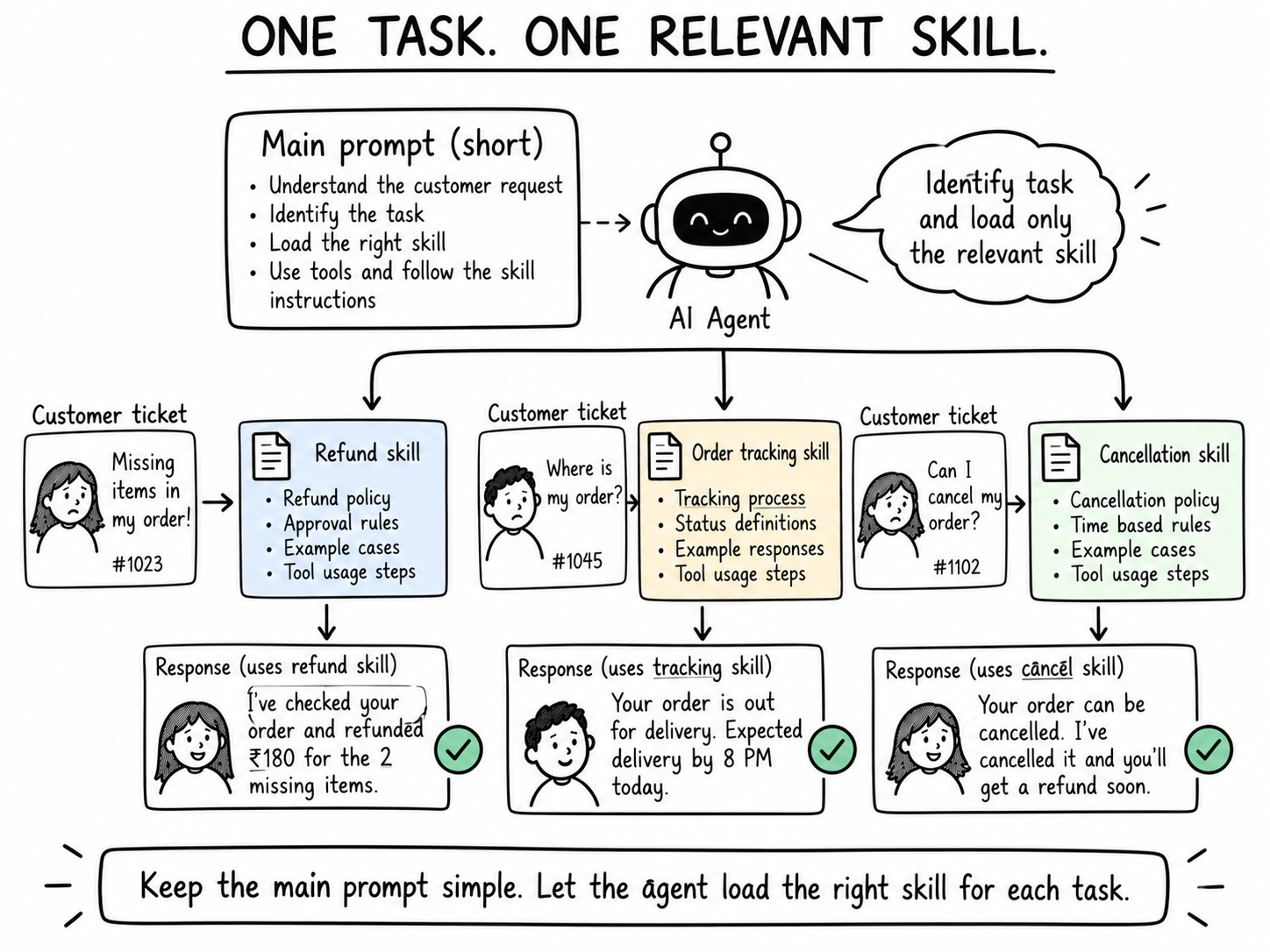
You split the prompt into files.
skills/refunds/SKILL.md has the refund policy, 12 worked examples and the edge cases
skills/order-status/SKILL.md has the tracking rules and the rider delay thresholds
The main prompt is now 200 words. It only says which skill to open for which ticket type
A refund ticket loads only the refund skill. Accuracy goes back up. When policy changes, you edit one file.
5. Loop engineering
The agent is now running 7,000 times a day. You cannot read 7,000 outputs. Day nine, you pull a sample of 200 tickets.
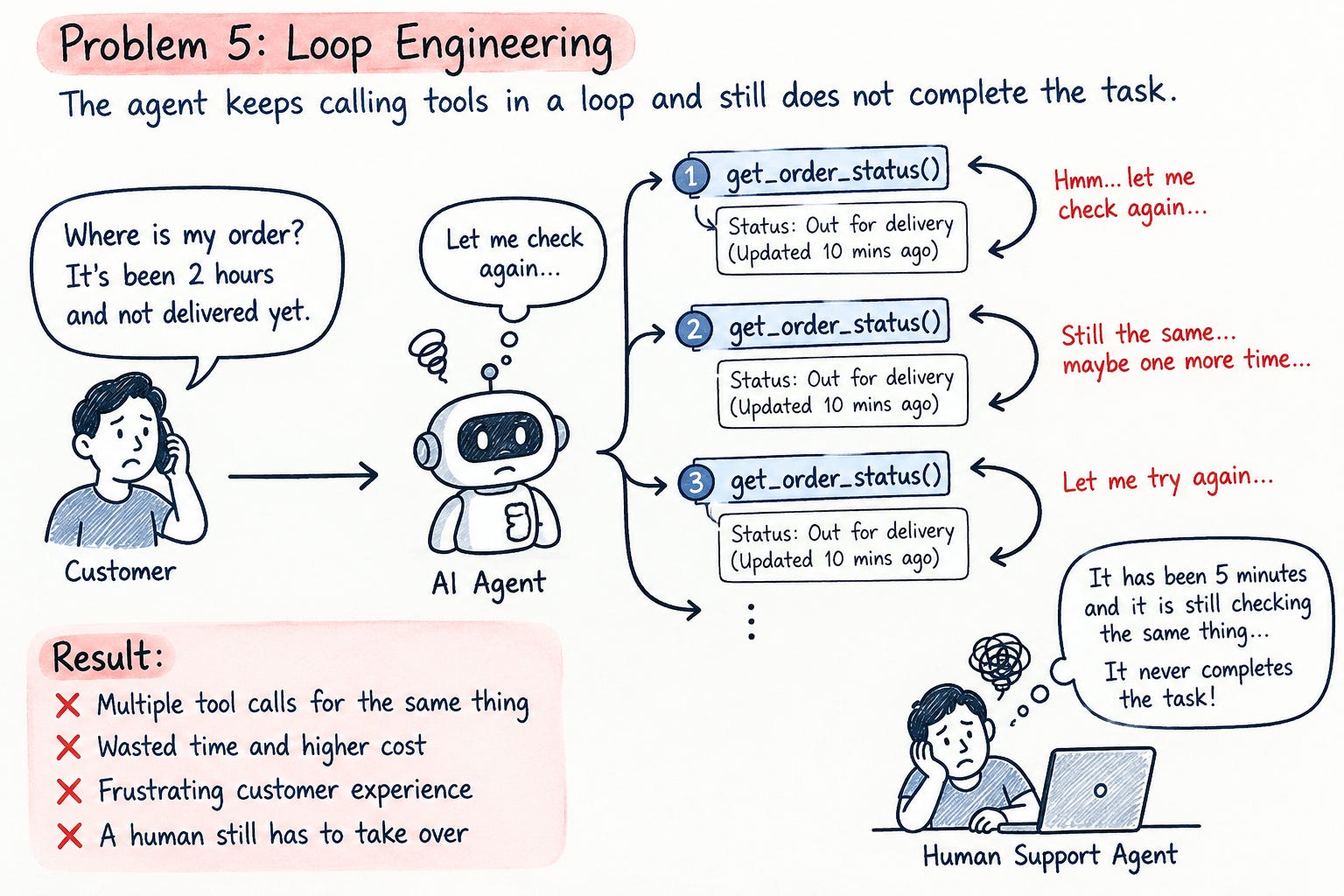
In 6 of them the agent called lookup_order 20 times one after another because the order ID was wrong, then gave up and refunded anyway. You realise nobody ever decided when the agent should stop, when it should retry and when it should ask for help. The agent decided on its own, and badly.
That decision is loop engineering. The term was picked up in June 2026 after an essay by Addy Osmani and posts by Peter Steinberger and Boris Cherny all said the same thing. Stop prompting the agent one turn at a time.
Design the loop that runs it. A loop has four parts. Do the work. Check the work. Retry if the check fails. Stop at a limit and hand over.
This is what you do: you write the loop for one ticket.
The agent reads the ticket and drafts a decision with reasons
A second, cheaper model checks the draft against the refund policy
If the check fails, the agent retries once with the checker’s note
If it fails again, or crosses 8 tool calls, the ticket goes to a human
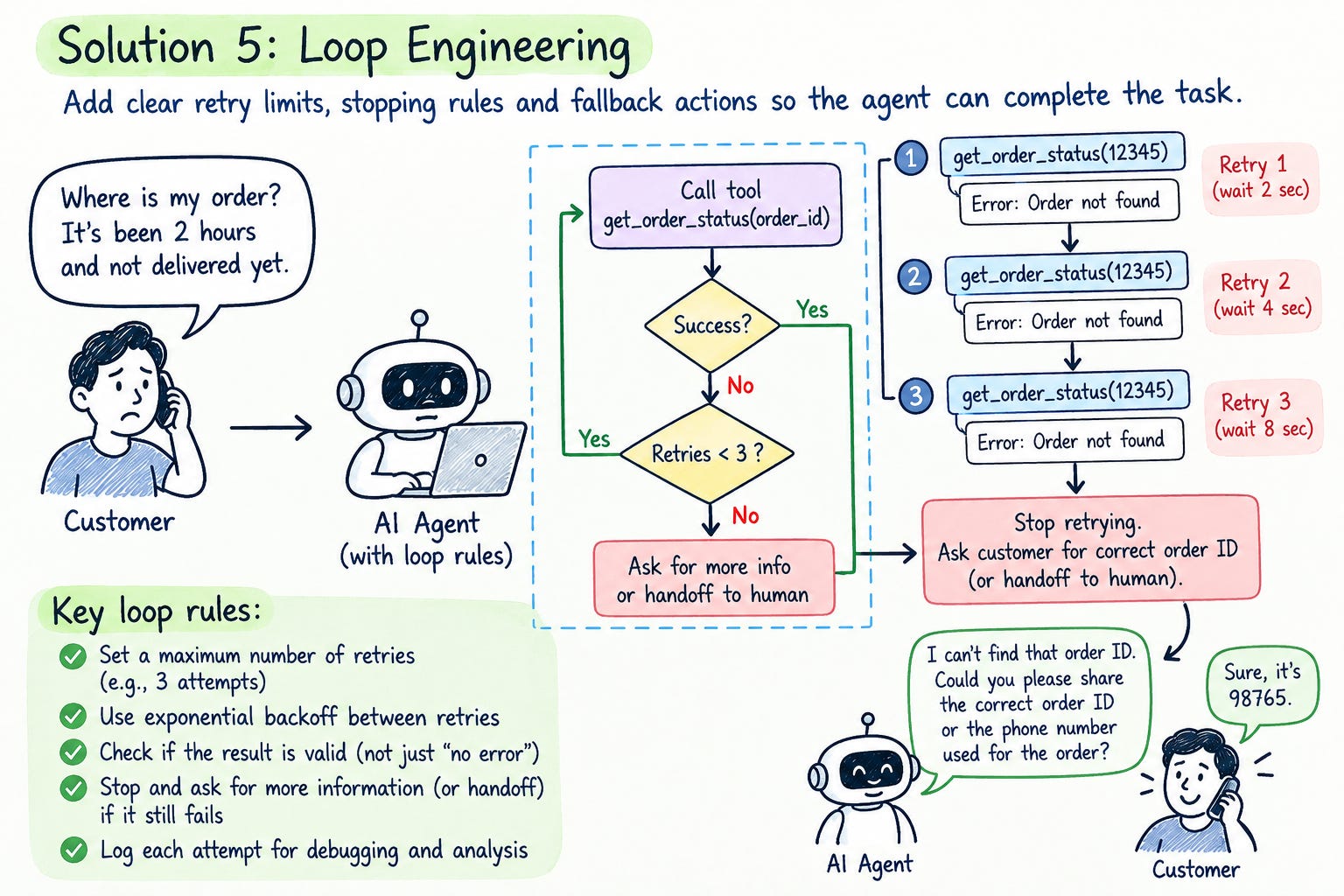
The 20 lookup problem is gone. You stop thinking about the prompt. You start thinking about the loop.
6. Computer use
Around 8% of tickets involve a third-party rider partner. Their delivery photos sit inside a web dashboard which has no API. Your agent cannot fetch them. So those 560 tickets a day still go to a human, and they are the slowest ones because the human has to log in and search manually.
Computer use lets a model operate a screen the way a person does. It takes a screenshot, finds the right button, clicks, types and reads whatever comes up. It works on any website or app, even the ones built with no AI in mind.
You add a computer-use step only for those 8% of tickets. The agent logs into the partner dashboard, searches the order ID, opens the photo and brings it back into the normal loop. It takes around 40 seconds instead of the 2 seconds an API call would take. It fails maybe one time in twenty, and those go to a human.
You use it because the alternative is 560 human tickets a day. Computer use is slow and less reliable than an API. It is the right choice only when there is no API.
7. GEO / AEO
Week 2, you notice a new type of ticket. Customers are asking why the refund takes 7 days. Your policy is 48 hours. You ask three of them where they got 7 days from. All three say they asked ChatGPT or Google AI mode before writing in. You try it yourself. The AI answer says 7 days. It is picking that up from some 2023 blog post, because your own help page has the policy buried in paragraph six.
GEO is Generative Engine Optimisation. AEO is Answer Engine Optimisation. In practice, both mean the same thing. SEO was about ranking in a list of links. GEO is about being the source the AI answer reads and quotes. If the AI cannot find a clear answer on your page, it will pick one up from somewhere else.
You rewrite the help page. The first line states the policy in one sentence. Each heading is a question a customer would actually type. The refund timeline is a small table, not a paragraph.
Three weeks later, the AI answer says 48 hours. The 7-day tickets stop.
8. AGI / Superintelligence
Day 13, a new model gets released. It is cheaper and scores higher on every benchmark than the one inside your agent. Your agent is not even two weeks old and the model inside it is already not the best option. And this will happen again in a few months.
AGI means artificial general intelligence, an AI that can do most cognitive work at the level of a capable human, across any field. Superintelligence means an AI that is better than the best humans at that work. Neither exists today. Every major lab says it is building towards them. Because they are racing, the model inside your agent will keep getting cheaper and better, on a schedule you do not control.
You take one design decision. Everything in sections 2 to 6 is built such that the model is a swappable part. The harness, the MCP servers, the skills and the loop do not depend on which model is running inside. When a better model comes, you change one line of config and rerun your 200 test tickets.
The model is the part that keeps changing. The system around it is what you own.
About Author
Shailesh Sharma! I help PMs and business leaders excel in Product, Strategy, and AI using First Principles Thinking.
AI Learning Resources
12 Weeks LIVE AI PM Cohort (Alumni now ship AI at Google/Microsoft, etc)
Self-Paced AI PM Cohort Recordings (65 Hours of Content) | Use AIBUILDER20 for 20% Discount [Alumni Shipping at Google, Microsoft, Uber]
Quick AI PM Course (20 Hours of Content) [ Rated 4.9/5 from 1000+ Product Managers from Google, Coinbase, Microsoft, etc]