

If you are reading this, you might be an aspiring Product Manager or you’re already a Product Manager who wants to understand the technical side of things.
There are a lot of people who think that understanding Technology is not even required to become a Product Manager.
They may be right, but I believe that everyone should have a basic understanding of tech because it unlocks a whole new dimension of feasibility and viability of a Feature or Product.
So let’s dive deeper into this.
Why Tech Matters for a Product Manager?
Technology is at the core of almost every product. From the simplest mobile app to complex software, understanding the underlying technology is crucial for success in product management.
Bridging the Gap: Communication and Collaboration
Product managers act as the bridge between the business world and the development world.
One day you will be talking to the business team or the revenue team, getting all the requirements, and the next day you will be discussing those with your engineering counterpart.
A strong understanding of technology allows Product managers to communicate effectively.
Imagine you are building a feature for WhatsApp to integrate a Gen AI chatbot. You are ready with all the use cases listed in your PRD. You have set up a meeting with the engineering team to groom the requirements.
Then the engineer asked, “What is the latency of Chatbot Repsonse we are good with?”, “Do we want to store the chat in the encrypted form in our database?”, “What’s the expected traffic or concurrent users?”.
With all of these questions, you will become overwhelmed and start feeling left out of the discussion. So, a basic understanding of technical concepts will help you to articulate your vision and requirements in a way that resonates with the development team. This leads to fewer misunderstandings, faster development cycles, and ultimately, a better product.
Making Informed Decisions about Feasibility & Prioritisation
Product Managers are constantly making decisions about features, functionalities, and roadmaps. Understanding technical concepts will help you evaluate the technical feasibility of a feature that will allow you to make informed decisions about what’s possible and what might need to be re-imagined. Also, technical complexity impacts development timelines and resource allocation. If you understand the technical Concepts, then you can make intelligent decisions about investing your dev bandwidth.
Let’s understand this with the help of an example.
You are a Product Manager at Netflix to improve Personalisation.
In the context of Netflix, Personalisation means showing users what they want to stream. Inspired by brainwave research, you proposed a solution of Mind Reading Personalisation in Netflix.
You write the Product Requirement Document ( PRD ), including all the use cases. You have set up a meeting with the Engineering team to discuss the feature.
The idea is that users would wear a headset while streaming Netflix. The headset would subtly monitor their brain activity in real-time, allowing the platform to understand their subconscious reactions and preferences to the content they are watching or listening to. This data would then be used to generate hyper-personalised recommendations, even predicting what they might enjoy before they consciously realise it.
What do you think about the technical viability and feasibility of the feature? A good Product Manager will understand the feasibility and challenges, like
Brainwave patterns are highly individual. Developing a universal algorithm to reliably interpret these signals across a diverse user base would be an immense challenge.
Analysing complex brainwave data in real-time and translating it into meaningful content preferences with low latency would require significant computational power.
Ensuring the accuracy and reliability of the recommendations based on potentially noisy brainwave data can also pose feasibility challenges.
Innovations are good, and we should strive towards that,t but it’s super important for a Product Manager to understand the technical feasibility, which can help in a better prioritization.
Tech Drives the User Experience
User Experience and User Interactions hinge on Technology. Think about how Apple revolutionised music consumption with the iPod. By deeply understanding digital audio compression (MP3), portable storage (hard drives), and intuitive user interfaces (the click wheel), they created a product that not only met user needs for portable music but also surpassed them, transforming an entire industry.
In subsequent chapters, we will cover everything around Tech that you need to become a better Product Manager.
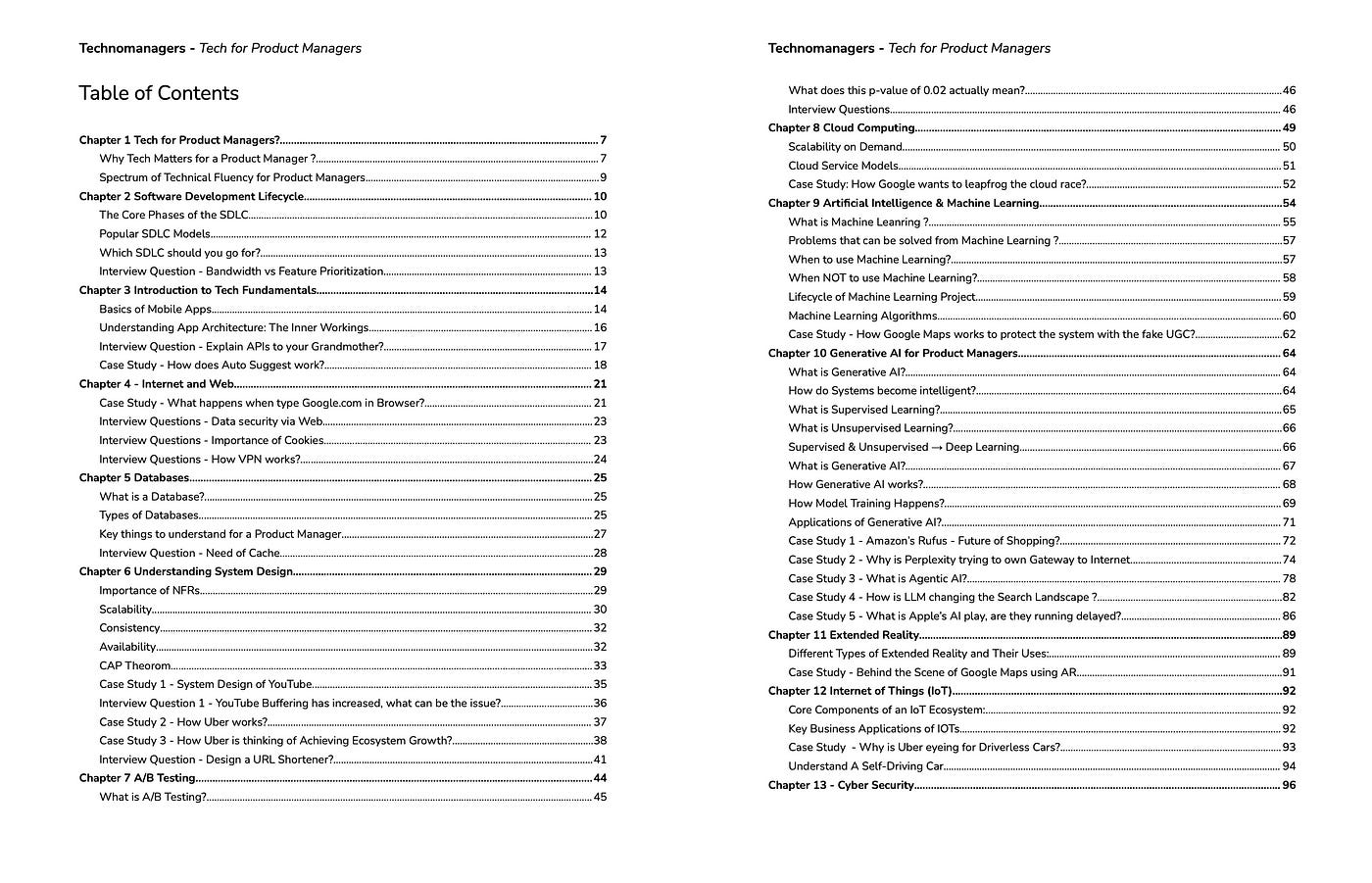
Above Book we have explained everything with a Case Study Based Approach, this can be a game changer in your Product Management Career
For More, check out our PM Interview Mastery Course ( Crack PM Interview with First Principle Thinking like the top 1% ) — 5/5 Rated
Hey, I’m Shailesh Sharma! I help PMs and business leaders excel in Product, Strategy, and AI using First Principles Thinking.
For more, check out my Live cohort course, PM Interview Mastery Course, Cracking Strategy, and other Resources
More about PM Interview questions and Mock Interviews | YouTube | Courses & Cohort | Tech & Strategy Newsletter