

Do this to win in 2027 (and stop doing what worked in 2026)
In this article, we will discuss:
1. The AI PM Trap of 2027
2. Why Most PMs Will Fail in 2027
3. What a Real Winner Looks Like in 2027
4. The New PM Interviews (AI Interviews 2.0)
5. The 2027 Roadmap to Become an AI PM
It is late at night, and you are scrolling LinkedIn.
One PM has posted a demo of an AI agent she built over the weekend. The next post is about another round of layoffs.
The one after that is a job description that says AI native PM; must have shipped agents in production.
You close the app. You open it again and find Microsoft, Amazon, and Google all planning layoffs.
If you are a Product Manager going into 2027, you are probably feeling this.
Last year you were told to learn AI. You did. You learnt prompting, you built a prototype, you even shipped a small AI feature.
And still it feels like the bar has moved again. It has. Let me show you where it moved.
The AI PM Trap of 2027
In 2026, the trap was simple. People watched a few YouTube videos on vibe coding and called themselves AI PMs.
In 2027, the trap is more dangerous because it looks like real work.
You built a prototype in Lovable or Claude Code. It worked in the demo. Your manager was impressed. So you think you have made it.
Here is the truth.
A demo that works once is NOT equal to a product that works for a million users (Demo is easy; production is hard)
Prototyping is now table stakes. Every PM can do it. Your intern can do it. So it no longer makes you stand out.
Quick self-check. Give yourself 1 point for every question you can answer with confidence today.
Can you write evals for your AI feature and tell which ones should be deterministic and which ones need an LLM as judge?
Can you explain why your agent failed on step 4 of a 7-step task, and not just that the final answer was wrong?
Can you tell what it costs you every time a user asks your AI one question?
Can you decide what your agent is allowed to do on its own, and where a human must approve?
Can you explain what context your model sees, and why giving it more context made it worse?
Can you price an AI product that does the work, not just helps with the work?
If you scored 5 or 6, you are ahead of most PMs in the market.
If you scored 2 or less, do not panic. But do not ignore it either. This article is for you.
Why Most PMs Will Fail in 2027
The majority of Product Managers will learn AI tools. Very few will learn how AI products actually work.
And in 2027, that difference becomes very expensive.
Three things have changed.
First, AI now does the work most PMs were proud of. It writes the PRD, the user stories, the competitor research and even the first prototype. If your value was in writing documents, that value is gone.
Second, companies have moved from AI that talks to AI that acts. A chatbot that gives a wrong answer is embarrassing. An agent that books the wrong flight, refunds the wrong customer or deletes the wrong file costs real money. Companies need PMs who can control that risk, not PMs who can make a nice demo.
Third, tools change every three months. The PM who only learnt tools has to start again every quarter. The PM who learnt the system underneath (data, models, context, evals, cost) just picks up the new tool and moves on.
2026 exposed the PMs who never learnt AI.
2027 will expose the ones who only learnt the surface of it. I know this is brutal, but this is the truth, and I am definitely sure you don’t want to be the one.
What a Real Winner Looks Like in 2027
The bar has moved one level up. Here is the simplest way to see it.
2026 winner built a RAG chatbot. 2027 winner can prove it answers correctly and knows what every answer costs.
2026 winner vibe coded a prototype. 2027 winner took that prototype to production with specs and evals.
2026 winner knew what an agent is. 2027 winner decided what the agent is allowed to do without asking a human.
2026 winner wrote good prompts. 2027 winner designs the full context the model sees.
So a true Product Manager in 2027 should be able to
Write evals that catch failures before users do ( Deterministic evals, LLM as Judge, and step-level evals for agents )
Design agents with clear permissions: what it can do alone and where a human must click approve ( Autonomy vs Control )
Engineer the context, decide which documents, memory and tools the model sees, because more context is not better context
Manage the unit economics, cost per task, when a small model is enough and when you need a frontier model
Monitor AI in production, because a feature that worked in January can quietly break in March after a model update
Price AI products by outcome, per task or per resolution, not only per seat
Know when NOT to use AI, and keep simple rule-based flows where the audit trail matters
Many More
The New PM Interviews (AI Interviews 2.0)
Interviews have changed again.
In 2026 they asked you questions about AI. In 2027 they ask you to use AI in front of them.
Some interview loops now give you Cursor, Lovable or Bolt and ask you to build a working prototype in about 45 minutes while the interviewer watches. Meta has reportedly added a Product Sense with AI round, where you use AI during the case itself.
The test is not whether you can prompt. The test is whether you can spot when AI gives you a confident wrong answer, and fix it.
Behavioural questions also went one level deeper. Tell me about a trade-off is now: Tell me about a time your AI feature got worse after launch. How did you find out, and what did you do?
They are testing AI Product Sense, Agent Evals, Reliability, Cost, AI Pricing, AI Safety and your judgment on where not to use AI.
Some examples are below
Your AI support agent resolves most tickets on its own, but customer satisfaction has dropped. What do you do? ( Evals and Metrics )
Write the evals for a travel booking agent that can book and cancel tickets on its own. ( Agent Evals )
How would you price an AI agent that does the work of a sales rep? Per seat, per task or per outcome? ( AI Pricing )
Model costs drop 10x next year. What changes in your product strategy? ( AI Strategy )
You are the PM of a paid AI model. Your biggest enterprise customer wants to move to an open-source model that is good enough and much cheaper. How do you respond? ( AI Strategy )
In this product, where would you NOT use AI, and why? ( AI Judgment )
Notice one thing. None of these can be answered with a framework you memorised. You need to have built or broken an AI system to answer them well.
Check out our self-paced AI PM course (Including AI PM Interview Preparation )
4.9/5 · 1000+ enrollments · Use NYE27 for 40% off → See testimonials and course details
The 2027 Roadmap to Become an AI PM
You need a plan to move from a traditional PM to an AI PM. Here is the step-by-step guide. I have added a checkpoint to every step, so you know when you are actually done and can move on.
This is the same roadmap 800+ PMs have followed in our AI PM Course, including PMs who now ship AI at Google, Microsoft and Coinbase.
#1 Understand Basic AI and ML
→ Machine Learning, Artificial Intelligence, Deep Learning, Generative AI, Linear and Logistic Regression, Decision Trees, Training vs Inference
#2 Learn from Real AI Case Studies
→ How Google, Microsoft, Amazon, OpenAI, Netflix, Nvidia and Uber use AI in their products and pricing
#3 Understand ML Systems and Data Architecture
→ AI Product Lifecycle, AI Data Pipelines, the AI Flywheel, ML System Design
#4 Master Advanced Prompting and Context
→ How to write the Perfect Prompt, System Prompts, Temperature Control, Advanced Prompting ( CoT, ToT, etc. ), getting consistent outputs, deciding what context the model sees
#5 Vibe Coding and Prototyping
→ Beginner to Advanced Vibe coding, Model Parameters, the PM Reliability Framework for prototyping
#6 Understand RAG, Agents and Evals
→ RAG System Architecture, Chunking and Retrieval, RAG Metrics, Designing Agents, Agentic Workflows, Evals, Deterministic and Probabilistic Evals, LLM as Judge
#7 AI Interview Preparation
→ AI Product Sense, AI Success Metrics, AI Pricing, AI Evals, AI Product Strategy ( Real questions like success metrics of GPT 5.0 and evals for a travel booking agent )
#8 Ship One Thing and Show It
→ Build one small AI product end to end, write its evals, and post what broke and how you fixed it
Steps 1 to 8are what the course is built around.
Are You Ready for 2027?
The world is changing fast.
You can keep learning tools that change every three months and feel the stress every time a new one drops. Or you can learn the system underneath them, and become the PM who decides how AI gets built.
Go back to the self-check at the top. Whatever your score is today, you can take it to 6 by the time 2027 starts.
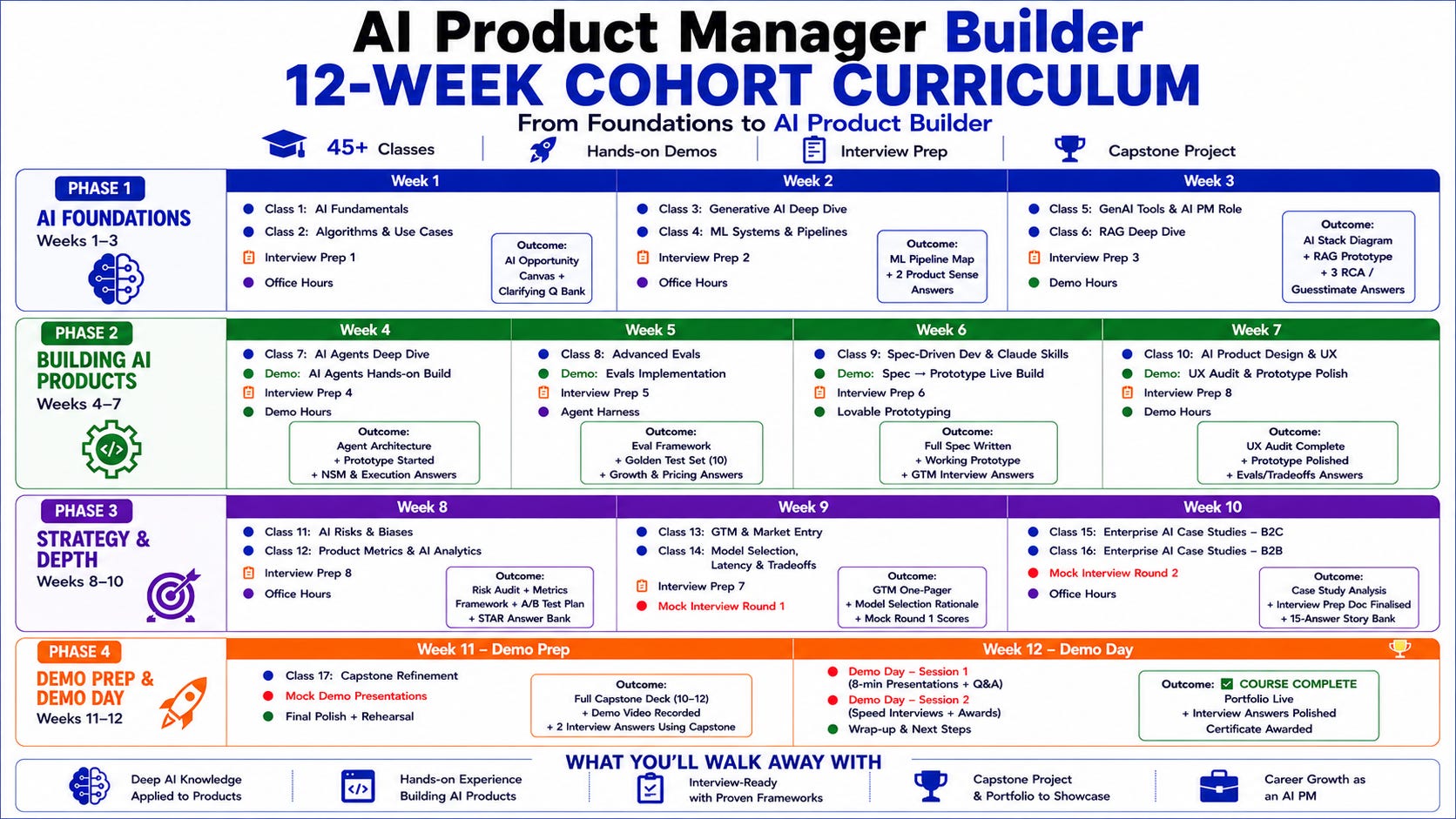
12-week program details can be found here -
[Alumni Shipping at Google, Microsoft, Uber] - 1 out of 3 is getting placed
About Author
Shailesh Sharma! I help PMs and business leaders excel in Product, Strategy, and AI using First Principles Thinking.