


In this article, we will identify the various stakeholders in the AI value chain and their respective strengths and weaknesses.
In the entire AI value chain, there are five important stakeholders. Let’s deep dive into them one by one:
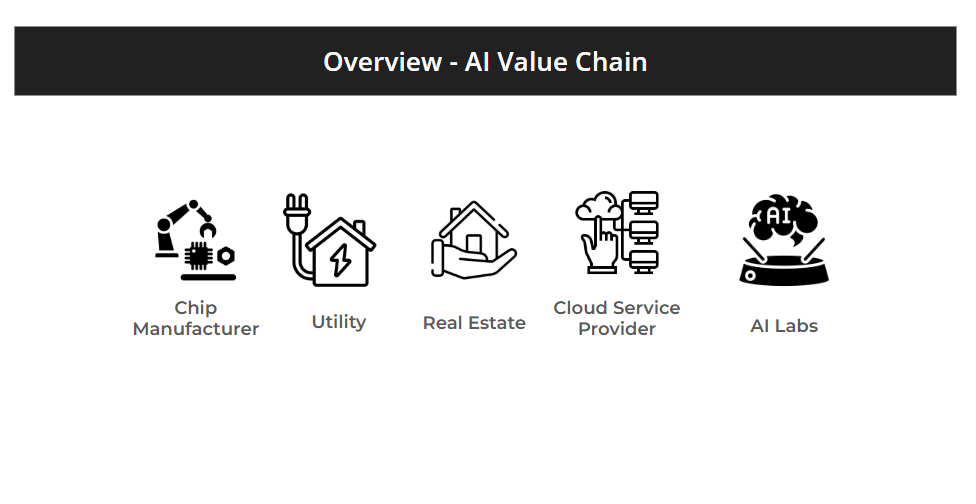
AI Labs
The most visible companies in the AI boom are the labs working on training their models, shipping conversational interfaces for users and cracking enterprise / individual deals to earn revenues.
The success of these players depends upon three important things:
The model and its capability to perform tasks, as compared to its peers
Distribution network, i.e. how many users can be acquired by these AI labs
The very demand of AI itself
Running a business for AI labs is extremely capital-intensive. Developing a new-generation model can cost hundreds of millions, and running it daily requires constant use of large clusters of advanced GPUs within specialised data centres. At the present stage, there is a stark difference between the revenue generated and the capital deployed. For example, Anthropic is expected to earn a revenue of $2.2bn and burn capital of $3bn in 2025
The investments are so unprecedented that AI labs are entering into multi-year contracts and carrying the heaviest financial risks.
If you really want to understand Strategy in depth and Crack Strategy Interview Questions, you need to check out this book. 5/5 Rated, and it is helping so many people get job Offers. ( Like this post if you have read till here )
Cloud Service Providers
Positioned next to the AI research labs are the hyperscale cloud providers—Amazon Web Services, Microsoft Azure, and Google Cloud. These firms procure semiconductor components from Nvidia and TSMC, acquire land, secure long-term electricity supply, and manage extensive data centre infrastructure. They subsequently commercialise this capacity by offering ‘compute’ to enterprises, startups, and AI laboratories through a combination of on-demand provisioning, reserved allocations, and managed AI services.
The success of these players depends upon two important things:
Selecting the right location, designing efficient data centres, and optimising networks are crucial to reducing costs. Building near cheap power and available land can greatly cut overall expenses
The demand for AI itself
Cloud service providers are better positioned than AI labs, as the barrier to entry is very high in this business. But their margins can quickly erode if the cost of power and semiconductors shoot up and cloud service providers can’t pass on these costs to the AI labs.
Utility & Real Estate
Every data centre is essentially a warehouse of GPUs running nonstop, under intense power demands and heat stress. Running the warehouse requires land (to build the warehouse), power and coolants.
Land parcels with direct links to transmission lines, substations, and fibre networks are the optimal sites for building data centres. These parcels are scarce and are becoming valuable. Similarly, an increase in the power demand is providing opportunities to energy companies to earn higher revenue & profits.
AI demand is just one of the use cases for the utility & real estate companies; largely, their success is not completely dependent on where the AI cycle goes.
Chip Manufacturers
Next in the value chain come chip designers and manufacturers.
Nvidia designs the GPUs that power the training and deployment of modern AI models. In Q2 2025, the company reported $46.7 billion in revenue, of which $41.1 billion was derived from data centre sales. Nvidia is maintaining a dominant position because of its proprietary CUDA software framework, which has become the industry standard for machine learning and effectively locks developers and organisations into its ecosystem.
Manufacturers such as TSMC have the expertise in producing advanced AI Chips. Their cutting-edge manufacturing technology is helping them gain the pole position.
While an unprecedented demand for AI is creating huge tailwinds for these companies, any reduction in the demand for AI can impact these companies negatively. While the entry of newer players in the manufacturing and design space can shake up the profit margins of the existing players, high barriers to entry make it less likely.
Be the Top 1% PM - Best PM Interview Mastery Course | PM Cohort & Resources
About Author
Shailesh Sharma! I help PMs and business leaders excel in Product, Strategy, and AI using First Principles Thinking. For more, check out my Live cohort course, PM Interview Mastery Course, Cracking Strategy, and other Resources