

Let’s get the uncomfortable part out of the way first.
Yes, AI writes PRDs now.
Good ones. Yes, it turns forty customer interviews into a clean thematic synthesis in less time than it takes you to open Notion.
It writes the SQL. It builds the metric tree. It drafts the competitive teardown, generates fifteen solution options, converts a messy sixty-minute call into tidy tickets, and produces a roadmap deck that looks a lot like the one you spent Sunday night building.
Yes, a real chunk of what you spent five years getting good at now costs twenty dollars a month.
That is true. It is not hype, and pretending it is not happening protects nobody.
But here is the other true thing.
The product managers doing well right now are not the ones fighting the tools. They are the ones who worked out, quietly and early, what the tools cannot do. Then they got aggressively good at exactly that.
This was never a replacement story. It is a story about repricing.
What AI Is Actually Good At
Before we talk about your career, we should be honest about the machine: the honest answer is quite a lot.
AI is good at production. Give it a clear brief, and it returns something usable in seconds. It is good at generating options, which means you now start from twelve directions instead of a blank page.
It is good at the mechanical middle of the job: first-draft specs, acceptance criteria, edge-case enumeration, release notes, stakeholder updates, the thing you write to the thing you write.
It is very good at compression. Two hundred support tickets into eight themes. A competitor’s entire changelog into a positioning read. A quarter of Amplitude data into a paragraph you can send to your VP.
It is good at recall. It never forgets that you shipped a similar feature in 2024 and it went badly.
And it is good at speed, which is the part that quietly breaks everything. Because when the cost of producing a product artifact falls toward zero, the artifact stops being evidence of anything.
The PRD Was Never the Job. But It Was the Proof.
Here is the thing nobody in your org will say out loud.
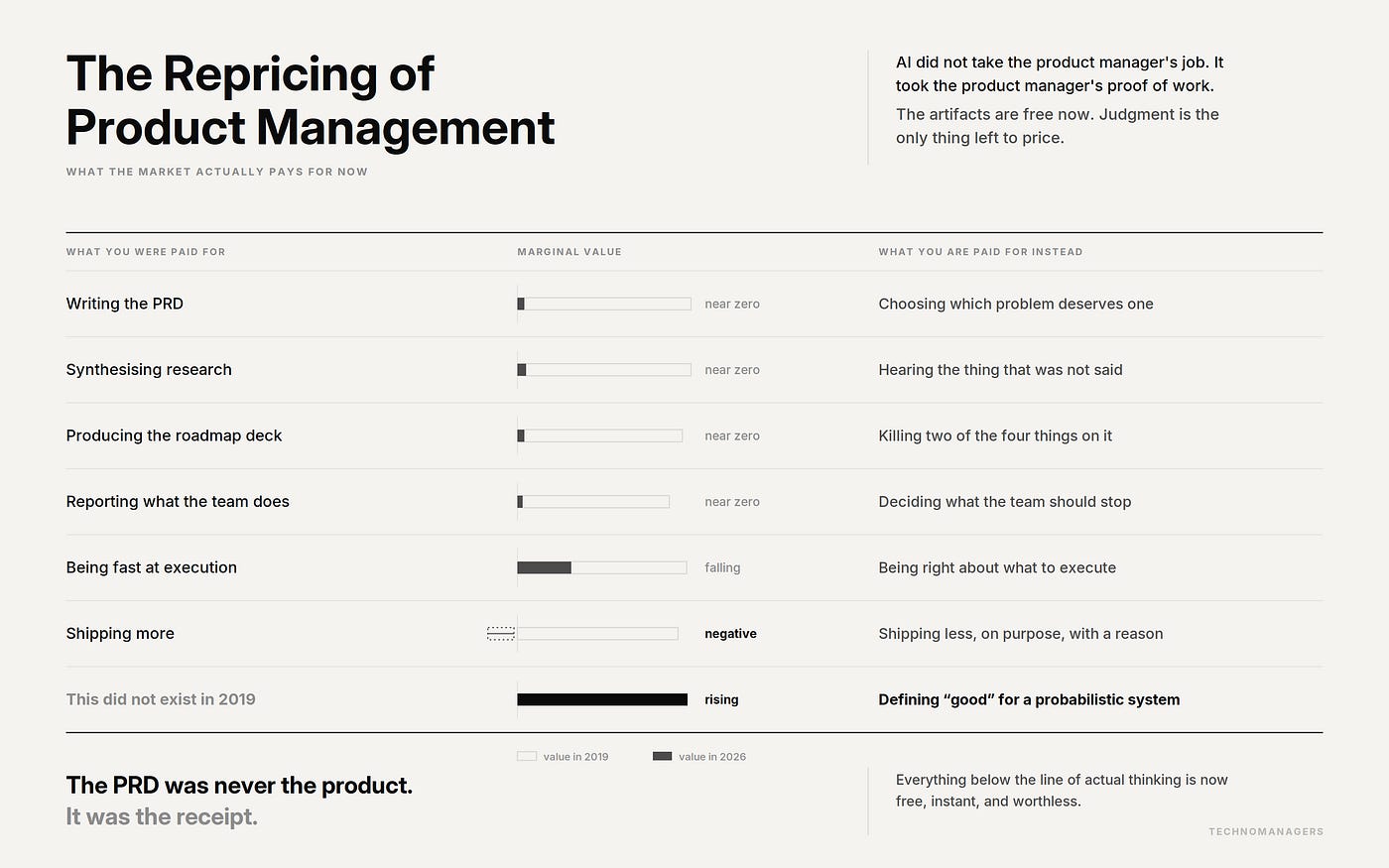
For twenty years, product management was based on two things that were bundled together.
One was judgment.
The other was the throughput of artefacts.
Judgment is invisible, so nobody could price it directly. Artefacts are visible, so the org priced those instead and hoped they correlated.
The PRD was not the product. The PRD was the receipt. It was how you proved to people who could not see inside your head that you had actually thought.
AI just made it possible to produce the receipt without doing the thinking.
That is the whole disruption in one line. Not that your work got automated. That your proof got counterfeited, including by you, at three in the morning, when you did not have the energy to think, and the model was right there.
Which means the bundle has broken. Artefacts are now free. Judgment is now the only thing left to pay for. And a lot of PMs are about to discover that they were being paid for the wrong half.
What Just Got Expensive
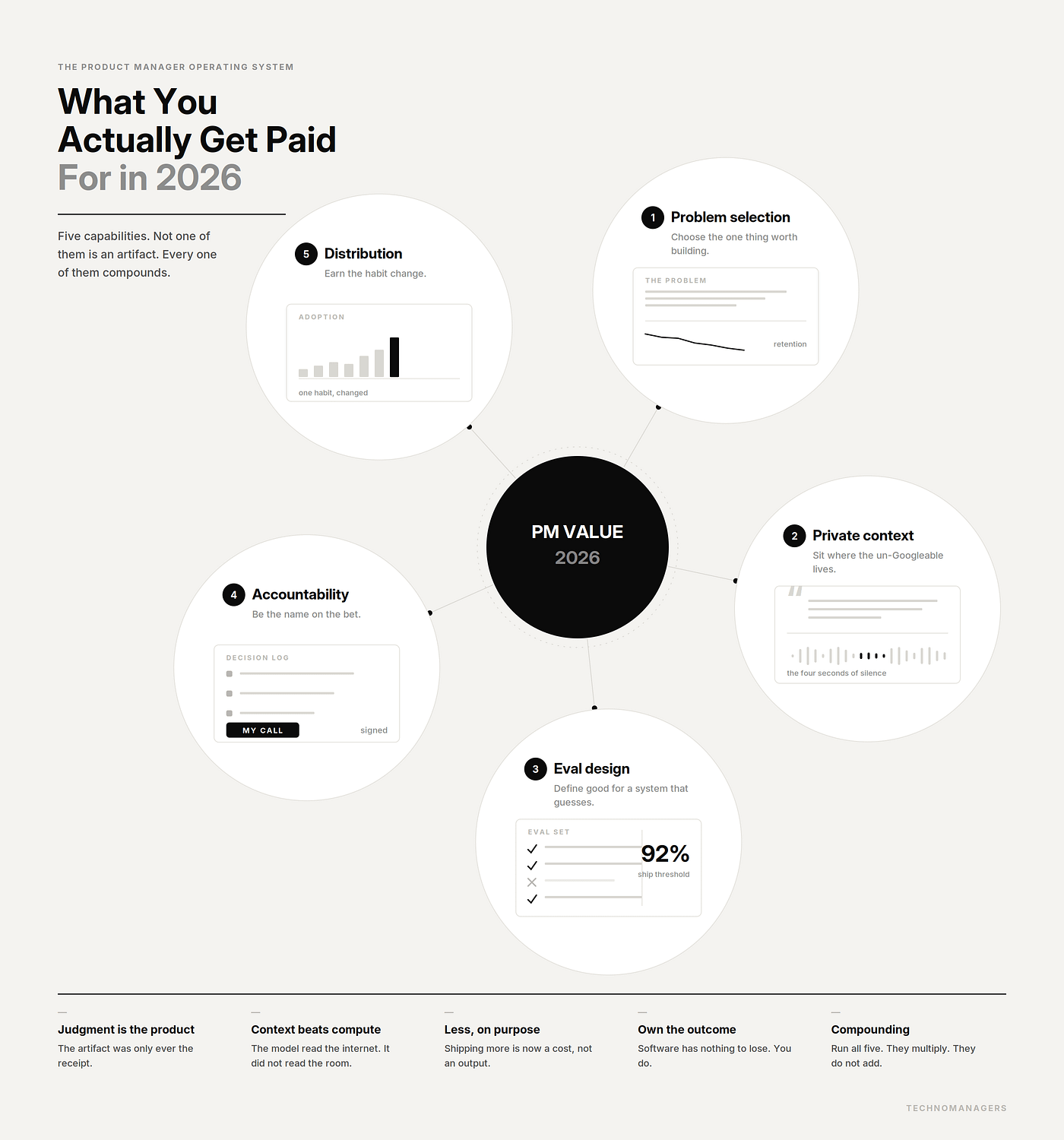
1. Deciding what not to build
Engineering throughput is going up. In some teams, it has already doubled. Every instinct in a product org says: great, we can ship more.
That is the trap.
More features mean more surface area, more support load, more cognitive tax on the user, more code somebody has to maintain in eighteen months. When building was expensive, the cost of building acted as a filter. It stopped you. It killed your worst ideas for you, for free, before you ever had to argue.
That filter is gone. You are now the filter.
The PM who uses AI to ship three times more features is not three times more productive. They are quietly destroying their own product and calling it velocity. Restraint used to be a luxury. It is now the core competency, and almost nobody is training for it.
2. Context that cannot be scraped
The model has read the entire internet. It has not sat in the room where your biggest customer went quiet for four seconds before saying “yeah, no, it’s fine.”
It does not know that your CFO’s real constraint is not budget, it is a board meeting in November. It does not know that the sales team has been quietly promising a feature that does not exist. It does not know which of your three churn reasons is the real one and which two are what people say instead of the real one.
Every model in the world is working from public information. Your entire edge is private information. The PMs who are winning right now are the ones who have systematically increased their intake of the un-Googleable: sales calls, support queues, cancellation flows, the thing users do instead of the thing they said they would do.
Proprietary context is the last unfair advantage. Go get more of it.
3. Defining “good” for a wrong system four per cent of the time
This one is new, and it is worth more than everything else on this list.
Traditional software is deterministic. It works, or it does not. QA is a binary. AI features are probabilistic. They are confidently wrong sometimes, and your job is now to decide how wrong is shippable.
What accuracy do we ship at. What does a failure look like. Which failures are annoying and which ones are lawsuits? What is the eval set? Who writes the rubric? What do we do when the model is right on the metric and wrong for the user?
No model answers those questions for you, because those questions are value judgments dressed as engineering. The PM who can write a real eval, set a real threshold, and defend a real tradeoff between accuracy and latency and cost is doing something that did not exist as a job three years ago and is now the highest-leverage thing in the building.
If you learn one new skill this year, learn this one.
4. Owning the call
A model can generate a hundred roadmaps. It cannot be accountable for one.
It cannot be in the room when the number is missing. It cannot take the hit, revise the thesis, and go again with credibility intact. It cannot build the trust that makes seventeen people move in the same direction on incomplete information.
Accountability is the one input in the product process that cannot be delegated to software, because software has nothing to lose. You do. That is not a weakness in your position. That is your position.
5. Getting anyone to use the thing
When everyone can build it, building it is not the moat.
Distribution is. Adoption is. Being the reason a user changes a habit they have had for four years is. AI has made the supply of software effectively infinite and has done nothing to increase the supply of user attention. Attention is now the scarcest thing in your business, and it always was, and now everybody is about to find out.
The Part That Will Sting
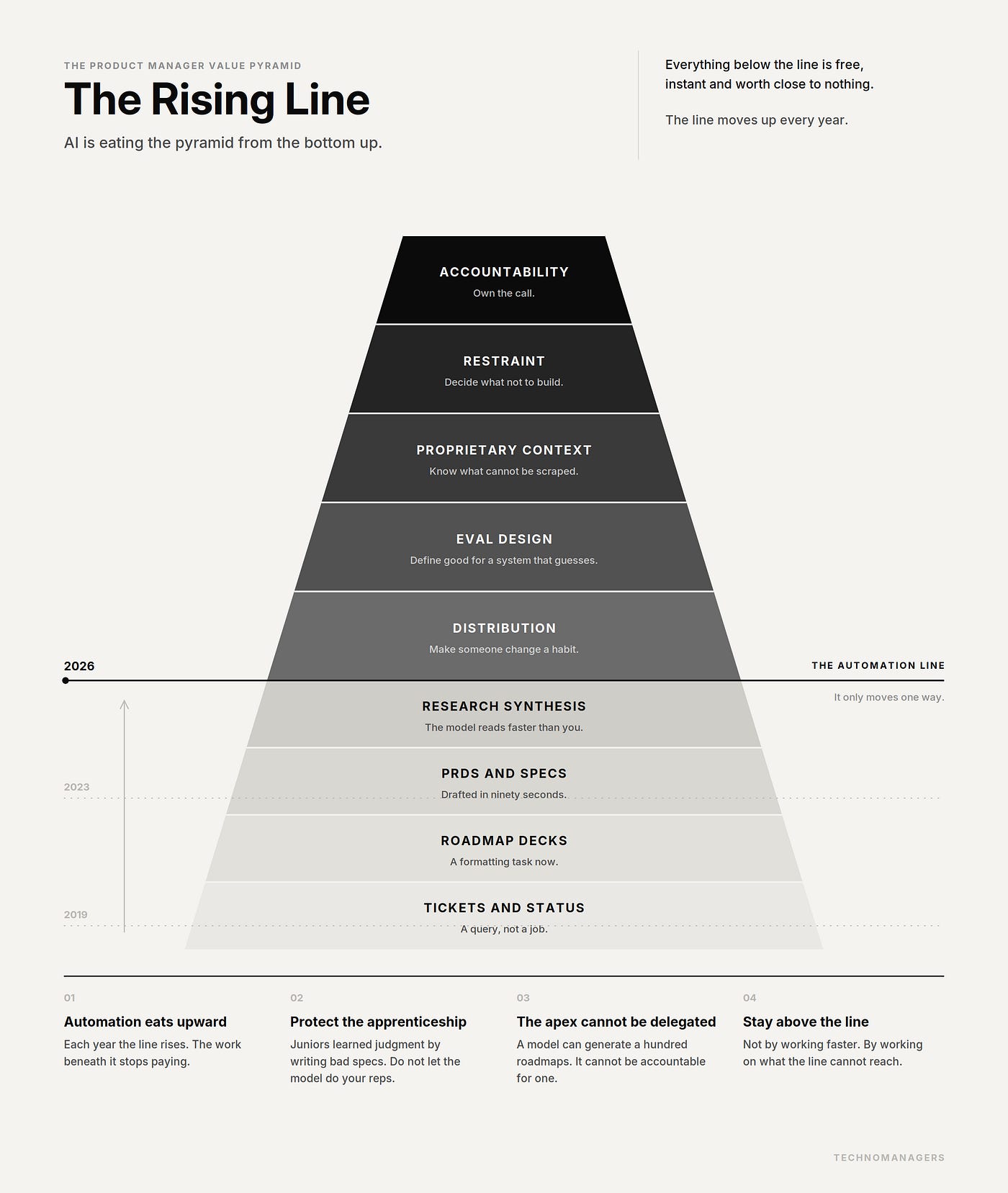
The middle is collapsing.
If your day is: attend standup, translate the conversation into tickets, update the status doc, write the spec, chase the sign-off, send the summary, then you are describing a set of tasks that a competent model plus one senior PM now does in an afternoon. That is not a prediction. Look at your ratio of PMs to engineers over the last two years and extend the line.
And there is a second-order problem nobody has solved. Junior PMs used to learn judgment by writing three hundred bad specs and having them torn apart. That was the apprenticeship. If AI writes the first draft of everything, the apprenticeship disappears, and we get a generation of PMs who can review work but have never done it. Reviewing is not the same as knowing. You cannot recognise a bad tradeoff you have never personally made.
If you are early in your career, do not let the model do your reps. Write the spec badly, yourself, first. Then let the model tear it apart. The order matters more than the output.
What To Do On Monday
Five things. None of them requires permission.
Take your current roadmap and delete something. Not defer. Delete. Write one paragraph on why. That paragraph is worth more than the roadmap.
Book three customer calls this week that have no agenda and no demo. Your edge is private information. Go and get some.
Pick one AI feature in your product, or one you wish existed, and write the eval. What does good look like, in numbers, with examples of failure? If you cannot do this, you now know what to learn.
Stop using AI to produce your artefacts and start using it to attack them. Draft the thesis yourself. Then ask the model for the strongest argument that you are wrong. Then answer it.
Write down the last three decisions you made and what you were betting on. Not what you shipped. What you believed. That document is the only real evidence of judgment you will ever have, and increasingly, it is the only thing that separates you from a very fast intern with API access.
Flagship AI PM Course (PMs at Microsoft, Google, Coinbase, Indeed & 800+ rated 4.9/ 5).
See testimonials and course details
If you want to learn how to build a product using AI and become an AI Product Manager, you can join our 12-Week AI Product Manager/Builder Cohort (100 hours, including 20 Hours of Interview Prep)
About Author
Shailesh Sharma! I help PMs and business leaders excel in Product, Strategy, and AI using First Principles Thinking. AI Product Manager/Builder Cohort
More Resources
Product Management Mock Interview (Detailed)
Crack AI Business Roles (AI Management Consulting, AI Category Management, AI General Manager, Revenue Planning, etc.) - Course Details
Crack AI Program Manager Roles - Course Details