


Imagine you a Senior Product Manager at Amazon leading outbound and Logistics.
You are recently building an AI feature for your logistics.
A user asks: Where is my shipment?
You have written a perfect prompt:
You are a helpful assistant. Provide the user with their current order status in a polite tone.
Despite your perfect prompt the AI fails.
It says: I do not have access to your personal data to track your shipment.
Why did this happen?
The prompt was clear but the model had no data. It did not have the tracking ID, the GPS coordinates of the truck, or the delivery partner details.
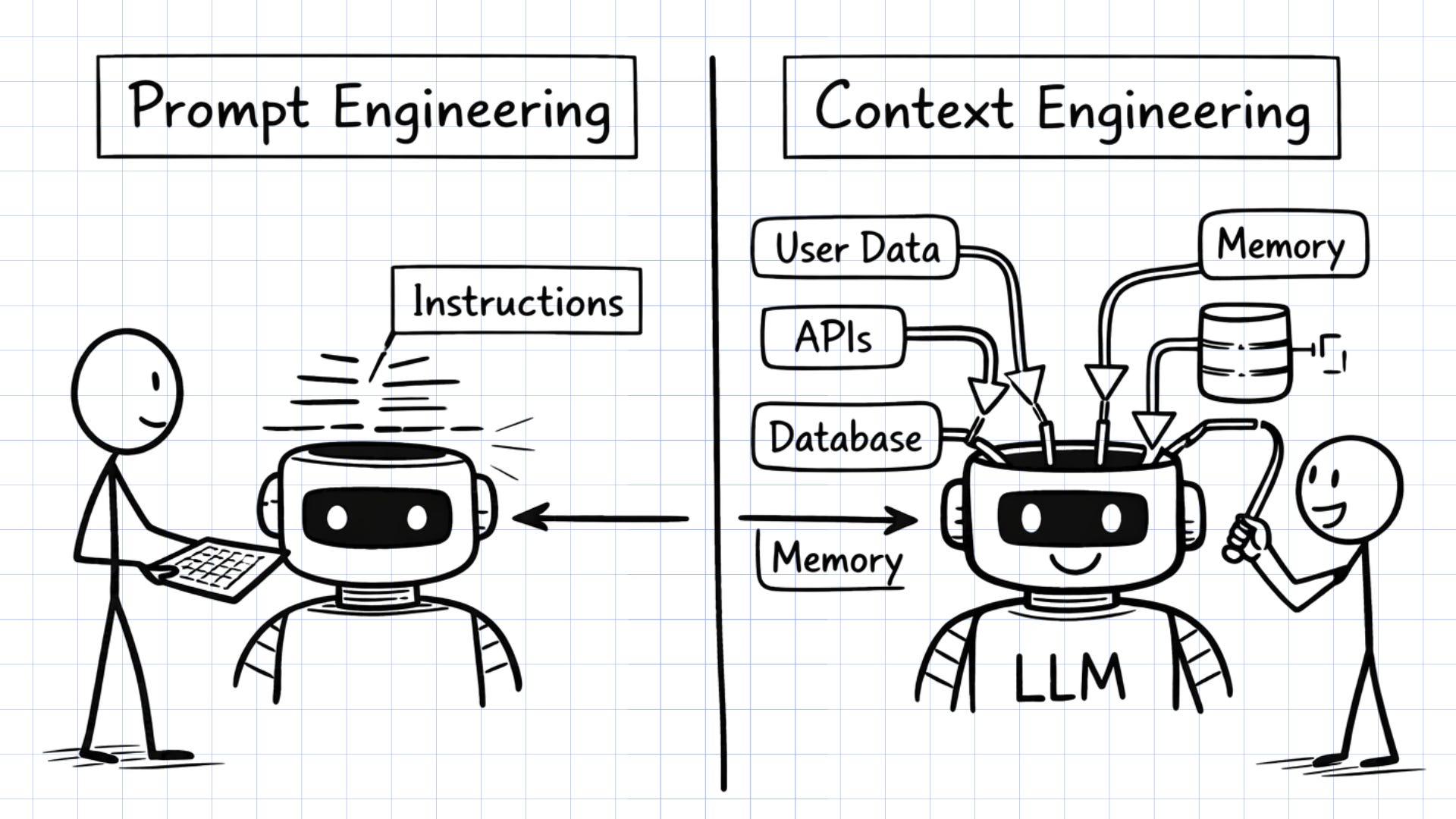
This is the exact point where Prompt Engineering stops and Context Engineering starts.
What is Prompt Engineering
Prompt Engineering is essentially about how you talk to the model.
It is the art of phrasing instructions to get a specific response format or tone. When you tell Gemini to write a PRD or summarise a meeting note you are doing prompt engineering.
It focuses on the instructions. It is usually static.
You write a prompt and you hope the model is smart enough to follow the rules you set.
What is Context Engineering
Context Engineering is about the information environment you build around the model.
It is not about what you say but what the AI knows at the moment you say it.
As a Product Manager, you should think of it as the data pipeline for AI. It involves:
Identifying the intent of the user.
Fetching relevant data from your databases or APIs.
Cleaning that data so the model can process it efficiently.
Feeding only the necessary bits into the conversation.
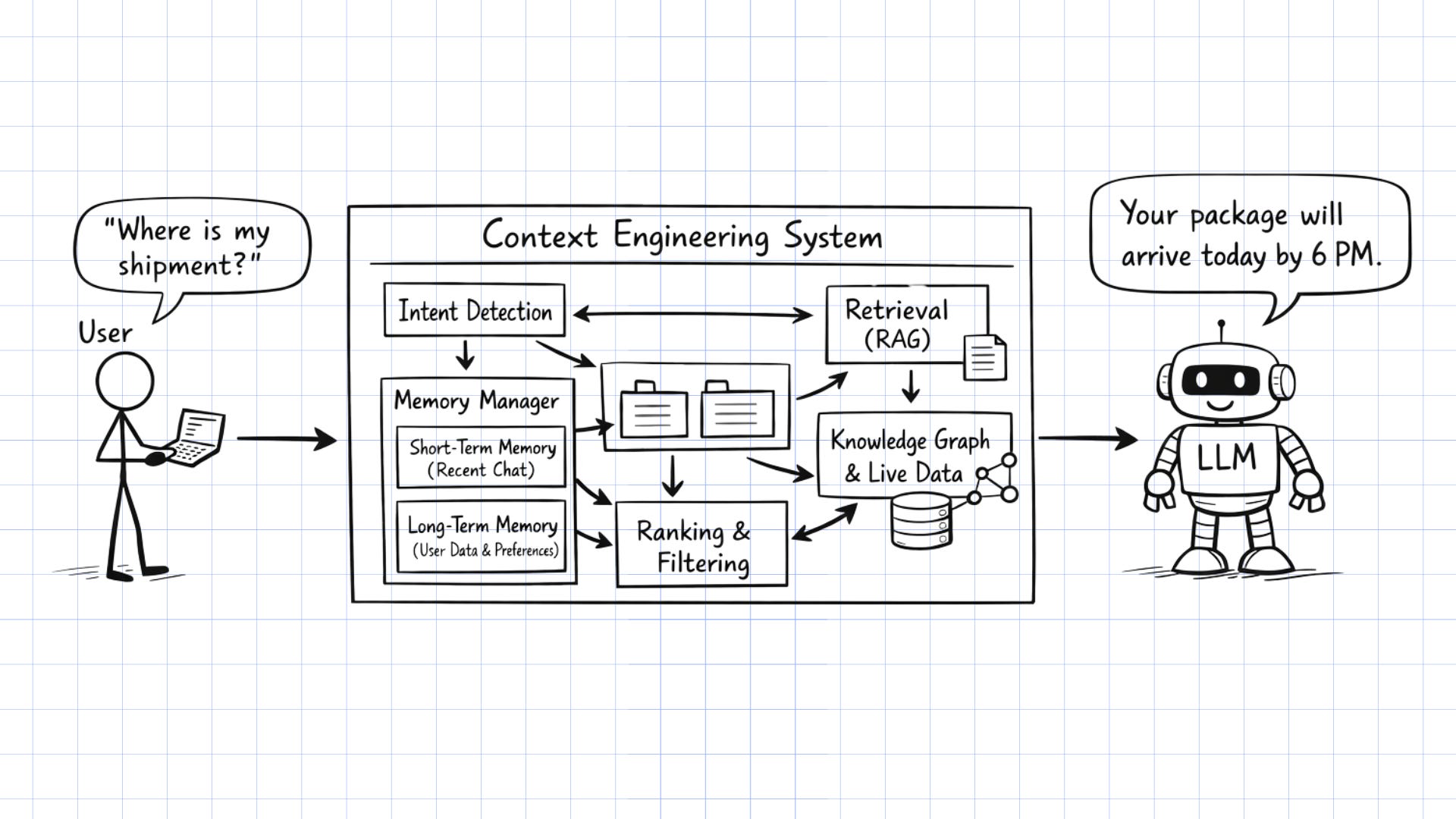
In our shipment example context engineering is the system that automatically pulls the tracking ID from the database and hands it to the AI before the AI even starts typing.
Critical Components of Context Engineering
If you are designing an AI product these are the core systems you need to build:
1. Memory Management
Memory is not just storing old chats. It is about deciding what is relevant right now.
If a user says: Change my address in the first message and then asks: When will it arrive? in the tenth message the AI must remember the new address.
Context engineering handles this through:
Short-term Memory: Keeping the last few exchanges in the prompt so the AI follows the flow.
Long-term Memory: Storing user preferences or past behaviours in a database and fetching them only when needed.
Summarisation: If a chat is too long you cannot send everything to the AI because it gets confused or too expensive.
You must summarise the past 20 messages into 3 bullet points and feed that as context.
2. Retrieval (RAG)
This is the process of searching your own documents or data to find the right information. Instead of the AI guessing it looks up your specific knowledge base.
You need to break your data into small pieces.
You need a system to find the most relevant piece based on the user’s question.
If you give too much data the model loses focus. This is called the lost in the middle problem.
3. Knowledge Graph and Data Freshness
A model is only as good as the data it sees. If your inventory levels change every second but your context engineering system updates every hour the AI will give wrong information.
Context engineering ensures the AI is looking at the live production database and not a stale copy. It maps relationships between data points so the AI understands that Product A and Product B are compatible.
4. Ranking and Filtering
If a user asks for a refund your system might find 10 different policy documents. Sending all 10 to the AI is a waste of money.
Context engineering uses a ranker to pick the top 2 most relevant policies.
It also filters out sensitive data like passwords or internal employee notes before the data reaches the AI.
Why do we need Context Engineering when there is Prompt Engineering
You might think that writing a better prompt can solve everything. But for a real product prompt engineering has a limit.
A model can be very fluent but still wrong. Prompt engineering improves fluency. Context engineering provides the facts.
You cannot write a custom prompt for 10000 different users. You need a system that dynamically changes the data based on who is logged in.
Reducing Hallucinations: Models lie when they do not have enough information. When you provide the exact context the model does not have to guess.
The Difference: An Example
Let us look at a Fintech app helping users with tax planning.
The Prompt Engineering Way
You give the AI a massive instruction set. You describe every tax law in India. You tell it: If a user asks about Section 80C explain the limits.
The AI explains the law but it does not know the user has already exhausted their limit. The advice is generic and not very useful.
The Context Engineering Way
You give the AI a simple instruction: Help the user with their tax queries based on the data provided.
The system then:
Pulls the user’s investment data for the current year.
Sees they have invested 1.2 Lakhs in PPF.
Feeds this specific number to the AI.
The Result: The AI says: You have 30000 left to claim under Section 80C. Would you like to see ELSS options?
So Prompt Engineering is about writing. Context Engineering is about systems.
If you want to build a product that users actually trust you should spend your time on the data. A simple prompt with the right context will always beat a complex prompt with no context.
If you like this article, you will absolutely love our AI Product Management Course ( having real AI PM Interview Questions from Google, OpenAI, Anthropic, Amazon, Nvidia, Booking etc) - ( 35+ Videos ) & ( Extra 25+ Real Case studies as well )
About Author
Shailesh Sharma! I help PMs and business leaders excel in Product, Strategy, and AI using First Principles Thinking. For more, check out my AI Product Management Course, PM Interview Mastery Course, Cracking Strategy, and other Resources