

If you want to learn Generative AI in a very Easy and Intuitive way, you are at the right place.
This is Part 1 of the Series - Gen AI for Everyone
So, what is Generative AI?
If you see, everyone is talking about Generative AI in recent times, but what exactly is it?
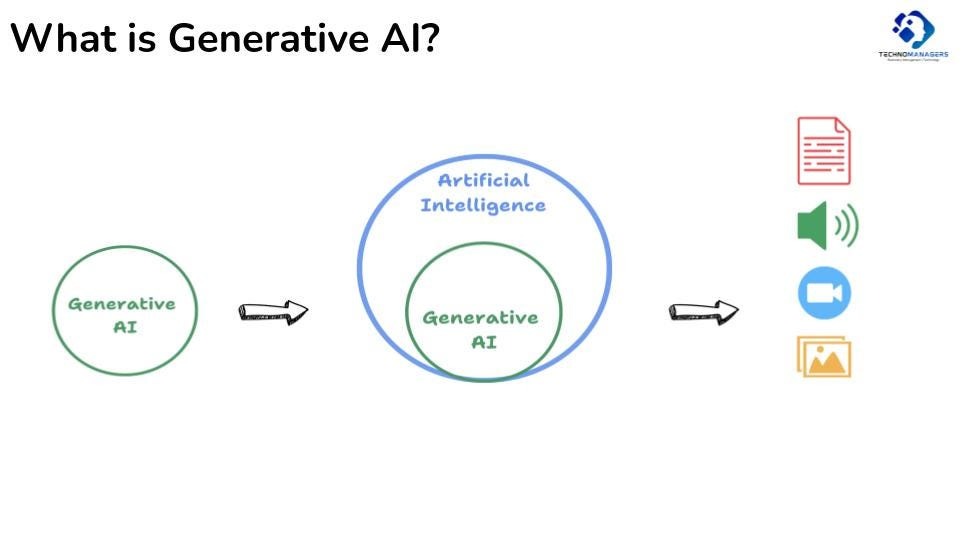
Generative AI is a type of AI that can generate various types of Content, including Text, Images, Audio, Videos, etc.
But the Next question is — What is AI? So let’s understand this?
So AI is a branch of Computer science which deals with the creation of intelligent systems that Learn and act on their own. It is getting computers to think and learn like humans.
How do Systems become intelligent?
There are several ways in AI through which we can make our system intelligent. Machine learning is one such way.
So, what is Machine Learning? A lot of people confuse AI and Machine Learning!
Machine learning is a subfield of AI where we make systems intelligent by using Data.
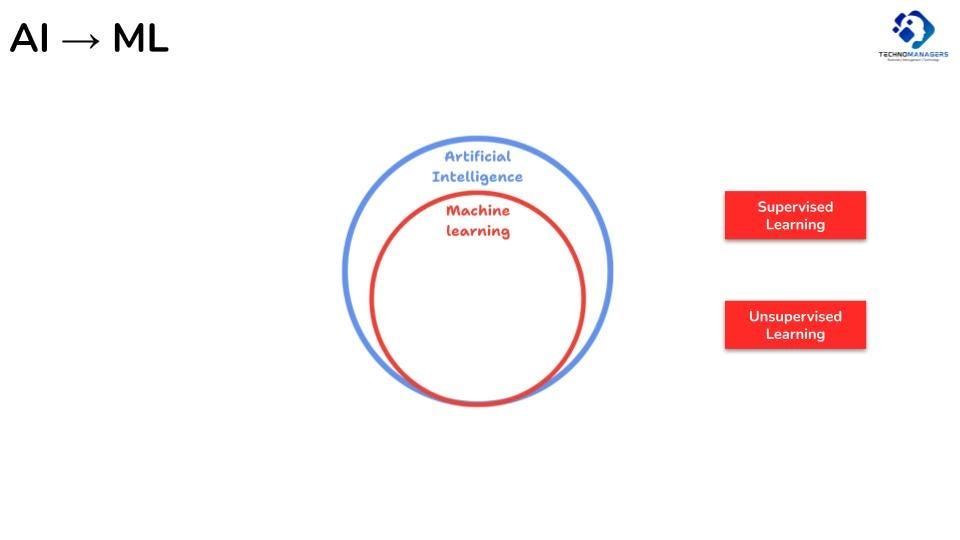
So instead of giving a computer a set of rules to follow, we feed it a large amount of data and let the system figure out the rules on its own and become intelligent.
Once the System is trained with the data, it can make some predictions
Now, how do the System Learn from the Data?
You might be thinking why I am telling you all these.
Why not jump on Generative AI directly?
But believe me, everything will make sense in 3–4 minutes.
So, there are two fundamental learning approaches in Machine Learning through which a System Can learn from the Data.
One is Supervised Learning and Another is Unsupervised Learning
So, what is Supervised Learning? Let’s understand that first
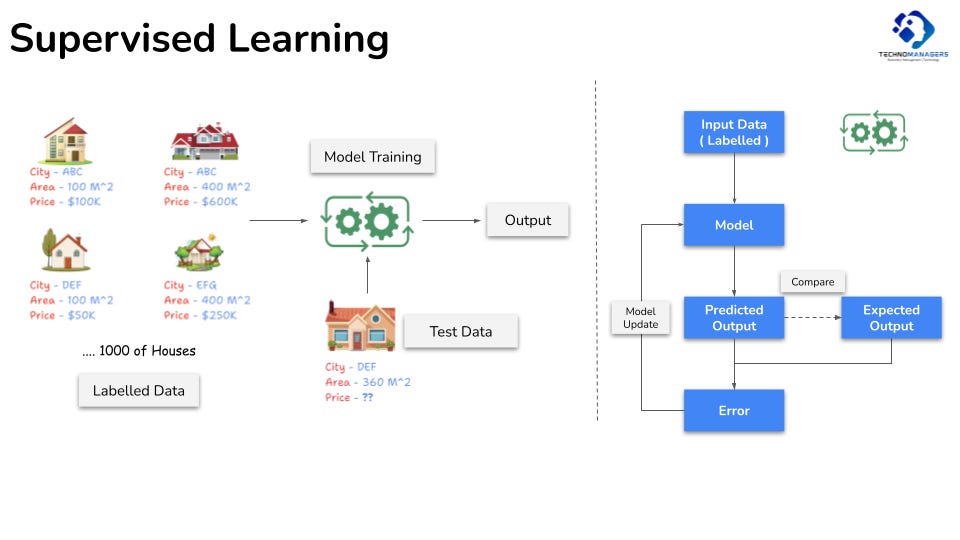
Supervised learning is a method to train the Model using labelled data? Here, the data with which you are training your model will have labels.
Imagine this example: There are a lot of houses. Each house has a label of what city it belongs to, what the carpet area and what the price of that house.
See each house has the tag of City, Carpet Area and Price.
Imagine we have 1000s of such data points.
In real life also, a builder would have seen 1000s of such data points in their entire life, and based on that, they would be able to tell approximately — What would be the price of the House given its city and carpet area correct?
Can we create such intelligence in a machine?
So that if we give data related to the new house, the Model will be able to predict the Price of any New house given its city and the Carpet Area.
Yes, we can do that — we can train a Model on the past Data ( 1000s of houses with their label ). This is called model training.
Now,for any new house the Model will be able to predict it. This is how supervised learning will look like.
Now, see how the model training will work?
So you have 1000s of Labelled Data, correct?
What you do is input some labelled data ( for which you already know the price ) and check what the model is predicting.
If the model's prediction is far off from the actual value, then you get the error. You feed this error back into the model and update the model to minimise it.
You did this till the time the Predicted Value is close to the actual Value.
Once you have done that, then any data ( which is not even part of the training data ) can be input into this model, and the model will give output with reasonably good accuracy.
I hope you are able to get this one.
Now moving onto the Unsupervised Learning -
So in unsupervised learning, we don't have the labelled data. There are no tags, no labels, nothing.
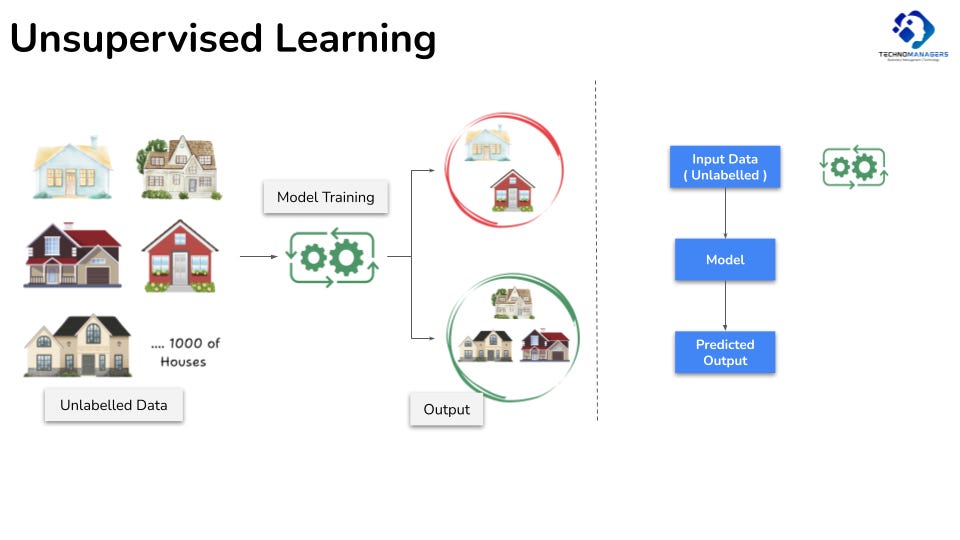
The machine itself finds the pattern and structure in the data and clusters it.
Imagine now we have a lot of houses. The model will be input with the data and it will find the patterns. Finally found the cluster and relationship in the data.
Here, if you see the model has clusters of Small houses and big houses.
This is essentially helpful in identifying hidden patterns in the data, for example, grouping customers with similar purchase habits etc.
Still, you guys are wondering — Where is Generative AI? Hold on — soon we will see and we will have great clarity.
So till now we have discussed the AI, Machine learning, Supervised and unsupervised learning. Correct?
Although Supervised and Unsupervised learning are good, they have some limitations.
For example, in supervised learning, it’s good to train the model with reasonable accuracy,y but it’s time-consuming to identify labels.
If you remember in the last example of House Price Prediction, we used Carpet Area, City. There can be other labels as well, like amenities, neighbourhood on which the price will depend. So there can be 100s of such parameters, who will come up with them?
So it would require domain expertise as well, someone from the real estate industry might know better about the factors which which will affect the Pricing correct?
But on the other side, in unsupervised learning, we can identify hidden patterns.
Supervised & Unsupervised → Deep Learning
So, imagine if we leverage both Supervised and Unsupervised learning to create a robust model, that’s what deep learning is.
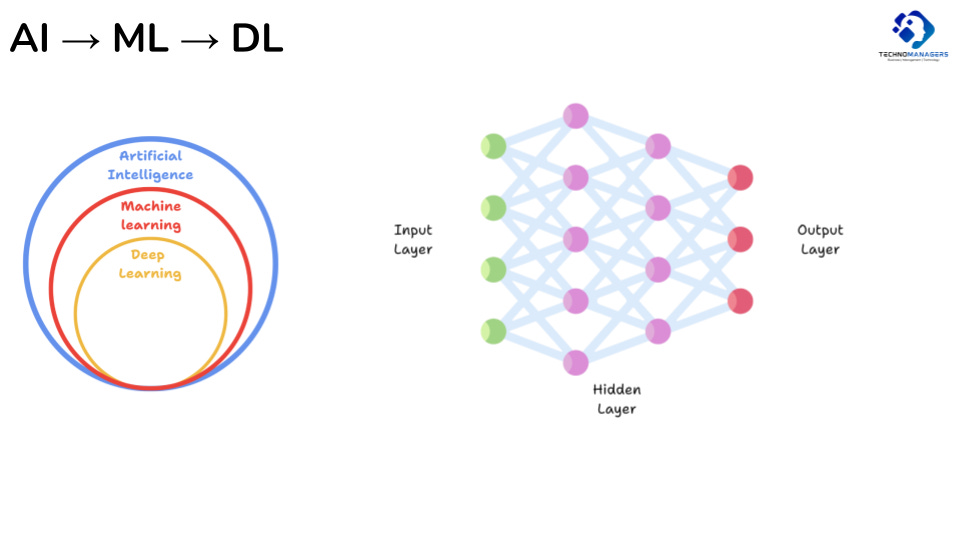
So deep learning is a subfield of Machine Learning where we can leverage both Supervised learning ( that is labelled Data ) and unsupervised learning ( that is unlabelled Data ) to train our model and make it more powerful.
This is called semi-supervised learning. Here, labelled data will help the model to learn about basic concepts and unlabelled data to find hidden patterns and generalise to new instances.
Deep learning uses artificial Neural Networks to learn from complex data in a way inspired by the Human brain. Like our brain, they are interconnected with a lot of neurons or Nodes as you can see in the picture.
Deep learning models can have many layers of neurons
In a deep neural network, the input layer receives data, which passes through hidden layers that transform the data using nonlinear functions. The final output layer generates the model’s prediction.
I hope you get my point.
Now we have finally got into Generative AI -
So, Generative AI is a subset of Deep learning, which means it uses artificial neural networks and processes both labelled data and unlabelled data and creates robust models which are capable of creating new data.
Now you can understand how Generative AI fits in all these AI paradigms.
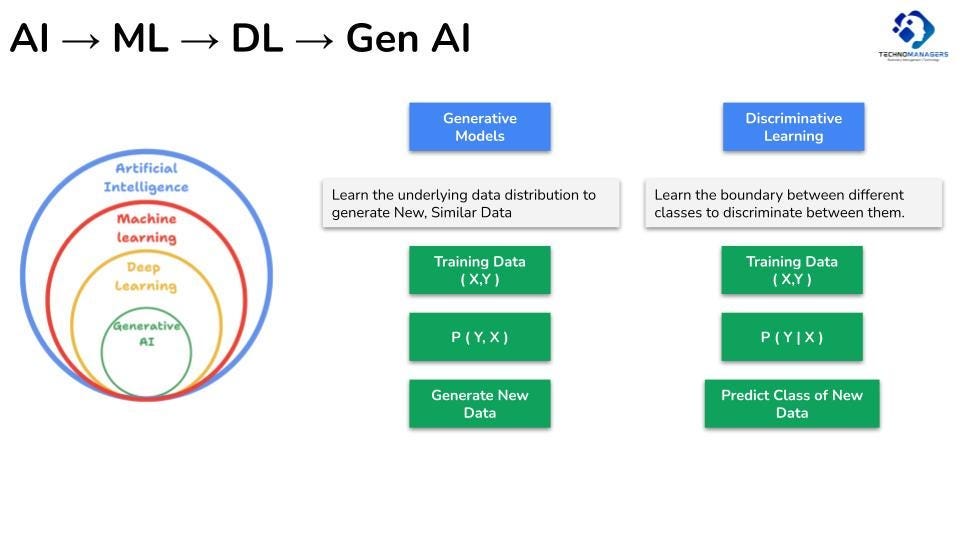
Without deep learning, we wouldn’t have the powerful models capable of generating realistic images, text, and other forms of data.
I hope all the dots are getting connected with this.
But let’s understand this -
Any Machine Learning Model can be of two types — Generative Model or Discriminative Model.
Generative AI is built upon generative models.
These models aim to learn the underlying probability distribution of the data.
What does that mean ? This means Generative models learn about : “How was this data generated?”
And using this they are able to generate new samples that resemble the training data
Discriminative models, on the other hand, focus on learning the boundary between different classes or categories.
They aim to predict the probability of a data point belonging to a specific class.
SO, in a nutshell, Generative AI is a type of artificial intelligence that uses deep learning models to create new content, such as text, images, music, or code, by learning the underlying patterns and structures of existing data.
Now I think you would have a better understanding of this.
PM Interview Mastery Course ( Crack PM Interview Like the top 1% )
Crack any PM interview with First Principle Thinking
Module 1 — First Principle Thinking in PM Interview
Module 2 — Asking Great Clarifying Questions in PM Interview
Resources to Download
Strategy for Product Managers, Leaders, Everyone ( Download Here )
PM Interview Mastery Course ( Crack Interview like top 1% ) — First Principle Thinking ( 10 Video lectures )
Technomanagers
More about PM Interview questions and Mock Interviews | YouTube | Website | Tech & Strategy Newsletter

To understand such Tech Concepts and Machine Learning Case Studies. Download our Tech for Product Manager having Concepts and Case Studies about Artifical Intelligence