

Before we move ahead, find out our
Flagship AI PM Course (PMs at Microsoft, Google, Coinbase, Indeed & 800+ rated 4.9/ 5).
See testimonials and course details
You can spot an AI-written PRD in seconds.
The problem statement is soft and vague.
The solution is a feature list.
The metric indicates a need to improve engagement and retention. Which means nobody measured anything.
People blame the model. Wrong.
The model is fine. It can reason better than most of us. The problem comes before the model runs.
We treat a PRD as writing. It is not writing. It is context.
And context is the one thing we forget to give.
A PRD is just compressed context
Think about what a PRD really is.
It is everything you know about a problem. Put in one place. So an engineer can build it without a meeting.
You know a lot.
The support ticket that started this. How three rivals handle the same moment. What your team owns, and what it does not. The PRD that got approved fast. The one that got torn apart.
None of it is written down. It sits in your head.
Then you type “write a PRD for smart substitutions.” And you send none of it.
So the model guesses. It uses the average PRD it has seen. And hands that back.
That is what generic means. The model is not lazy. It is hungry. You did not feed it.
One giant prompt will not fix it
The next idea is simple. Paste everything into one big prompt. Research, notes, rules, screenshots.
Then “now write it.”
It does not work. Here is why.
The model does not read a long prompt evenly. Stuff in the middle gets ignored. Add too much, and it starts contradicting itself.
You have felt this already. A long chat forgets what you said at the start. So you open a new chat. Now it knows nothing.
So the big prompt fails twice. It does not carry to the next PRD. And it breaks inside one chat.
You do not need a better prompt. You need a place that holds your context.
Build the engine, not the prompt
Every big tool now has this. A workspace that remembers
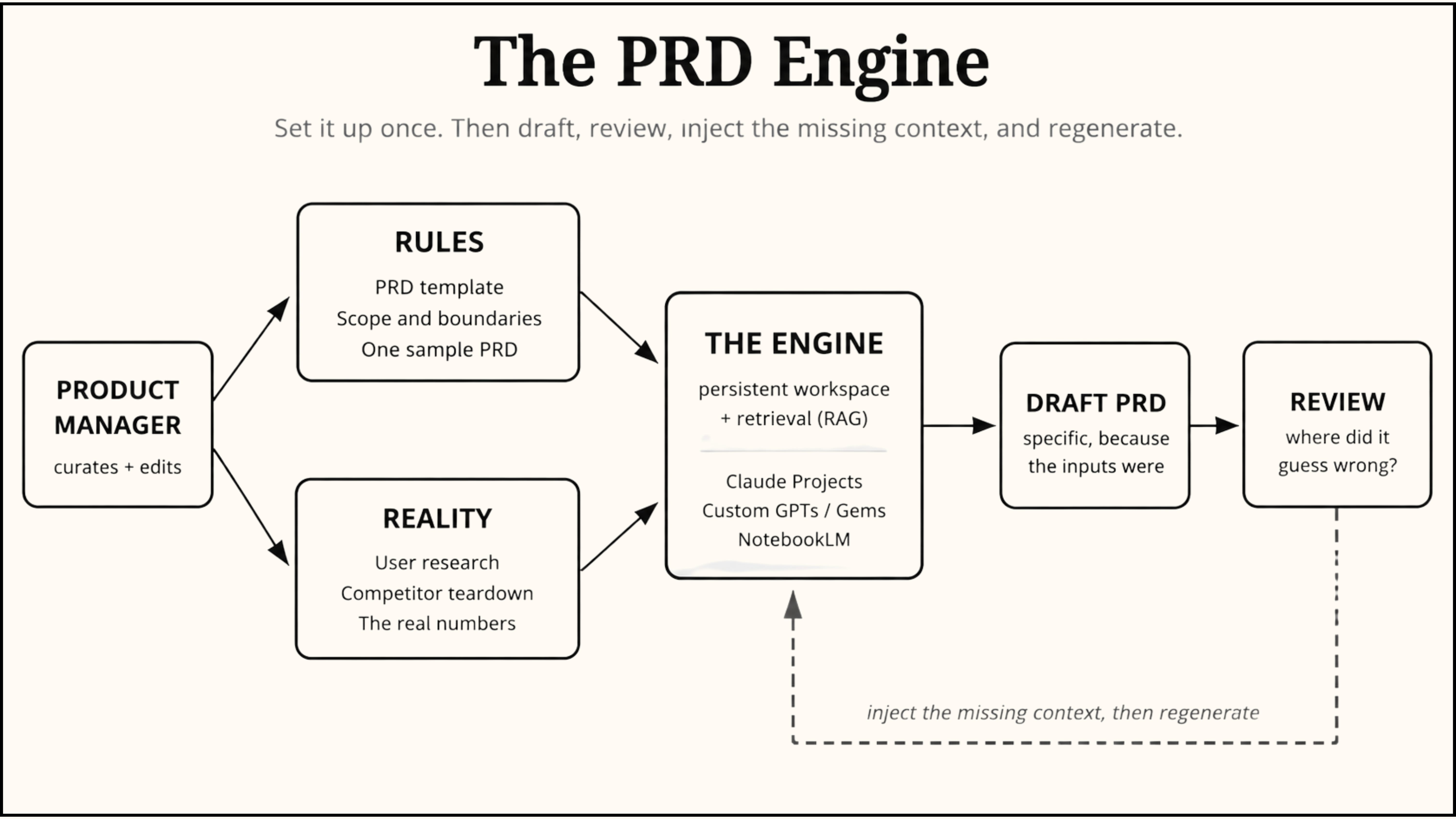
You load your files once. After that, it pulls what it needs into each chat. No more pasting the same files every day.
Here are the ones I use. And the one thing you learn about each is only by using it.
Claude Projects. Make a Project. Call it PRD Engine. Add your template, two or three old PRDs, the research, and the competitor teardown. Put your writing rules in the instructions box, not as a file. Files are what it knows. Instructions are how it behaves.
ChatGPT Custom GPTs. Same thing, but you can share it. Upload the files. Add your rules. Share the link. Now your whole team drafts the same way. One catch. If the rules are too long, it ignores half of them. Keep them short.
Gemini Gems. Best if your team lives in Google Workspace. A Gem can read straight from Drive. Point it at your folder. But it only sees files shared with the account. A locked file is invisible. Then it makes things up, and you wonder why.
NotebookLM. Different tool. It reads. It does not invent. Load twenty user interviews. Ask what people said about stockouts. It answers with the exact line. It never leaves your sources. That is the point. Use it to build proof. Then take that proof to your drafting tool.
Pick one and start. Do not overthink the brand.
Set it up once. Use it for every PRD. Improve it slowly.
Now, one example.
You are a PM at a quick commerce app. An item goes out of stock while the order is being picked. Right now, the app either refunds it silently or the picker guesses a swap. Users get upset both ways. You have to write the PRD for smart substitutions.
What to put in the engine
Two buckets. Rules. And reality.
Rules are your calls. Only you can make them.
The PRD template. So the model stops making up a format.
Your scope. Write it plainly. You own the substitution flow and the notification. You do not own picker staffing, stock accuracy, or the packing SLA. Skip this, and the model gives you a fix that needs better stock accuracy. Fun thing to learn live in a review.
One PRD that shipped well. One good example teaches your bar faster than the word “detailed.”
Reality is what is actually true on the ground. This is where generic dies.
Load the real research. Not a summary.
Users leave after a silent refund. It ruins the meal they planned. They also leave after a bad swap. Toned milk for full-fat. They will approve a swap. But they will not wait long.
Add the competitor teardown. In your words. What each rival does well. What annoys people?
Add the numbers. How often a stockout hits mid-order. What one bad swap costs. The refund, plus the orders they never place again.
The model can arrange all this. It cannot know it. That part is yours. Always.
Writing the draft
Here, people hand over too much. They ask the model to invent the solution.
Do not. The idea is yours.
Give the shape. Let it do the work.
For substitutions: one pushes the moment an item goes out of stock. Three ranked swaps. A ninety-second window to approve. A fallback if the user says nothing.
Then ask it to map every path. The clean one. And all the messy ones.
Point each section to its source. Problem from research. Limits from scope. Depth from the sample PRD.
Give it specifics. Get specifics back. That is the whole trick.
The loop is the real work
The first draft is a draft. That is the step everyone skips. And it is the one that matters.
Read it like a reviewer. Not like the author who just made it.
Look for one thing. Where did the model guess. And did it guess wrong.
Ask a few questions. Did it handle the messy paths, or just name them? Are the metrics real, or nice words? Did it turn a guess into a fact?
Run the substitution draft. The gap shows up fast.
The happy path is clean. User pinged. Picks a swap. Order moves on.
But the ninety-second timeout gets one weak line. The case where the user does not tap.
That line is the whole product.
Refund the item, or swap the top pick by default. One protects revenue. One protects trust. They pull opposite ways.
It is the biggest decision in the PRD. The draft treated it as small.
Why? Because you never told it the ninety seconds is fixed. It is tied to the packing SLA. Not the model’s fault. A fact you had and did not share.
So do not fix the draft by hand. Go back to the engine. Add the SLA rule. Add the “what is the default” question. Run it again.
That is the loop. Draft. Find the guess. Add the missing fact. Run again.
And every round makes the engine smarter. Not just the doc. Your next PRD starts from a workspace that already knows your SLA, your scope, your bar.
What your job becomes
You did not write the PRD by hand. You also did not accept junk.
You did the real work. You chose what context matters. You fed it in. You edited the thinking.
The model did structure. You did truth and judgment.
That is the shift.
The best PM here is not the one with the best prompt. It is the one with the best context. And the patience to keep feeding it.
The document falls out at the end. The engine is what you built.
Most people will keep typing one-line prompts into an empty box. And keep getting the same dull output.
You do not have to.
Build the engine once. Feed it well. Edit like the toughest reviewer in the room.
Those generic PRDs were never the model’s fault. They were context you had and did not share. And you are the only one who can.
If you want to learn how to build product using AI and become AI Product Manager, you can join our 12 Weeks AI Product Manager/Builder Cohort (100 Hours including 20 Hours of Interview Prep)
About Author
Shailesh Sharma! I help PMs and business leaders excel in Product, Strategy, and AI using First Principles Thinking. AI Product Manager/Builder Cohort
More Resources
Product Management Mock Interview (Detailed)
Crack AI Business Roles (AI Management Consulting, AI Category Management, AI General Manager, Revenue Planning, etc.) - Course Details
Crack AI Program Manager Roles - Course Details