


Before starting, find out our AI Product Management 2026 — Winner’s Playbook
When we discuss artificial intelligence today, there is one term that everyone is quite familiar with, which is the Large Language Model or LLM.
However, you will also hear other terms in the industry like SLM, which stands for Small Language Model, and FM, which stands for Frontier Model.
It is important to understand that these are not three completely separate categories. The LLM is really the umbrella term for these technologies, but we label them differently because we use them for different purposes in our technical strategies.
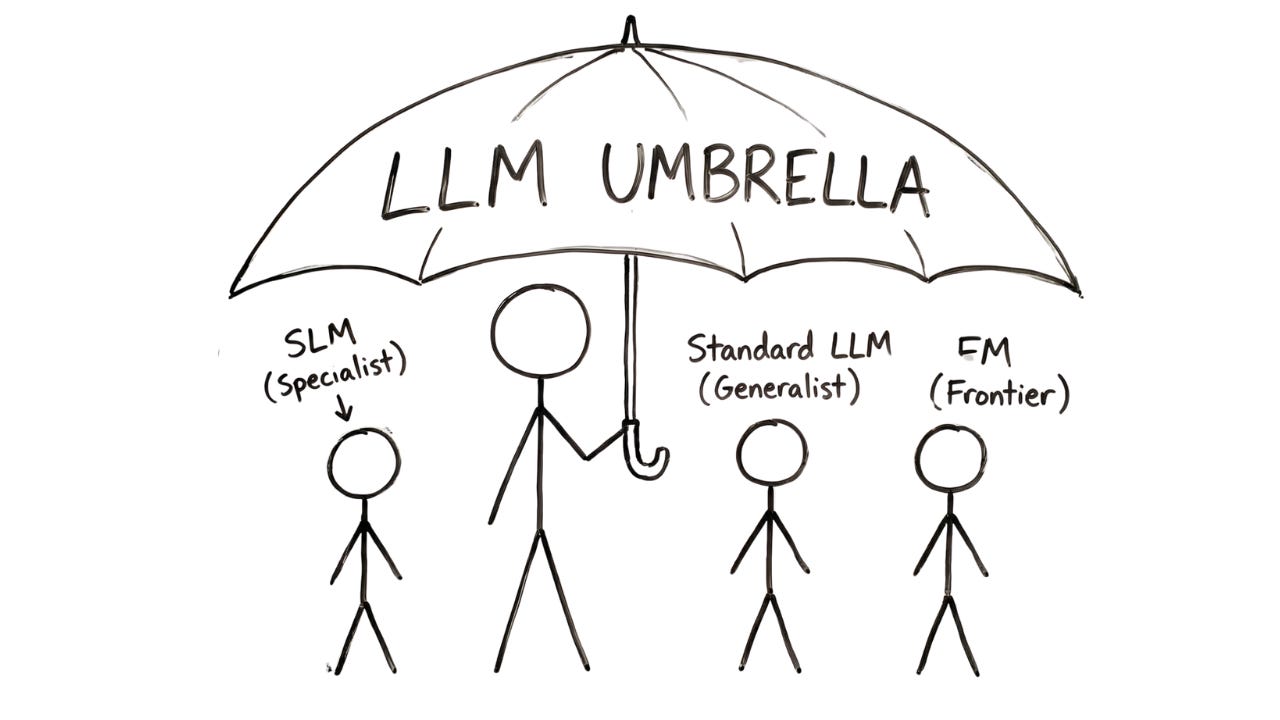
In this article, we will define these terms and look at the specific use cases where each model performs the best.
What are Large Language Models (LLMs)?
When most people think about AI, they are thinking about Large Language Models. These are models that are quite big and typically have tens of billions of parameters. Parameters are the weights learned during training that determine the capabilities of the model.
Generally speaking, more parameters mean the model has a bit more knowledge, nuance, and reasoning ability.
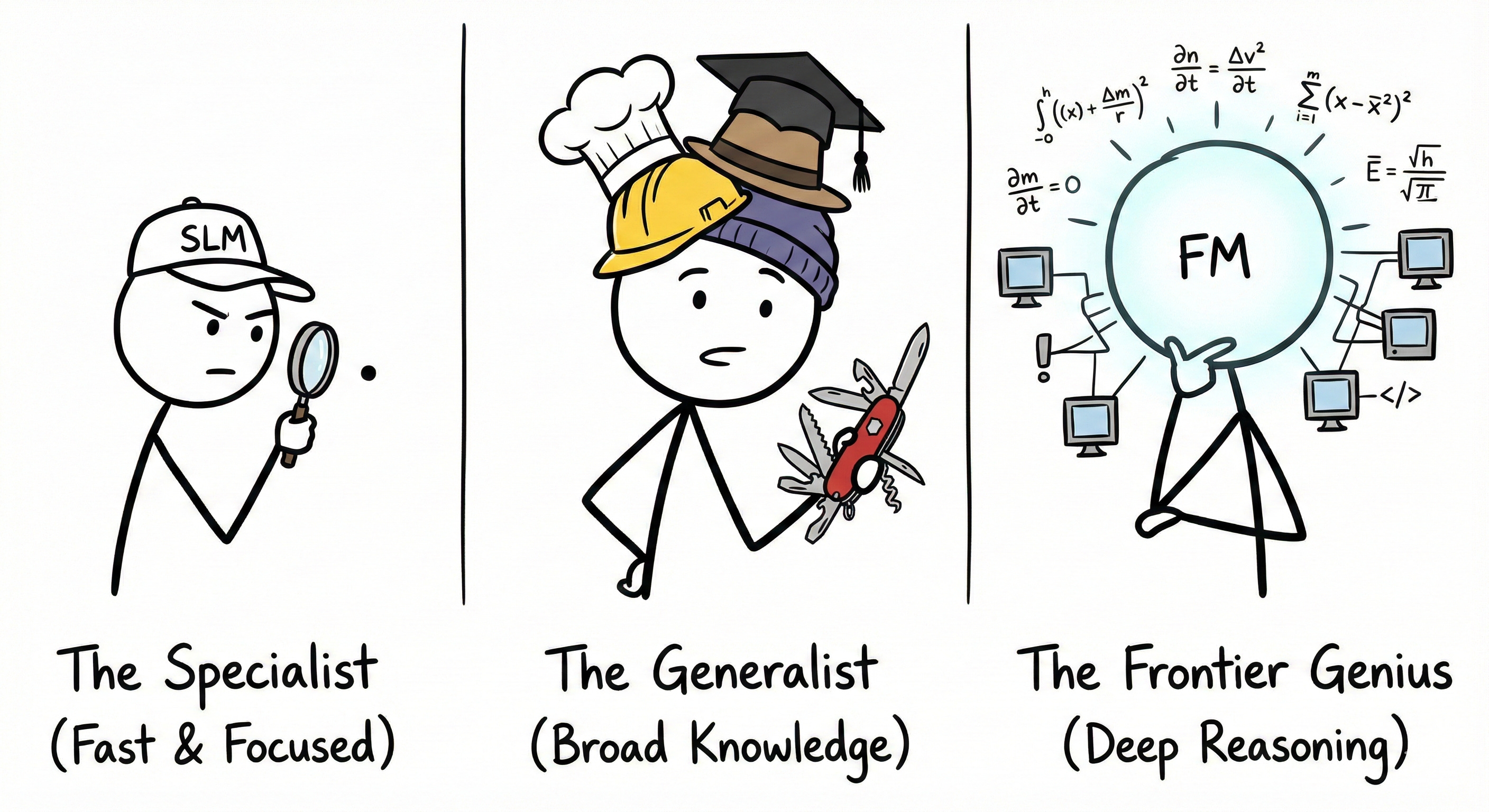
We can think of LLMs as generalists.
They possess broad knowledge across many different domains and can handle sophisticated back and forth conversations.
Because they are large, they usually run in the cloud or SaaS environments as they require large amounts of GPU memory and processing power.
What are Small Language Models (SLMs)?
On the other hand, we have Small Language Models.
These models have fewer parameters, usually less than 10 billion. Many people ask if an SLM is just a worse version of an LLM.
It is better to think of them as specialists rather than generalists.
Today, a well-tuned SLM can often match or even beat bigger models at focused tasks.
What are Frontier Models (FMs)?
Finally, we have Frontier Models. These are the cutting edge of AI technology.
They often have hundreds of billions of parameters and deep tool integration. They are the most capable type of model we have today and possess the best reasoning abilities for complex tasks.
Examples of Frontier Models include Claude Sonnet and Opus, GPT-5 from OpenAI, and Gemini Pro from Google.
Selecting the Right Model for the Right Use Case
You might ask why we do not just use Frontier Models for everything since they are the most capable.
The answer is that the choice of AI model is specific to the use case. We must match the capability to the need.
Let us look at three scenarios to explain this.
Scenario 1: Document Classification
Consider a company that receives thousands of documents every day, such as support tickets or insurance claims.
Each document needs to be classified and routed to the correct department. This is a perfect job for a Small Language Model.
There are three main reasons for this.
First is speed. An SLM with 3 billion parameters requires less computation per inference than a 70 billion parameter model. Document classification is a straightforward pattern-matching exercise that does not need massive scale.
Second is cost. Fewer parameters mean less memory and fewer GPU resources are needed.
The third reason is governance. These documents often contain sensitive data. By running an SLM on-premise, the data never leaves the internal environment and there are no external API calls. For regulated industries like finance and healthcare, this compliance is often non-negotiable.
Scenario 2: Customer Support
Now let us look at a customer support scenario.
A customer contacts support because their billing does not match their expectations. The system needs to pull information from a billing database, technical configuration data, and the ticket history of that customer.
The model must synthesise all this data to understand the relationships and generate a solution.
This is a good fit for an LLM because of the breadth of the solution. LLMs are pre-trained on broader datasets than SLMs, spanning technical documentation and customer service interactions.
They are also better at generalisation. Customer support queries have high variability, and different customers describe problems in different ways.
An LLM can handle edge cases and nuanced reasoning even if it has not seen that specific scenario before.
Scenario 3: Autonomous Incident Response
Finally, let us consider a critical system alert that comes in at 2:00 AM regarding application servers timing out.
An incident response system running on a Frontier Model processes this alert. The model needs to query monitoring systems, check logs, identify the root cause, determine the fix, and execute it by calling APIs.
This requires a multi-step investigation and execution, which is the domain of agentic systems. Frontier Models have strong agentic capabilities.
They can plan multi-step workflows, break down complex tasks, and evaluate their results to adjust their approach.
They can maintain coherent reasoning across long chains of investigation, keeping track of what they have learned and what to do next.
While humans are often still in the loop today, the underlying capability for this complex reasoning lives in the Frontier Model.
So SLMs, LLMs, and FMs are all language models, but they serve different needs. You should use an SLM when you need speed, low cost, and on-premise control. You should use an LLM when you need broad knowledge and nuanced reasoning. And you should use a Frontier Model when you need the absolute best reasoning for complex problems.
If you like this article, share this article and you will absolutely love our Course ( having real AI PM Interview Questions ( Details Below )
Click here to join the AI PM Course and get the full roadmap.
Most Detailed AI Product Management Course ( Along with AI PM Interview Questions )
Highest Rated Course — 4.8 / 5 ( 500+ Enrollment in last 2 months) — Testimonials Here
For New Year, we are giving EXTRA 60% OFF on our AI PM Flagship Course for very limited Time
Coupon Code — NYE26 , Course Link — Click Here
Shailesh Sharma! I help PMs and business leaders excel in Product, Strategy, and AI using First Principles Thinking. For more, check out my AI Product Management Course, PM Interview Mastery Course, Cracking Strategy, and other Resources