


Many PMs are struggling to pass PM interviews as AI PM questions are rising rapidly.
If you think about Vibe coding, Prototyping is good enough, you are already an Year Behind. Questions are coming regarding AI Product Sense, AI Metrics, and the Reliability of AI Products ( Deterministic and Probabilistic Evals, AI Pricing, AI Strategy, and AI/ML Algorithms and usecases
Let’s discuss one such type of Question - AI Metrics
Product Managers are creating AI products left write and centre. But it is equally important to know what metrics need to be measured. Because if you can’t measure, then how are you going to improve this?
Let us look at a real example. ( This can be asked in your Next PM Interview )
Imagine you are the PM for an AI feature in Instagram Reels called Auto-Beat Sync.
This feature takes a bunch of photos and videos from a user and automatically trims them to match the beats of a popular song.
To measure success here, we have to look at metrics through the lens of first principles.
We must break it down into two clear layers:
How is the model performing technically?
How is the product succeeding for the business?
The First Principle
Before we jump into numbers, we must ask: What is the primary job of this AI?
For Reels, the goal is to reduce the friction of creation.
If a user takes 30 minutes to edit a video manually, they might give up. If the AI does it in 5 seconds, they post more.
So, our metrics must prove that the AI is fast, accurate, and helpful.
1. Technical Performance Metrics
These metrics tell us if the machine learning model is doing its job correctly.
1.A The Confusion Matrix
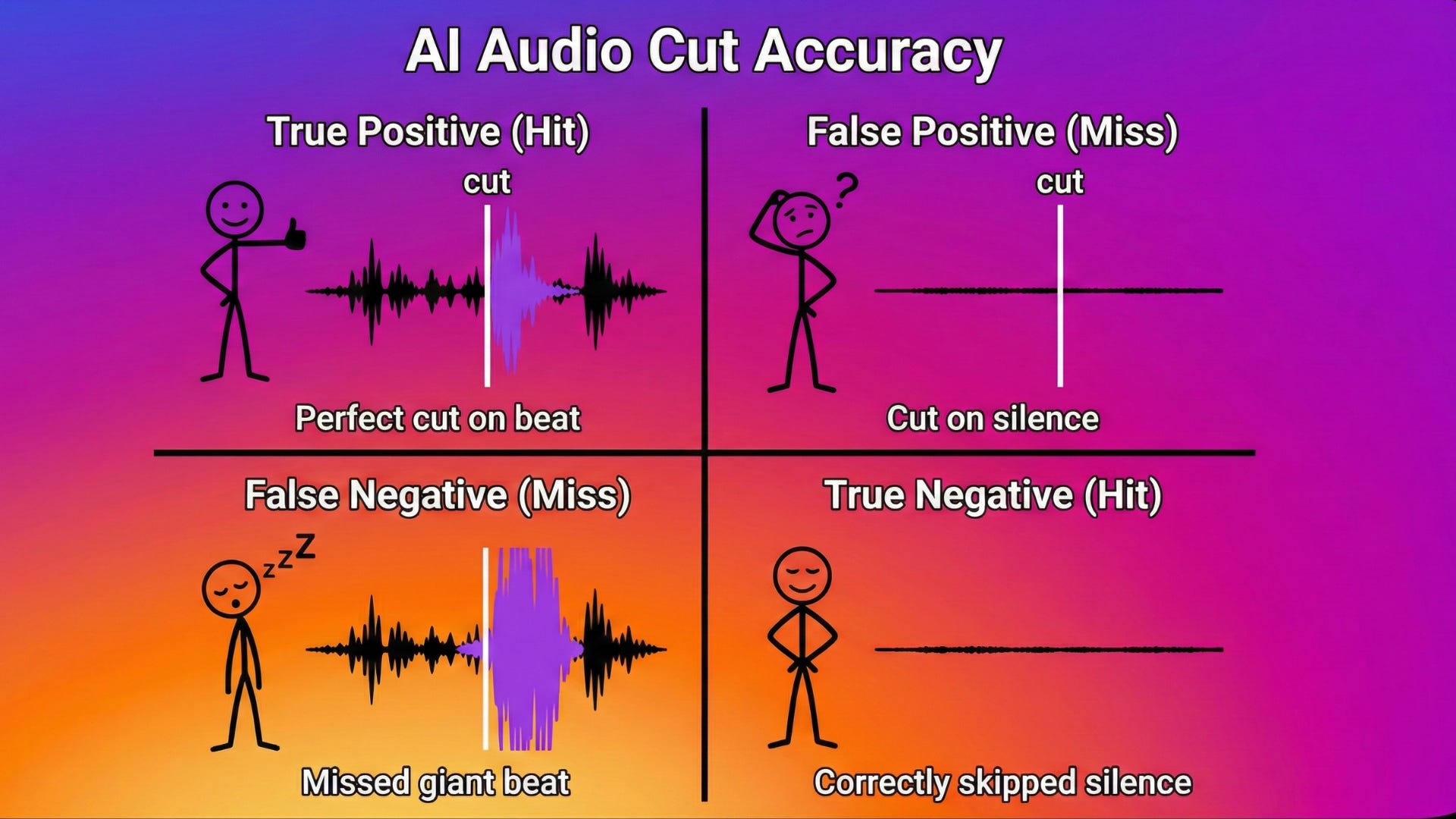
In our Auto-Sync feature, every time the AI places a cut on a beat, it is making a prediction. We track this using a confusion matrix:
True Positive: The AI placed a cut on a beat, and it actually sounds good to a human.
False Positive: The AI placed a cut where there was no beat or transition, making the video look jumpy.
False Negative: The AI missed a very obvious beat where a cut should have been.
True Negative: The AI correctly did not place a cut during a silent part of the song.
1.B Precision and Recall
This is where most PM interviews get intense. You have to decide which error is worse.
Precision: Out of all the cuts the AI made, how many were actually correct? If precision is low, the user gets a messy video with cuts in the wrong places.
Recall: Out of all the actual beats in the song, how many did the AI catch? If recall is low, the video feels slow because the AI missed many opportunities to transition.
For Instagram Reels, we usually want high Precision. A user would rather have 5 perfect cuts than 15 cuts where 5 are completely off-beat and annoying.
1.C F1 Score
This is the single number that balances precision and recall.
If you are comparing two different versions of the AI model, the one with the higher F1 score is generally the more stable one for the product.
2. Metrics for Generative AI and Text
If your Reels feature also includes AI Auto-Captions or AI Script generation, standard accuracy does not work. You need the specific NLP metrics mentioned in the video:
2.A BLEU Score
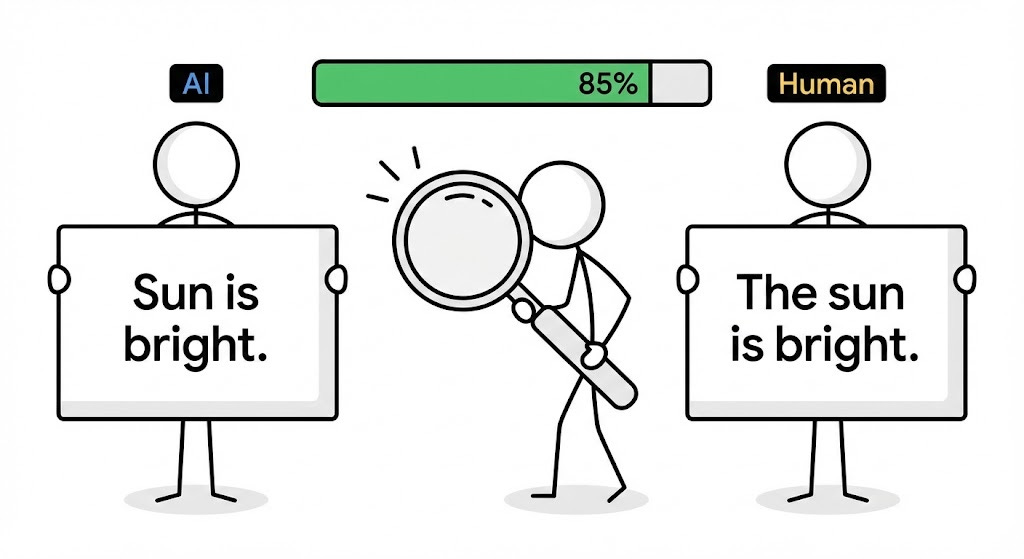
This stands for Bilingual Evaluation Understudy. We use this to see how much the AI-generated text matches a human-written reference.
If the AI generates captions for a Reel, a high BLEU score means the words match what a human would naturally say.
2.B ROUGE Score
This is used when the AI has to summarise something.
If a user asks the AI to write a short caption based on a long video description, ROUGE tells us if the AI captured the important points or just the gist of the video.
2.C METEOR
This is a more human-like metric. Unlike BLEU, it understands synonyms. If the video has a car and the AI says vehicle instead of car, METEOR will not penalise the model, but BLEU might.
As a PM, you want a high METEOR score because it shows the AI is creative and flexible.
3. Business Success Metrics
Even if the model has 99% accuracy, the product can still fail. We must track high-level KPIs:
3.A Feature Adoption Rate
How many people who open the Reels editor actually click on the Auto-Sync button? If this is low, either the UI is bad, or users do not trust the AI.
3.B Edit Completion Rate
This is a very important metric. It measures how many users who started using the AI tool actually finished and posted the Reel.
If users start the AI process but then delete the draft, it means the AI output was not good enough to share.
3.C Time to Post
First principles tell us that AI should save time. We measure the average time it takes a user to post a Reel with AI vs without AI. If the AI tool is not significantly faster, it is not providing enough value.
4. Monitoring and Safety
Finally, we must look at the health of the AI over time.
4.A Model Drift
As music trends change or new types of videos like slo-mo become popular, an old AI model might start performing poorly. We track whether the Precision and Recall are dropping over months.
4.B Bias and Fairness
In a global app like Instagram, we must ensure the AI works equally well for all types of music, whether it is Bollywood, Hip-Hop, or Jazz. If the Recall is high for one genre but low for another, the product is biased.
Question can come around Success metrics for Agents / Agentic Workflow / RAG Systems etc. You can find all these details in our Course ( having real AI PM Interview Questions )
Most Detailed AI Product Management Course ( Along with AI PM Interview Questions )
For New Year, we are giving EXTRA 60% OFF on our AI PM Flagship Course for very limited Time
Coupon Code — NYE26 , Course Link - Click Here
Shailesh Sharma! I help PMs and business leaders excel in Product, Strategy, and AI using First Principles Thinking. For more, check out my AI Product Management Course, PM Interview Mastery Course, Cracking Strategy, and other Resources