

OpenAI’s problem is not the model. The model is good enough.
The problem is that nobody stays.
You open ChatGPT, ask one thing, and close it. OpenAI knows nothing about the rest of your day. And tomorrow you may open Gemini instead.
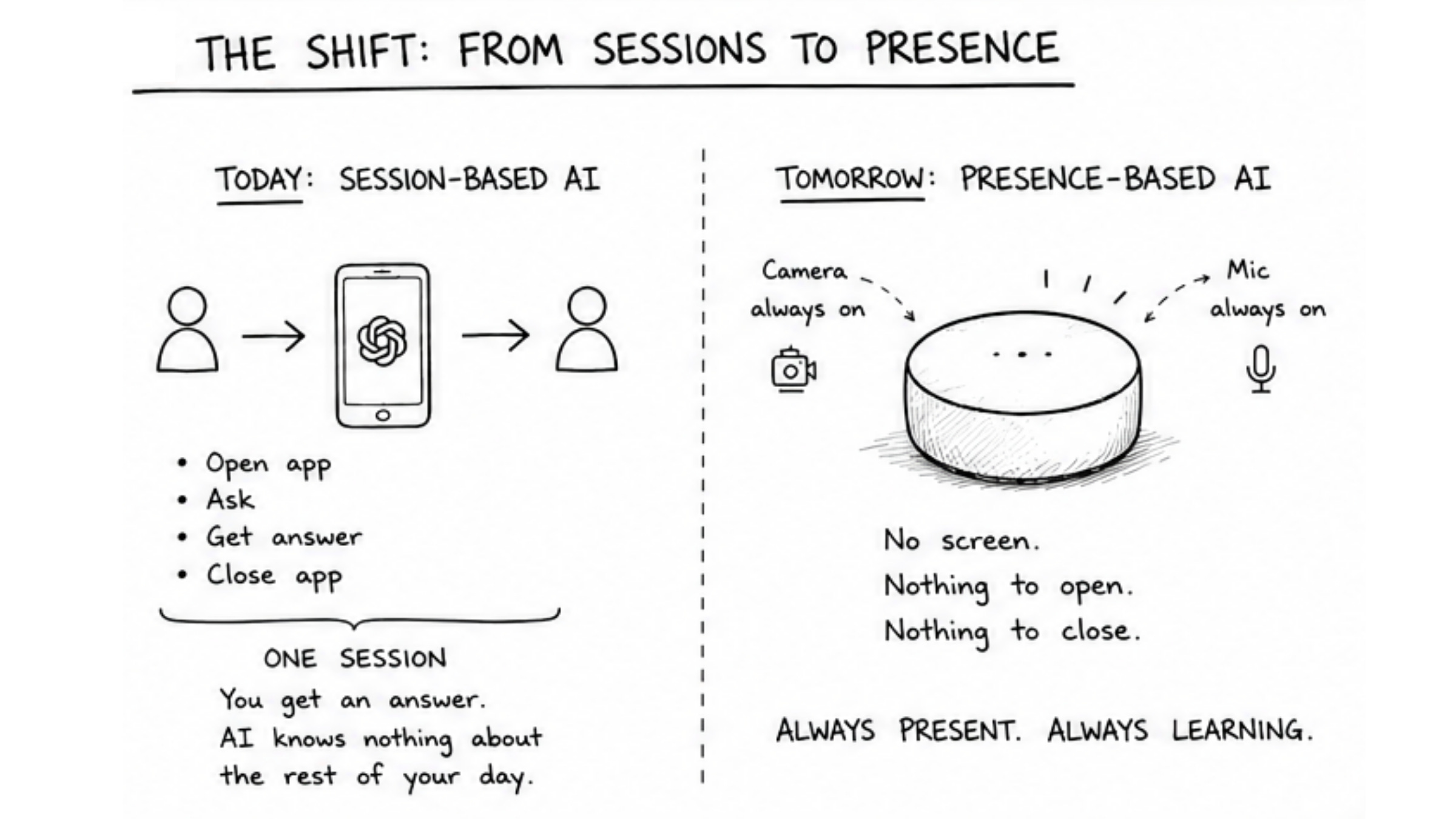
The first device is how OpenAI plans to get that time. That is why it has no screen.
The device is a small round speaker you can hold in one hand. No screen. The camera and microphone stay on. Small parts inside it move when it speaks. It costs 300 to 400 dollars. Jony Ive designed it, and OpenAI bought his company for 6.5 billion dollars.
Apple sued OpenAI in July. In August, Apple asked a court to stop this device from being built.
The screen is the part to focus on.
On your phone, you open the app, get your answer, and put it down. That is one session. It ends. Every number OpenAI reports today is a count of sessions.
A device with no screen has no ending. Nothing to open, nothing to close.
Breaking Down The Metric
North Star Metric = Agentic Actions Completed per User per Day
Actions = Context Hours x Actions per Context Hour x Completion Rate
Margin = Actions x (Value per Action - Cost per Action)
Context Hours is the time the device is near you, switched on, and allowed to see and hear.
This is the number nobody else has. It is not usage. You do nothing to create it.
Every other AI product needs you to start the clock. This one runs the clock just by sitting there.
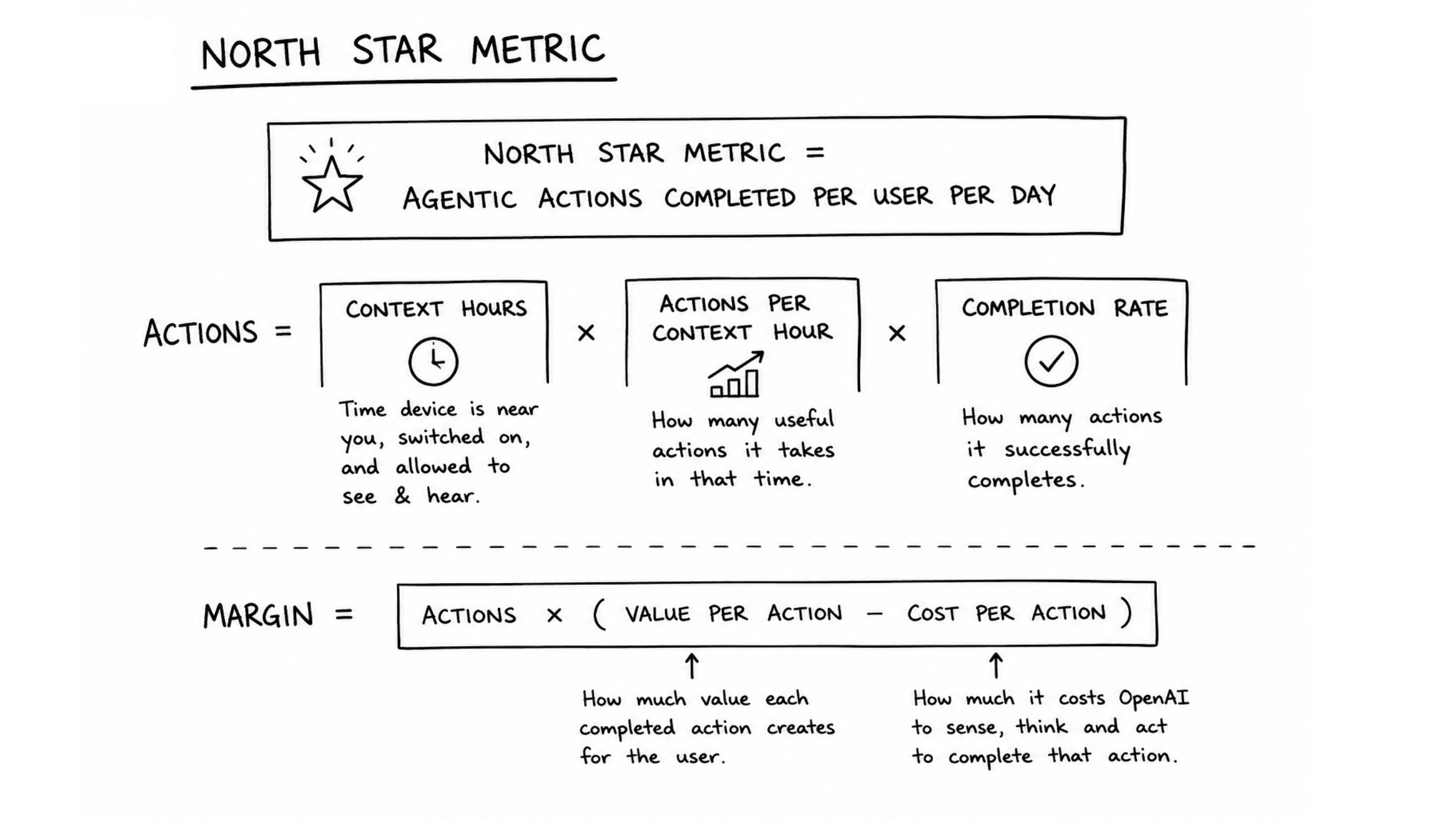
Five levers come out of this.
Lever 1: Context Hours
The device runs on battery. It fits in one hand. It is meant to be carried from room to room.
The bet: being there beats being smart.
A speaker stuck in your kitchen gets maybe two useful hours a day. A device you carry gets ten.
OpenAI has decided that ten hours with a weaker model is worth more than four app openings with a stronger one.
The missing screen is the proof. They removed the one part that would have made this easy to sell, so that usage never stops.
Lever 2: Actions per Context Hour
Amazon has sold hundreds of millions of Alexa devices and made no real business from them.
The reason is simple. Alexa waits. You say the wake word, it does one thing, and it goes quiet. Alexa always had huge context hours. It just never did anything with them.
The bet: the device has to speak first.
That is what the moving parts are for.
A device that interrupts you needs your permission to interrupt. Permission comes from it looking like it has a mind of its own. A box that suddenly talks feels broken. A thing that visibly turns towards you before talking feels alive.
OpenAI is paying real money and real breakage risk to buy the right to start the conversation.
Lever 3: Completion Rate
Voice with no screen has no backup. On a phone, if voice fails, you just tap. Here, if voice fails, nothing happens.
Because it is always with you, slow is okay.
Old assistants had to answer in one second, because you were standing there waiting for them.
A device that stays with you all day does not have that problem. It can take four minutes to book your cab and tell you when it is done. You were not holding it anyway.
Less speed needed. Harder tasks possible. That is the real difference from Alexa and Siri.
Lever 4: Value per Action
At 300 to 400 dollars, with metal, battery, camera, sensors and moving parts, there is almost no profit left in the hardware.
The device is not for making money. It is for stopping cancellations.
A subscription in a browser is cancelled in two clicks, and nothing changes in your house. A subscription attached to a metal object sitting in your living room is much harder to cancel.
OpenAI is paying hardware costs to buy retention.
There is a second reason. Today, OpenAI reaches every user through phones owned by Apple and Google. One of those two just sued them.
Lever 5: Cost per Action
Always listening and always seeing is the most expensive way to run a model. Every hour costs money whether you asked for anything or not.
Most of the work runs on the device itself, not in the cloud.
Detecting that someone entered the room, that the room is a kitchen, that nobody is speaking to it- all of this has to happen locally. Only the small part that needs real thinking should go to the cloud.
If that works, hours are cheap. If it does not, cost grows with the exact number they are trying to grow.
AI PM Course (PMs at Google, Microsoft, Coinbase & 800+ PMs rated 4.9/ 5).
See testimonials and course details
What Can Go Wrong
Lever 1 needs permission the buyer cannot give. A camera and open mic in a house also record people who never bought it. Your family. Your guests. Context Hours is decided by the least comfortable person in the house, not by the person who paid.
Lever 2 fails quietly. A device that interrupts badly does not get complaints. It gets muted. And a muted device has zero Context Hours, which makes every other number zero.
Lever 4 may be selling nothing new. Somebody already paying 20 dollars a month is being asked to pay 350 dollars more for access they already have, in a weaker interface.
Lever 5 is the contradiction. Context Hours grows in value and cost at the same time. Microsoft can fix this kind of problem by selling more agents. OpenAI cannot sell more hours than a day has.
And the court clock is running. Apple sued OpenAI and io in July, then asked for an order to stop them from building the device.
A separate case already forced OpenAI to stop using the io name. Neither case has to be won. Discovery and nervous suppliers alone can push a 2027 date.
My Reflection
The presence bet is right, and people are not taking it seriously enough.
Every lab is fighting on model quality, and model quality is getting closer and closer between them. Being present is not converging. There is one entry point into a home. Whoever holds it does not have to be the best.
So the price matters less than it looks. OpenAI does not need this device to sell well. It needs the device to be theirs, so that a policy change in Cupertino is not a life-and-death problem.
Lever 5 still does not work out in their favour. There is no sign yet of a local setup that makes always-on sensing cheap.
And the lever that decides this is Lever 2, not Lever 3. Everyone will judge the launch on how well it answers. The real question is whether it ever speaks first. If it never does, this is a 350 dollar speaker, and all those hours are worth nothing.
OpenAI does not need to be right about the device. It needs to be right that the entry point is worth owning.
If this changed how you think about our Job Ready AI PM Cohort
(12 Weeks, ~50 Sessions, ~100 Hours, ~10+ Products built, 2 Mock Interviews) Goes deeper. Registrations open; limited seats. Fill out this Form to Show Interest
About Author
Shailesh Sharma! I help PMs and business leaders excel in Product, Strategy, and AI using First Principles Thinking.
Sources: Bloomberg, Mark Gurman on the device form factor, sensors, moving parts and pricing, August 2026.