

Imagine you are a PM at WhatsApp.
You are building an AI agent that replies to customers on behalf of small businesses.
Meet Shailesh. He runs Technomanagers, an academy that teaches product managers to build with AI.
He ships AI products on weekdays and teaches the AI PM Cohort on weekends.
Almost every student talks to him on WhatsApp before joining.
Assume these numbers for a launch week.
He gets 40 enquiries a day. He replies late to 15 of them. Half of those people go quiet. That is 7 lost leads a day, or about 50 in one week.
Here is a typical message.
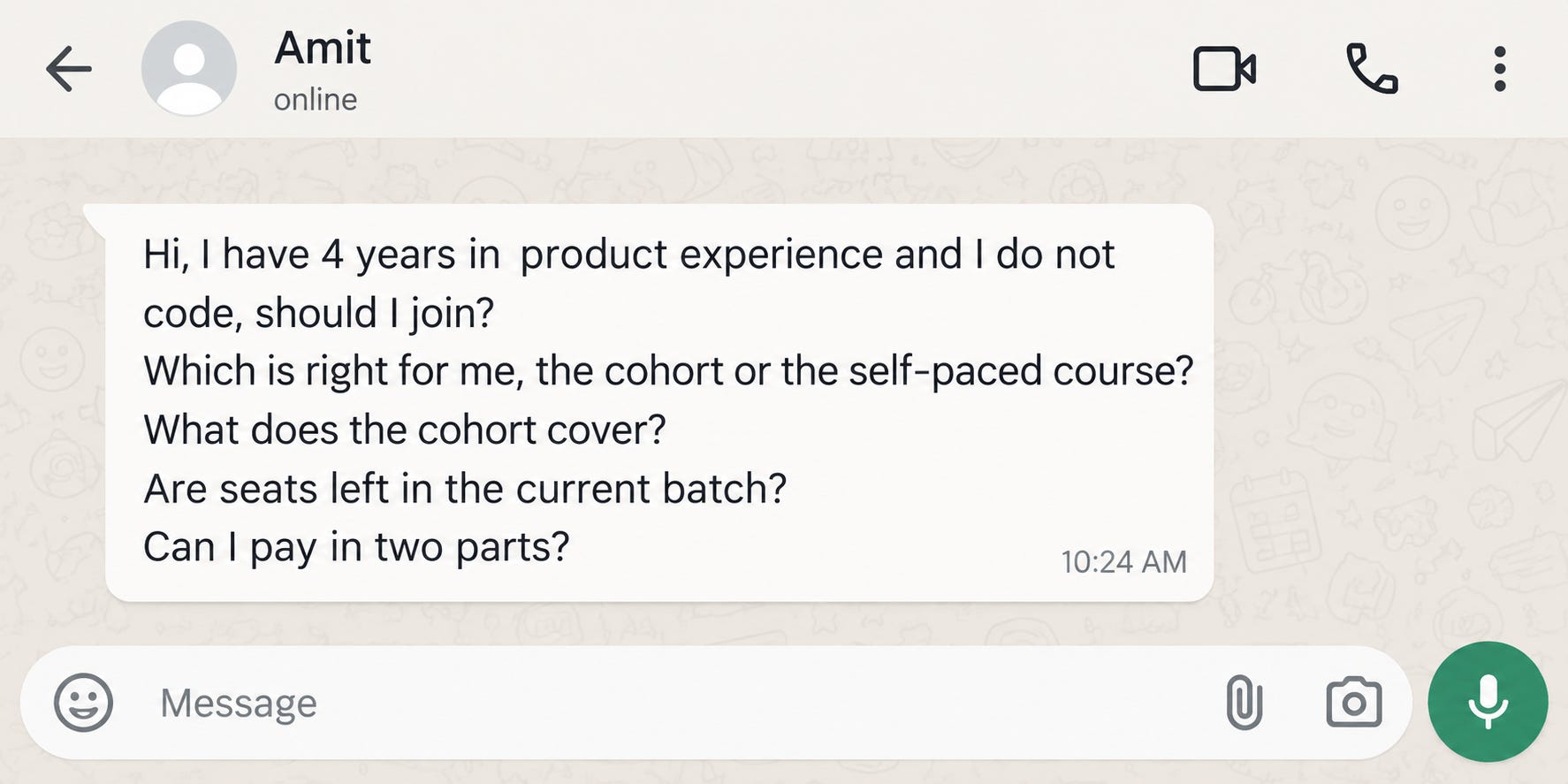
One message. Multiple questions. Each answer lives in a different place.
Skills, MCP, RAG and memory in one line each
A skill answers: what steps should I follow? It is a written procedure for one type of task.
MCP answers: what is true right now? It connects the agent to live systems like Topmate/LMS.
RAG answers: what does the document say? It searches pages a person wrote.
Memory answers: what did I learn last time? It saves lessons from past conversations.
Where each answer lives
Now split the message.
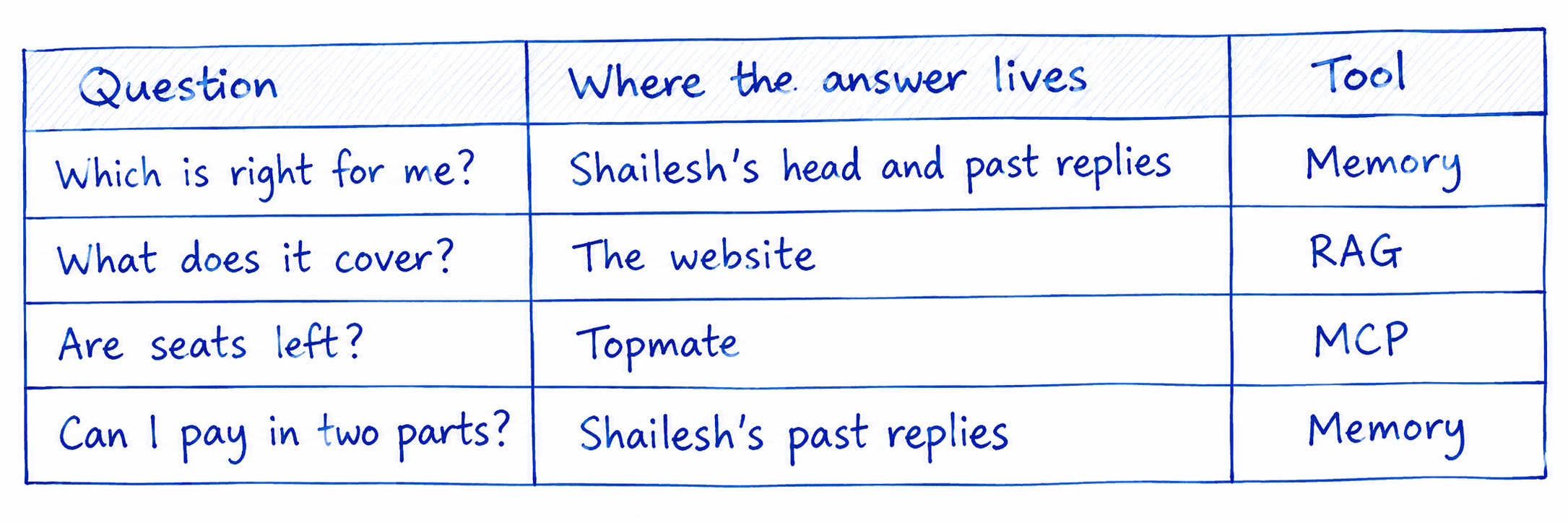
Now look at which questions close the sale. Nobody enrols because they read the syllabus. They enrol when someone says, " This is right for you, and here is how you can pay.
MCP and RAG answer the easy questions. The questions that close the sale live in Shailesh.
Do not guess. Read 200 failed chats.
You run a pilot with 50 small education businesses. Coaching classes, tutors, academies. You tag 200 chats the agent got wrong.
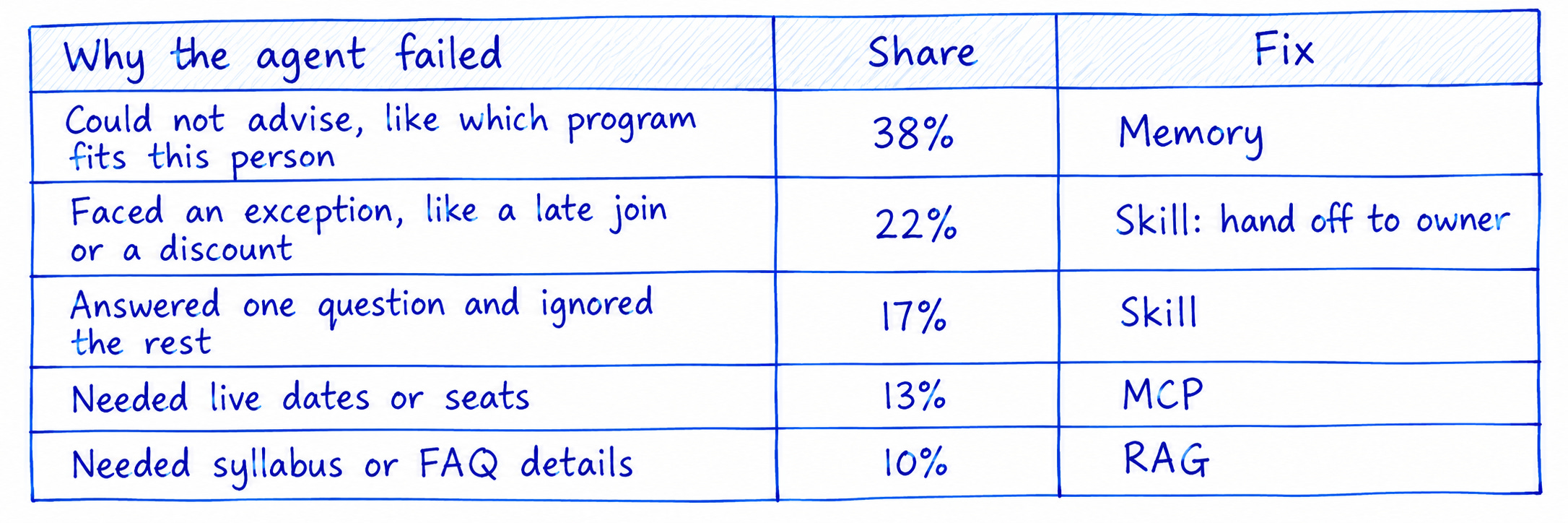
Memory and skills cover 77% of failures. MCP and RAG cover 23%.
The opportunity cost of each option
MCP to Topmate fixes 13%. Useful, but batch dates change only a few times a year. For now, put them in the prompt and update them by hand. Build MCP later.
RAG fixes 10%. But the full website and syllabus are about 10 pages. That fits in the prompt. RAG earns its cost when documents are too big to load. These are not.
That leaves skills and memory. Six weeks is enough to build both well.
The skill
WhatsApp writes one skill for all education businesses. Every coaching class and academy on the platform uses the same file.
name: course-enquiry
when: someone asks about joining a course

1. Find every question in the message. Answer all of them.
2. Ask about background and goal before recommending anything.
3. Recommend using the owner's saved rules.
4. Never promise an exception like a late join or a discount.
   Send it to the owner with one tap Approve or Decline.
Step 4 is the judgement. The agent collects everything. The owner decides. The customer gets an answer in minutes, not hours.
Memory
Memory has one big risk. It can turn an exception into a rule. Say Shailesh once let a friend pay in three parts. A careless agent now offers three parts to everyone.
So the agent never saves a rule on its own. When Shailesh answers something new, the agent asks him first.
Shailesh replied: Yes, you can pay in two parts.
Agent asks Shailesh: Save this for everyone?
[Yes]  [Only this person]

Saved rules
Two part payment is allowed for the cohort
Non coders from operations: suggest the cohort
Late joiners get recordings of all missed classes
Shailesh can open this list and edit it anytime. After a few weeks, it is the most useful FAQ his business has ever had. He never sat down to write it. His own replies wrote it.
The decision
Weeks 1 to 2: the skill with one-tap owner handoff.
Weeks 3 to 5: memory with the saved rules list.
Week 6: test on the same 200 chats.
Assume this fixes most of the memory and skill failures. The agent now fully answers about 70% of enquiries, up from 35%. For Shailesh, lost leads drop from 7 a day to about 2.
Same tools, opposite order
Ask the same question at Swiggy, and the answer flips. There, the knowledge sits in order and payment systems. So MCP comes first.
At a small business, even one with a website and a booking page, the knowledge that sells sits with the owner.
So before you pick a tool, ask where the knowledge lives.
In live systems, use MCP.
In documents, use RAG.
In repeatable steps, use a skill.
In people and their past replies, use memory.
A website tells people what you sell. Your replies tell them whether to buy. Only memory can learn the second.
If you found something new in this article, you'll love our AI resources.
AI Learning Resources
12 Weeks LIVE AI PM Cohort (Alumni now ship AI at Google/Microsoft, etc)
Self-Paced AI PM Cohort Recordings (65 Hours of Content) | Use AIBUILDER20 for 20% Discount
Quick AI PM Course (20 Hours of Content)
About Author
Shailesh Sharma! I help PMs and business leaders excel in Product, Strategy, and AI using First Principles Thinking.