

Ever wondered, How are you so hooked to the Infinite Scroll Taobao, Instagram Feed, TikTok Feed, Pinterest Feed?
How they are giving this much relevant content and that too in the real time?
In short they are not only taking your action but also inaction and in realtime they are able to serve you relevant Recommendations.
Let’s see in detail How do they do it?
As a Product Manager, you know that keeping users engaged relies heavily on providing relevant, timely content.
In the world of e-commerce and media, the Recommender System (RS) is the crucial module fighting the battle against information overload.
However, the traditional way most systems deliver recommendations often suffers from crippling delays.
A new architecture, known as EdgeRec, solves this by moving intelligence directly onto the user’s mobile device (the “edge”). This innovative approach results in massive improvements across core business metrics like GMV, CTR, and system speed.
Here is why the traditional system is failing your users and how EdgeRec completely changes the game.
The Problem: Slow Cloud Servers Can’t Keep Up with Real-Time User Behavior
Most large-scale RS operate under a “cloud-to-edge” framework. When a user scrolls down a feed, the mobile app (the edge) sends a request to the server (the cloud) for the next batch of recommended items.
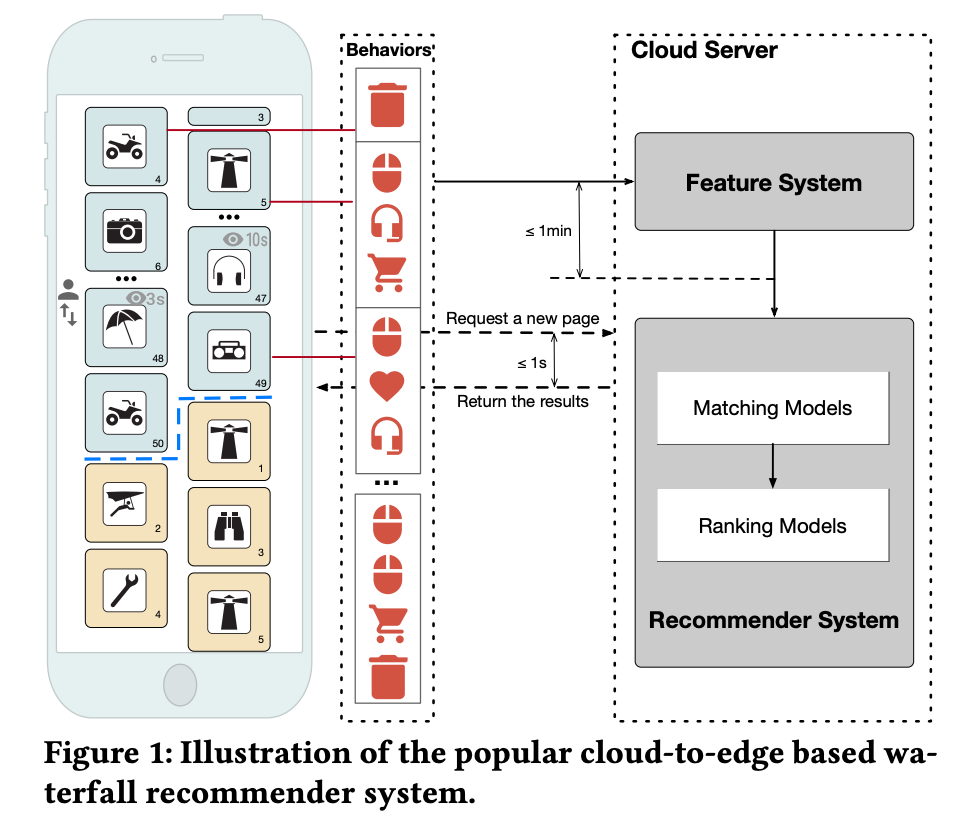
Reference Image - Recommender System on Edge in Mobile Taobao [Research Paper]
This architecture introduces two critical delays that destroy user experience:
1. Delay for System Feedback
Imagine a user is scrolling through their recommended items on a shopping app like Taobao. They scroll down a bit and then suddenly click on a red dress. This single click immediately signals a strong, sudden interest in the “dress” category.
In the old cloud-to-edge model, the RS on the cloud cannot respond to this instant preference change. The system only adjusts the list when the user scrolls far enough to request the next page of recommendations. This lag means the system fails to capitalize on that hot, momentary interest, resulting in a frustrating experience for the user.
2. Delay for User Perception
The cloud-based system is slow to capture user behaviors due to network latency and bandwidth limitations, sometimes resulting in a delay of up to 1 minute.
For example, a user might pause and spend a few seconds closely looking at a pair of headphones deep down in their feed (say, position 49), indicating a current preference. If they scroll to the next page, the cloud system might still not have processed that interaction in time, meaning the next set of recommendations misses the opportunity to display similar headphones.
In short, the delayed adjustments of the recommendations fail to match the user’s real-time, rapidly changing preferences, severely harming the user experience.
The EdgeRec Solution: Bringing the Brain to the Edge
EdgeRec is the first attempt to combine a Recommender System with Edge Computing. Instead of replacing the cloud, EdgeRec works with the cloud. The cloud still generates a large list of candidate items, but the critical job of reranking (adjusting the order of items shown) happens directly on the user’s mobile device.
This system design achieves two key benefits instantaneously:
1. Real-time User Perception: User actions are captured and consumed on the device.
2. Real-time System Feedback: The list is immediately adjusted based on those actions.
Capturing Positive AND Negative Signals
To make these instant adjustments effective, EdgeRec employs sophisticated methods to capture detailed user behavior, known as Heterogeneous User Behavior Sequence Modeling.
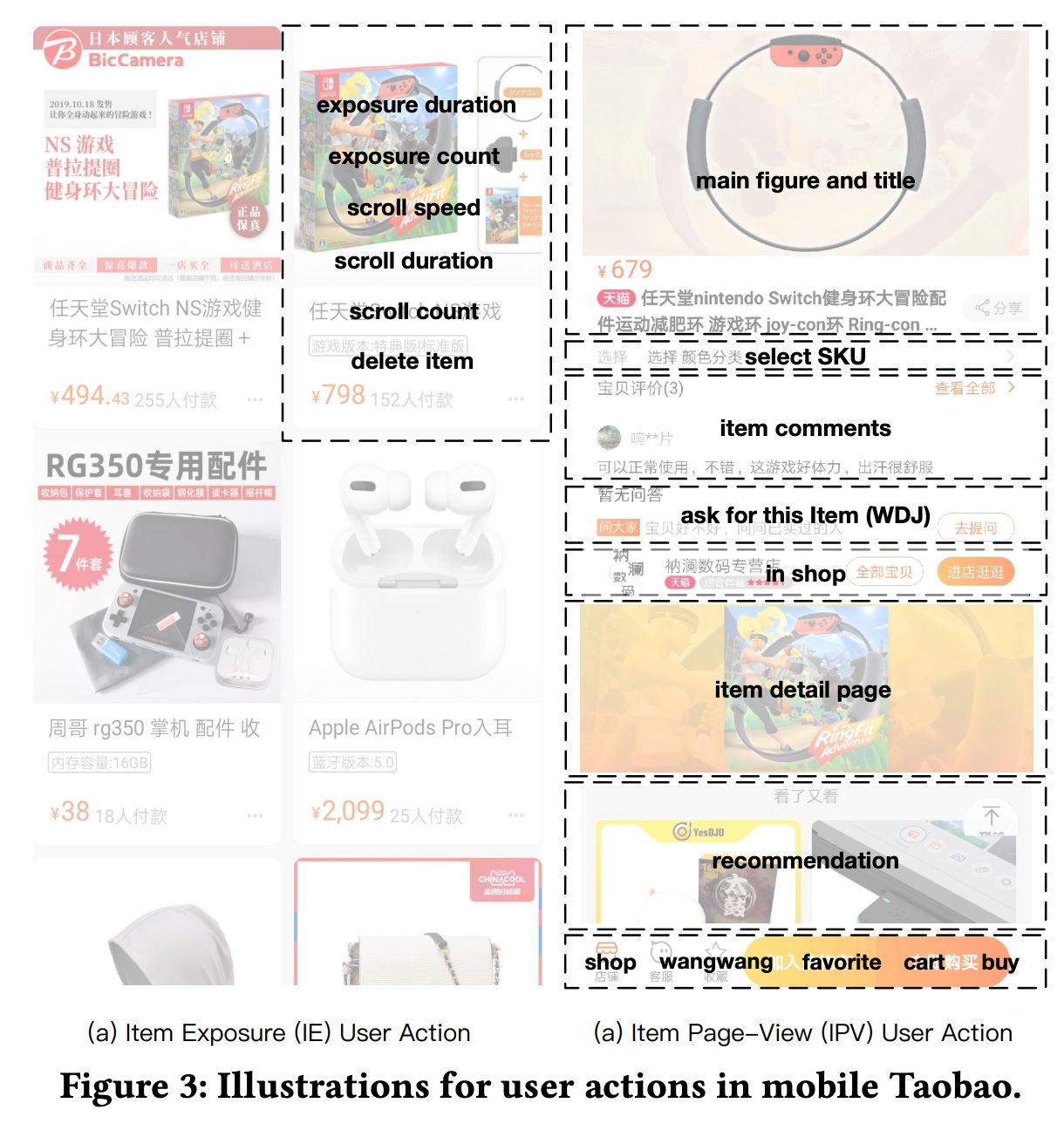
Reference Image - Recommender System on Edge in Mobile Taobao [Research Paper]
Traditional models usually focus only on “positive feedback” (like clicking or buying). But EdgeRec simultaneously models:
• Positive Feedback (Item Page-View / IPV): This captures detailed actions after a user clicks on an item and goes to the detail page (Item Page-View). Did they add it to the cart? Did they add it to their favorites? Did they go into the comments section? These detailed actions reflect a deep, real user preference, even if they didn’t buy immediately.
• Negative Feedback (Item Exposure / IE): This captures what the user ignores. Did they scroll quickly past the item? Did they repeatedly see the item without clicking? EdgeRec measures things like exposure duration and scroll speed to understand if the user has an underlying negative intention toward that item. For instance, if a user is exposed to the same item category multiple times and ignores it, the system knows to demote similar items instantly.
This level of detailed, real-time behavior is only possible because the data is collected, stored, and utilized right there on the user’s mobile device, bypassing network limitations.
The Business Impact:
EdgeRec was deployed on the massive mobile Taobao platform and demonstrated significant uplifts in key business metrics during online A/B testing.
GMV +10.92%
CLICK +8.87%
CTR +7.18%
Total items viewed +1.57%
This is a significant improvement. Furthermore, data showed that the CTR improved most notably toward the end of the displayed page, confirming that the real-time adjustments increase a user’s willingness to click before they scroll to the next page.
By moving the calculation to the mobile device, EdgeRec tackles the computing overhead associated with serving complex models to millions of users centrally. Critically, the system can now adjust the item ranking 15 times on average, compared to just 3 times in the traditional model, ensuring the recommendations always match the user’s moment-to-moment demands.
The traditional cloud-to-edge recommender system is fundamentally limited by network latency, resulting in poor response times and an inability to capture immediate user interests.
EdgeRec solves this by strategically deploying models on the mobile device, ensuring that every user action—positive or negative—is instantly captured and used for personalized reranking. The result is a system that responds up to 10 times faster and boosts your bottom line with double-digit GMV and CLICK promotions. This framework is the future of highly responsive and personalized digital products.
if you are Preparing for Google Product Manager Interview, Read This
Reference
Recommender System on Edge in Mobile Taobao [Research Paper]
Resources
About Author
Shailesh Sharma! I help PMs and business leaders excel in Product, Strategy, and AI using First Principles Thinking. For more, check out my Live cohort course, PM Interview Mastery Course, Cracking Strategy, and other Resources
My latest post on “How to answer product strategy questions?”
https://crackpminterview.substack.com/p/how-to-answer-product-strategy-questions-in-pm-interview