

You have probably seen a few AI PM roadmaps by now.
They all look alike. Learn the basics. Build something. Think like a senior PM. Study real companies.
But almost all of them get one step wrong.
And it is the step that gets you hired.
Over 1,000 PMs have followed the roadmap in this post, including PMs at Google, Microsoft and Coinbase. Here is the plan. The five stages first, with one thing to do in each. Then the step most roadmaps put in the wrong place. And how to fix it, starting this week.
Let us start with the stage most people rush through.
Stage 1: Know when AI is the right answer
Before you learn a single model, learn when not to use one.
A lot of AI products should not be AI at all. They are a rule, a form or a search box with a chatbot on top.
Here is how I would think about it. Ask three questions before anything else.
Is the task fuzzy or exact? Summarising a customer complaint is fuzzy. Calculating a refund is exact. Models are good at fuzzy. Plain code is better at exact.
What does a wrong answer cost? A bad playlist name costs nothing. A wrong refund costs money and trust.
Does the model have what it needs? If the answer lives in your order database, the model cannot guess it. It has to look it up.
Take a bank app. “What is my balance?” does not need AI. It needs a database query. “Why was my card declined?” is different. The facts are exact, but explaining them in plain words to a stressed customer is fuzzy. That part can be AI.
This is the judgment companies pay AI PMs for. Anyone can add a chatbot. Fewer people can tell you when not to.
That is the thinking part. Stage 2 is where you start building, and it is simpler than most people make it.
Stage 2: Get very good at prompting, then build a prototype
Prompting is the AI PM’s version of writing a spec. You are telling a system what a good output looks like.
Here is a drill that works. Pick one boring task from your own job. Release notes, user research summaries or weekly status updates. Write a prompt for it. Run it on 10 real examples. Keep rewriting the prompt until 8 out of 10 outputs are good enough to use without edits.
Then build a rough prototype in Claude Code. A small tool you can click and show someone. It does not need to be ready for real users. It needs to work on your laptop.
A prototype changes every conversation you have. In a product review, people argue about a slide. They react to something they can click.
Most people stop here. They can prompt, and they have built a toy. Stage 3 is where you learn why toys break.
Stage 3: Build one RAG app, one agent and one eval
You will keep seeing these three terms in AI PM job posts. In plain words:
RAG lets the model look things up in your documents before it answers.
An agent lets the model take steps and use tools, not just reply.
An eval is a test that tells you whether the answers are good.
Do not watch another video on them. Build one of each.
A RAG bot that answers questions from a set of help docs.
An agent that does a three-step task. Read a customer email, look up the order, draft a reply.
An eval with 20 questions and known good answers. Run your RAG bot on it and score the results.
The eval is the one most people skip. It is also the one that matters most. Without it, you cannot tell whether a change made the product better or worse. You are guessing.
You cannot make good product calls about systems you have never seen fail. Building them is how you see them fail.
Now you can build. Stage 4 is where the real jump happens. From building things to deciding things.
Stage 4: Think like a senior AI PM
A senior AI PM owns the whole thing. The spec, the experience, the price and the proof that it worked.
Let us break this down.
The spec. For an AI feature, the spec is not only what it does. It is what a good answer and a bad answer look like, with real examples. If you cannot write that down, your engineers cannot test it.
The experience. What does the user see when the AI is unsure? What happens when it is wrong? Good AI UX plans for the wrong answer, not only the right one.
The price. This is the part most PMs miss. Every answer your AI gives costs real money.
Think of it this way. Say one answer costs ₹0.50 in model calls. A typical user asks 40 questions a month. That is ₹20 per user per month, before servers, support or anything else. If your plan is ₹99 a month, this one feature eats about a fifth of your revenue. Now you have a pricing decision, not only a feature.
The proof. You shipped it. Did it work? Run an A/B test. Half your users get the feature, half do not. Then check whether it moved the metric you care about. Not whether people liked it. Whether the number moved.
This is where an AI feature stops being a demo and becomes a business.
One stage left. Then the step most roadmaps put in the wrong place.
Stage 5: Study how real companies ship AI
Pick three AI features you use every week. Mix consumer apps and business tools. For each one, write four lines.
What problem does it solve?
Why did they use AI here, and not a simple rule?
Roughly what does each answer cost them?
How would they know it is working?
Do this for a few weeks and patterns start to show. You see why some features feel useful, and others feel bolted on.
Those are the five stages. If you have seen AI PM roadmaps before, most of this probably looks familiar.
Here is what is missing.
The step most roadmaps get wrong
Interview prep.
Almost every roadmap puts it at the end. Stage 6. Learn everything first, then get ready for interviews.
That order is backwards. Three reasons.
Interviews test a different skill. You have to explain your thinking out loud, under time pressure, about a product you did not build. Knowing the material is not the same as explaining it to a stranger in 45 minutes. That takes practice, and practice takes time.
Waiting means late feedback. If you start mock interviews only after months of learning, that is when you find your gaps. By then, they are expensive to fix.
Explaining is how learning sticks. When you answer “should this be AI?” out loud, you find out whether you understood Stage 1 or only read it.
The interviewer is not testing whether you finished a roadmap. They are testing whether you can think like an AI PM in front of them.
Interview prep does not belong at the end. It belongs on day one.
Check out our self-paced AI PM course (Including AI PM Interview Preparation )
4.9/5 · 1120+ enrollments · Click for Discounts, see testimonials and course details
The fix: make interview prep the base layer
Picture the roadmap as a staircase. Five steps going up.
Most roadmaps add interview prep as a sixth step at the top. Move it to the bottom instead. Make it a base layer that runs under every stage.
Now go back to the stages you just read. Each one has an interview question hiding in it.
Stage 1 trains AI product sense. Try: “Your bank wants an AI chatbot for customer support. Should it be AI? What would you build first?”
Stage 2 trains you to talk about your own work. Try: “Walk me through something you prototyped. What did you change after testing it?”
Stage 3 trains AI root cause analysis. Try: “Your support bot’s resolution rate fell from 70% to 55% last week. Find out why.” Was it the documents, the model, the prompt or the users?
Stage 4 trains AI ROI. Try: “Each answer costs ₹0.50. Is this feature worth building? How would you price it?”
Stage 5 trains AI strategy. Try: “A much bigger company launches your feature for free. What do you do?”
The rule is simple. Whatever stage you are on this week, practise its interview question out loud this week. Record yourself on your phone. Listen back once.
What week one looks like
If you started today, your first week would look like this.
Learn: Stage 1. Pick three AI features and run each one through the three questions.
Practise: Answer “Should this be AI?” out loud for one product you use every day.
Check: Play back your recording. Did you give your answer and your reason in the first 30 seconds?
That is the whole pattern. Learn a stage. Practise its interview question. Check yourself. Then move up a step.
I have put the full week-by-week plan in one place. Each week pairs one roadmap stage with one interview drill, from day one to your first full mock interview.
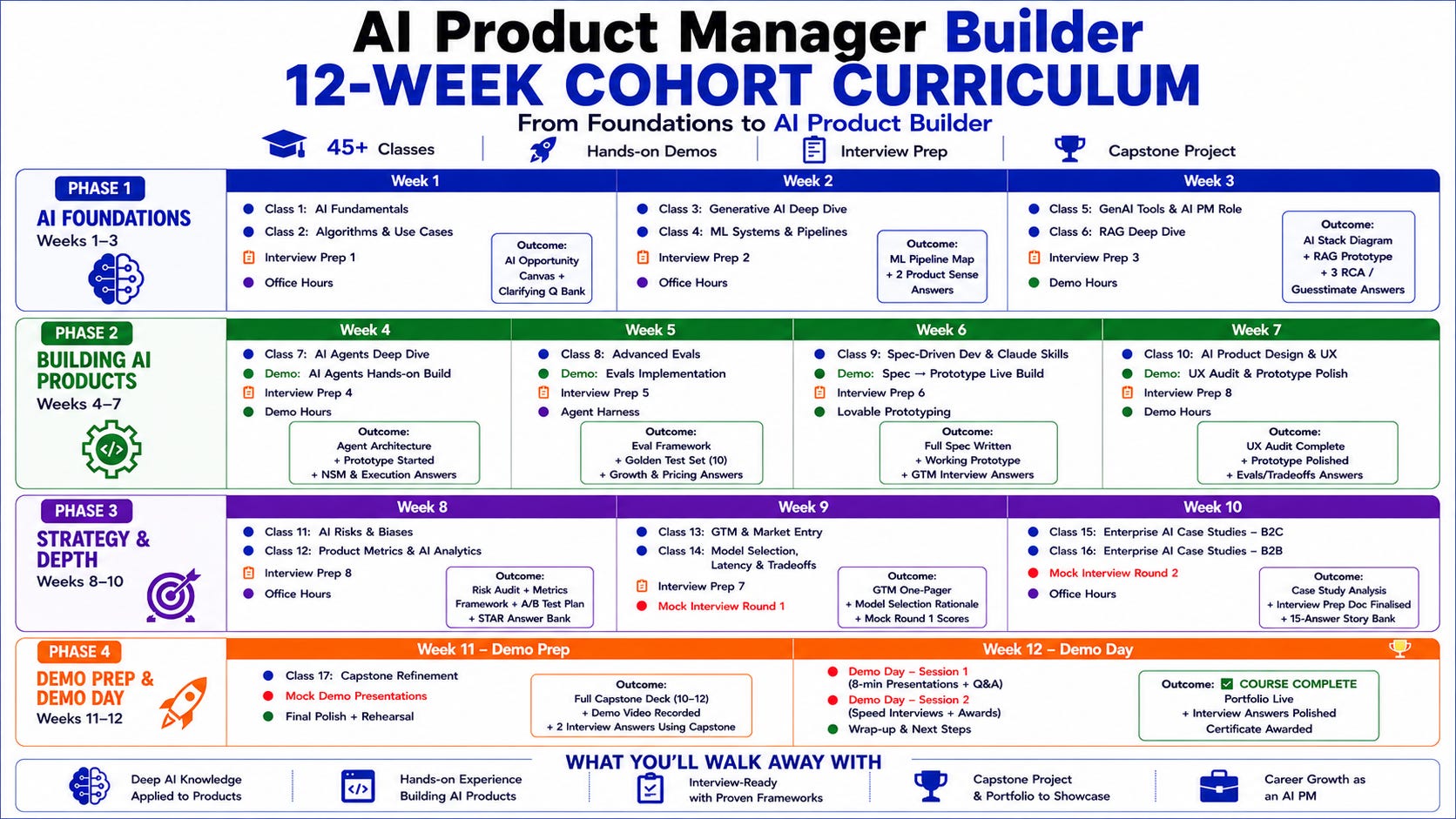
12-week program details can be found here -
[Alumni Shipping at Google, Microsoft, Uber] - 1 out of 3 is getting placed
About Author
Shailesh Sharma! I help PMs and business leaders excel in Product, Strategy, and AI using First Principles Thinking.


