

Breaking into AI Product Management often feels complicated.
It’s a role everyone talks about, but few truly understand how to land it.
Good news: It’s not as mysterious as it seems. It’s about a clear strategy and actionable steps.
Forget the confusing jargon. Let’s make this simple.
Is AI PM Just a Buzzword?
When you hear “AI Product Manager,” you might picture complex algorithms or cutting-edge tech.
While that’s part of it, an AI PM’s core job is simpler.
They connect advanced AI technology with real-world problems. They turn complex AI capabilities into products users love.
Why Everyone Wants an AI PM
The demand for AI Product Managers is skyrocketing.
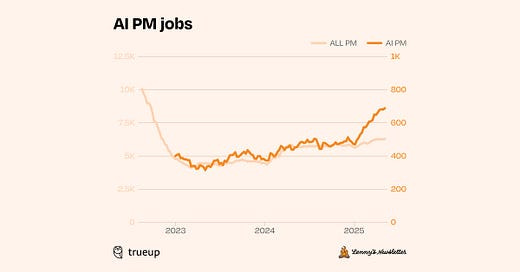
Companies urgently need people who can take AI from concept to a successful product.
Why? Because AI isn’t just a fancy add-on anymore. It’s becoming the foundation for many new products and services. And someone needs to lead that development.
This means huge career opportunities, high impact, and excellent compensation.
So, how do you get into this in-demand field?
The “No-Code” Secret: You Don’t Need to Be a Coding Genius
This is where many aspiring AI PMs get stuck.
They believe they need a PhD in Machine Learning or years of coding experience.
Here’s the truth: You don’t.
While understanding AI/ML basics is important, your job isn’t to build the models. Your job is to define what to build, why to build it, and for whom.
You’ll collaborate closely with brilliant engineers and data scientists. Your role is to guide their technical expertise towards solving a user problem.
Your 3-Step Launchpad into AI PM
Ready to jump into AI Product Management? Here are three practical steps:
1. Master the “Why” of AI (Product Sense, AI Style)
Go Beyond the Hype: Understand not just what AI is, but what specific problems it can solve.
Analyze AI Products: Study successful AI products. How does Netflix’s recommendation engine work? What problem does it solve? How about Spotify’s personalized playlists?
User First: For every AI concept, ask: What value does this bring to the user? How does it make their life better or easier?
2. Learn the AI Language (Without Becoming a Coder)
Speak the Lingo: You need to understand terms like “machine learning,” “deep learning,” “natural language processing (NLP),” ““computer vision,” and “supervised vs. unsupervised learning.”
This lets you communicate effectively with your engineering and data science teams. You don’t need to write code, but you need to understand possibilities and limitations.
we have explained AI and Tech with a Case Study Based Approach, This can be a game changer in your AI Product Management Career
3. Show Your Skills (Build Your “AI PM” Muscles)
Side Project Power: Even a small personal project can make a big difference.
Idea: Can you build a simple chatbot using a no-code tool like ManyChat?
Idea: Create a mock product specification for an AI-powered feature for an existing app. How could AI improve a social media feed, for example?
Network Strategically: Connect with current AI PMs on LinkedIn. Ask for informational interviews. Learn from their career paths.
From Feature →Intelligent System
This role is more than adding a new button. It’s about designing systems that can learn, adapt, and offer personalised experiences.
Embrace new challenges. AI is always evolving. Be curious. Be flexible. And always focus on the user.
Don’t wait for the perfect moment. Start learning, start doing, and start connecting. The AI PM role is within your reach.
Ready to start?
For More, check out our PM Interview Mastery Course
( Crack PM Interview with First Principle Thinking like the top 1% )
Hey, I’m Shailesh Sharma! I help PMs and business leaders excel in Product, Strategy, and AI using First Principles Thinking.
For more, check out my Live cohort course, PM Interview Mastery Course, Cracking Strategy, and other Resources
Learn the AI language without being a coder - I certainly have! I am not a PM, but a tech lead, often integrating AI into our systems and working with our architect and platform teams. Have an understanding has been enough. The more critical point is communication and empathizing with those stakeholders who will use the tools.