

Our next AI Product Manager & Builder Cohort starting - for early bird discount, you can fill the form here - AI PM Builder Cohort
Imagine you want to buy running shoes.
Earlier, you would probably open Amazon, search for shoes, compare a few products, read reviews, and make a purchase.
Now, you might start with ChatGPT.
You ask it to recommend running shoes under $150. It compares your options, explains the differences, and helps you narrow down your choices.
You haven’t opened Amazon once.
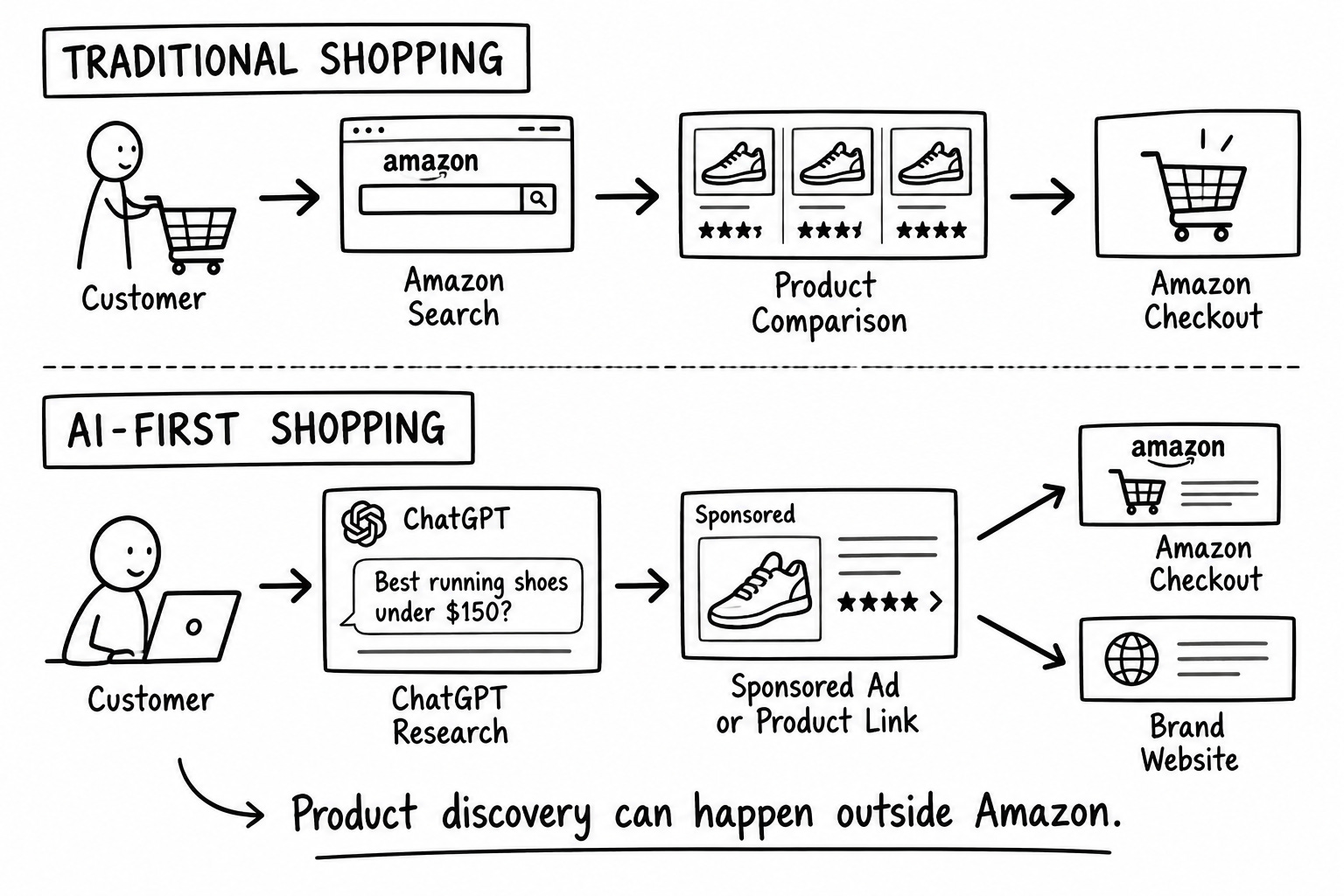
This creates an interesting problem for Amazon. The shopper still intends to buy something, but Amazon may no longer be the place where the shopping journey begins.
Amazon’s response is interesting: instead of trying to control the entire AI shopping experience, it is helping advertisers reach shoppers inside ChatGPT.
Through its advertising integration with ChatGPT, selected US advertisers can extend their Amazon Ads campaigns into ChatGPT’s conversational advertising experience.
Why would Amazon choose this strategy? Why not open its product catalogue to ChatGPT, pay for referrals, or try to own checkout inside the AI experience?
To understand the decision, we need to look at the incentives of both companies.
1. Start with the business problem, not the deal
Let’s separate two things that are easy to confuse.
Product discovery is where a customer researches products, compares alternatives, and decides what to buy.
Transaction is where the customer actually purchases the product.
Historically, Amazon has been strong at both. Customers discover products on Amazon, click on listings, and complete their purchases there.
AI assistants create the possibility of separating these activities.
A customer might discover a product on ChatGPT, click an advertisement or recommendation, and complete the purchase on Amazon. Alternatively, they might go directly to a brand’s website.
The critical question is: who controls each part of this journey?
If ChatGPT owns product discovery but Amazon owns the transaction, Amazon may still benefit from the purchase. However, it risks losing some of the advertising opportunities associated with product discovery.
This matters because Amazon has two related businesses.
Retail: It earns through products sold on its marketplace.
Advertising: Brands pay to get their products in front of potential customers.
These businesses reinforce each other. More shopping activity can create more advertising opportunities, while advertising can help products get discovered.
If shoppers increasingly start their journeys elsewhere, Amazon needs a way to participate in those journeys.
It does not necessarily need to own the first interaction. It needs to preserve its ability to create value from it.
2. Break the business problem into four levers
When analysing a strategy decision, don’t jump directly to solutions. First identify which part of the business is threatened and which parts remain strong.
For this case, I would analyse Amazon using four levers.
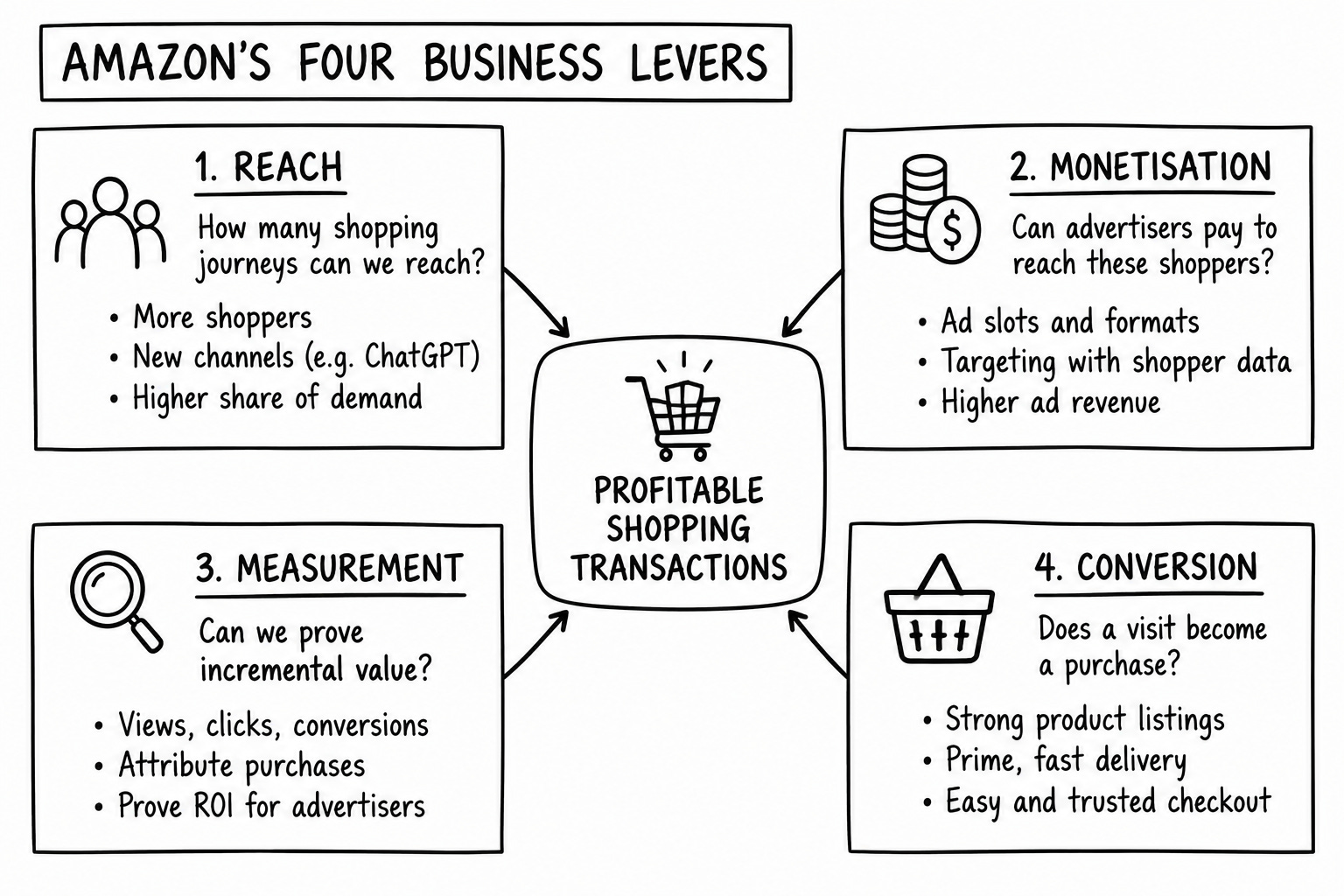
Lever 1: Reach
How many relevant shopping journeys can Amazon participate in?
When customers begin on Amazon, the company has multiple opportunities to influence their choices.
When customers begin on ChatGPT, Amazon might not be considered at all.
Advertising inside ChatGPT creates another opportunity to reach these customers.
Lever 2: Monetisation
How can Amazon and its advertisers make money from that attention?
On Amazon, brands can bid for visibility through advertising formats such as Sponsored Products.
ChatGPT introduces another place where shoppers can encounter a sponsored product while researching a purchase.
Amazon’s advertising infrastructure gives existing advertisers a way to extend campaigns into this new channel.
The important distinction is that Amazon is not creating the customer’s intent. It is helping advertisers reach that intent in a different place.
Lever 3: Measurement
Can the business establish whether the advertising actually generated value?
A brand needs to know whether its spending created additional purchases, not simply whether someone clicked an advertisement.
Amazon has an advantage when a transaction happens on its marketplace because it can observe the order directly.
However, measuring purchases across external websites and AI interfaces is more complicated.
The more difficult it becomes to connect advertising spend to business outcomes, the harder it is for advertisers to justify increasing their budgets.
Lever 4: Conversion
Once a shopper decides to buy, where does the purchase happen?
Amazon has an established retail experience, including product listings, checkout, fulfilment, and Prime benefits.
If a shopper clicks an advertisement and purchases on Amazon, the company can potentially benefit from the transaction as well as the advertising activity.
If the shopper purchases directly from a brand’s website, that retail benefit may not accrue to Amazon.
This is why the destination of the advertising click matters.
The strategic objective is not simply to win more clicks. It is to reach new shopping journeys while preserving the ability to generate profitable transactions.
For this analysis, that is the outcome I would optimise for. It is an analytical framework for this case, not a claim about Amazon’s officially declared company-wide North Star metric.
3. What options did Amazon have?
Once we identify the four levers, the available strategies become easier to compare.
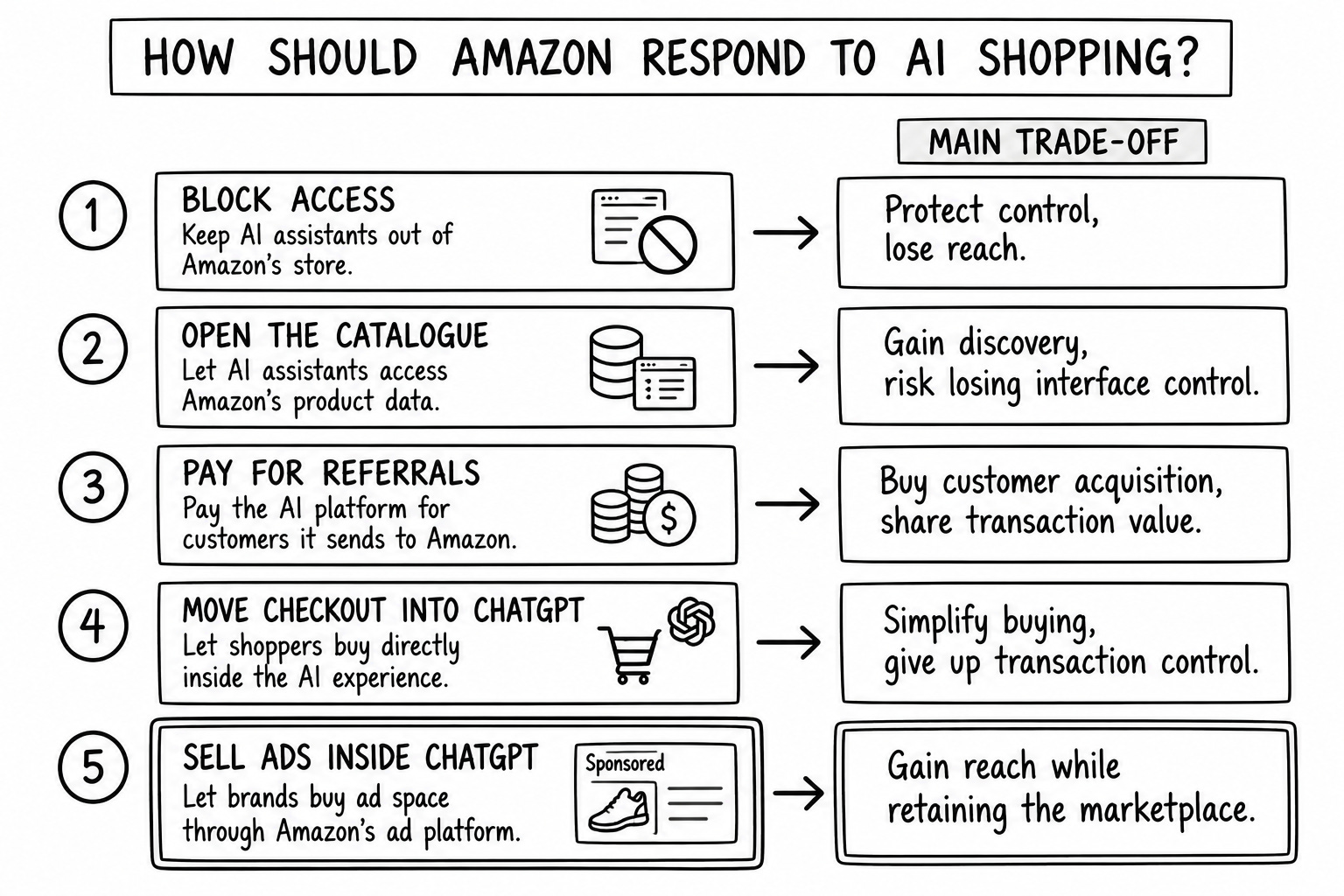
Option 1: Keep AI assistants out
Amazon could continue to restrict access to its product catalogue and avoid participating in external AI shopping experiences.
The advantage is control. Amazon retains its own shopping experience, advertising placements, and transaction flow.
The problem is reach.
Customers can still use AI assistants to research products. Restricting access does not make those shopping journeys disappear. It simply limits Amazon’s ability to participate in them.
Blocking access may make sense where the risks exceed the benefits. But it is not, by itself, a strategy for capturing demand in a channel that continues to grow.
Option 2: Open its product catalogue to ChatGPT
Amazon could make product details, prices, availability, and other information accessible to ChatGPT.
This could allow the assistant to recommend Amazon products more directly.
The advantage is better product discovery. The trade-off is control.
ChatGPT could become the interface where customers compare products and make choices, while Amazon becomes the destination they visit only when ready to purchase.
Amazon would also need to consider how external product discovery affects its own sponsored listings and advertising business.
Opening the catalogue could create more traffic, but it would not automatically preserve the economics of Amazon’s existing shopping experience.
Option 3: Pay for referrals
Amazon could compensate an AI platform for customers referred to its marketplace.
This would make the economics dependent on successful referrals or purchases, depending on the agreement.
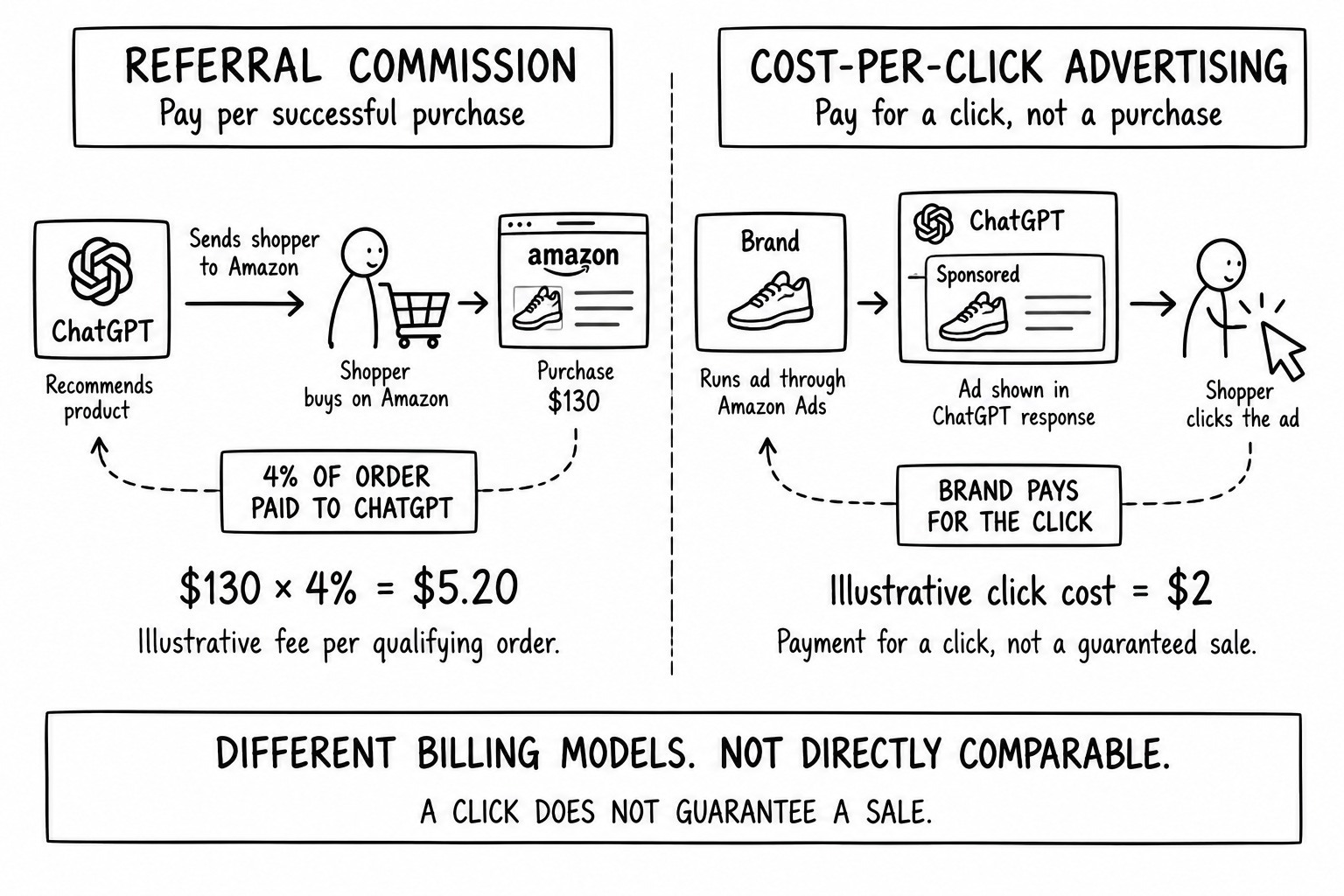
Consider an illustrative example. If a $130 purchase carried a 4% referral commission, the fee would be $5.20.
That may be reasonable if the referral creates incremental demand. It becomes less attractive if Amazon pays for a purchase that would have happened anyway.
There is another trade-off: referral payments do not necessarily preserve the advertising opportunities associated with Amazon’s own shopping experience.
The model can work, but Amazon would need to evaluate the cost of acquiring each incremental customer against the profit generated by that customer.
Option 4: Move the entire purchase into ChatGPT
Another option is to let the AI platform handle more of the purchase itself.
In principle, this creates a simpler experience. Customers can research, decide, and buy without leaving the conversation.
However, there is a difference between making a good recommendation and becoming a trusted transaction platform.
Research cited by EMARKETER found that 10% of AI-assisted digital shoppers usually completed purchases on the AI platform itself, compared with 69% who usually purchased through a retailer’s website or app.
This is a useful signal, although it should not be treated as proof that in-chat checkout cannot succeed in the future.
The strategic question is whether Amazon should give up control of a transaction experience it already knows how to operate before customers have clearly demonstrated a preference for buying through the AI platform.
Option 5: Sell advertising inside ChatGPT
This is the approach Amazon and OpenAI are testing.
Rather than immediately transferring product discovery or checkout, Amazon enables its advertisers to extend their campaigns into ChatGPT.
Amazon gains access to a new discovery environment through its advertising relationships. OpenAI gets another way to monetise the ChatGPT experience.
And if an advertisement sends the customer to Amazon, Amazon has the opportunity to retain the transaction as well.
This option does not eliminate every risk. Amazon does not control the ChatGPT interface, and not every advertising click will produce an Amazon sale.
But it allows Amazon to participate in a new channel without first rebuilding its entire shopping experience around that channel.
That is the central strategic trade-off: enter a new environment without giving away control of the parts of the business that already work.
4. Why the advertising model makes sense for both companies
The deal becomes clearer when we look at the incentives on each side.
What Amazon gets
First, it can reach customers who begin their research outside Amazon.
Second, existing advertisers get a way to extend their media campaigns into a conversational environment without treating it as an entirely separate advertising channel.
Third, Amazon can explore the economics of AI-driven product discovery before making a larger commitment to a different commerce model.
But there is an important condition.
Amazon benefits most when advertising in ChatGPT creates incremental value, especially when it leads to profitable transactions on Amazon.
If a brand pays to reach someone in ChatGPT, but the person buys directly from the brand, the advertising may still benefit the brand and the advertising channel. Amazon’s retail business, however, may not gain the same value.
So Amazon should not evaluate this initiative only by the volume of advertising spend. It should also understand where the resulting purchases occur and whether those purchases would otherwise have happened.
What OpenAI gets
ChatGPT has to balance monetisation with the experience that brings users back.
Its published advertising principles state that advertisements are clearly labelled and do not influence the answers ChatGPT provides. OpenAI also says conversations are not shared with advertisers, who receive aggregated information about ad performance.
These boundaries matter because users come to ChatGPT for help, not simply to browse advertisements.
OpenAI needs advertising revenue, but it cannot treat every conversation as an ordinary search-engine results page without risking the trust that makes the product useful.
Amazon brings an established advertising business and relationships with brands that already spend money on digital marketing.
That lowers the friction involved in getting advertisers to test a new channel.
The deal therefore fits both incentives: Amazon gains access to a new environment for its advertisers, and OpenAI gains a route to advertising demand without having to build every advertiser relationship from scratch.
What advertisers get
Advertisers get another opportunity to reach people while they are actively researching a decision.
A person asking for the best running shoes under $150 has expressed a more specific need than someone casually browsing a general website.
That does not guarantee the person will purchase. But it creates a potentially valuable context for advertising.
Advertisers still need to test whether the channel delivers incremental sales at an acceptable cost. Intent alone is not enough.
Follow the money with one simple example
Suppose Emily is shopping for running shoes that cost $130.
There are two hypothetical ways to monetise her journey.
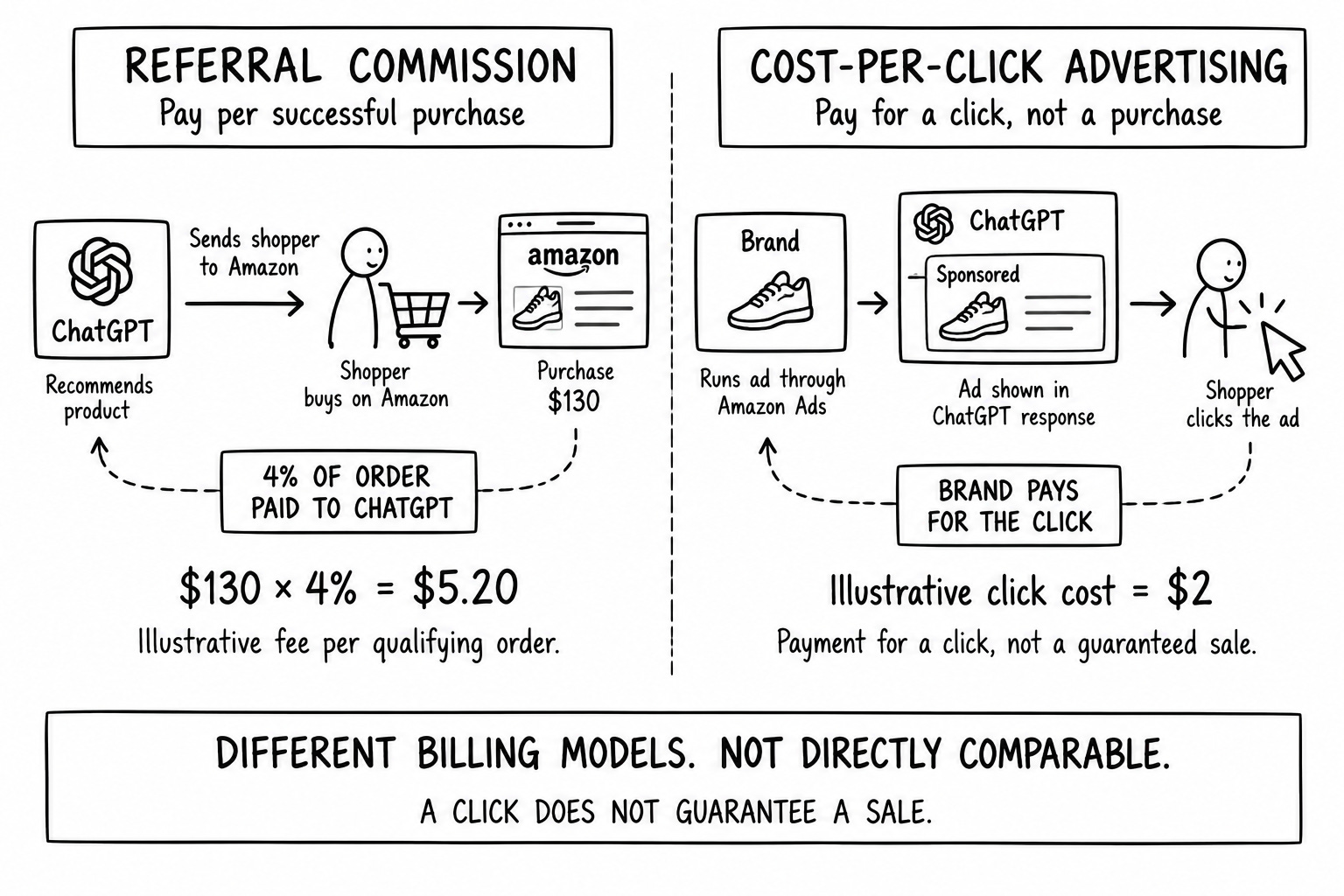
Model A: Referral commission
If an affiliate agreement pays 4% on a completed order, a $130 purchase generates a $5.20 referral fee.
The payment depends on a qualifying transaction under that hypothetical agreement.
Model B: Advertising
Suppose a shoe brand pays $2 for a click on its advertisement. The brand pays for the click under a cost-per-click arrangement even if Emily does not eventually purchase the shoes.
Both amounts are illustrative; neither represents a disclosed term of the Amazon–OpenAI integration.
The economics are not directly comparable. One amount is tied to an order, while the other is tied to a click.
But the difference reveals something important about the business models.
In the advertising model, the brand funds the acquisition of attention. In a referral model, the business paying the commission funds that acquisition in exchange for a share of the resulting transaction economics.
Amazon can potentially earn advertising-related revenue through the media arrangement and retail profit if the purchase happens on Amazon. Those benefits depend on the actual campaign economics and destination of the sale.
The larger lesson is this: a company should understand not just how much revenue a new channel creates, but who pays for the customer acquisition and who captures the value after the click.
Who has the stronger strategic position?
My bet is that Amazon has the stronger immediate position, although the outcome is not guaranteed.
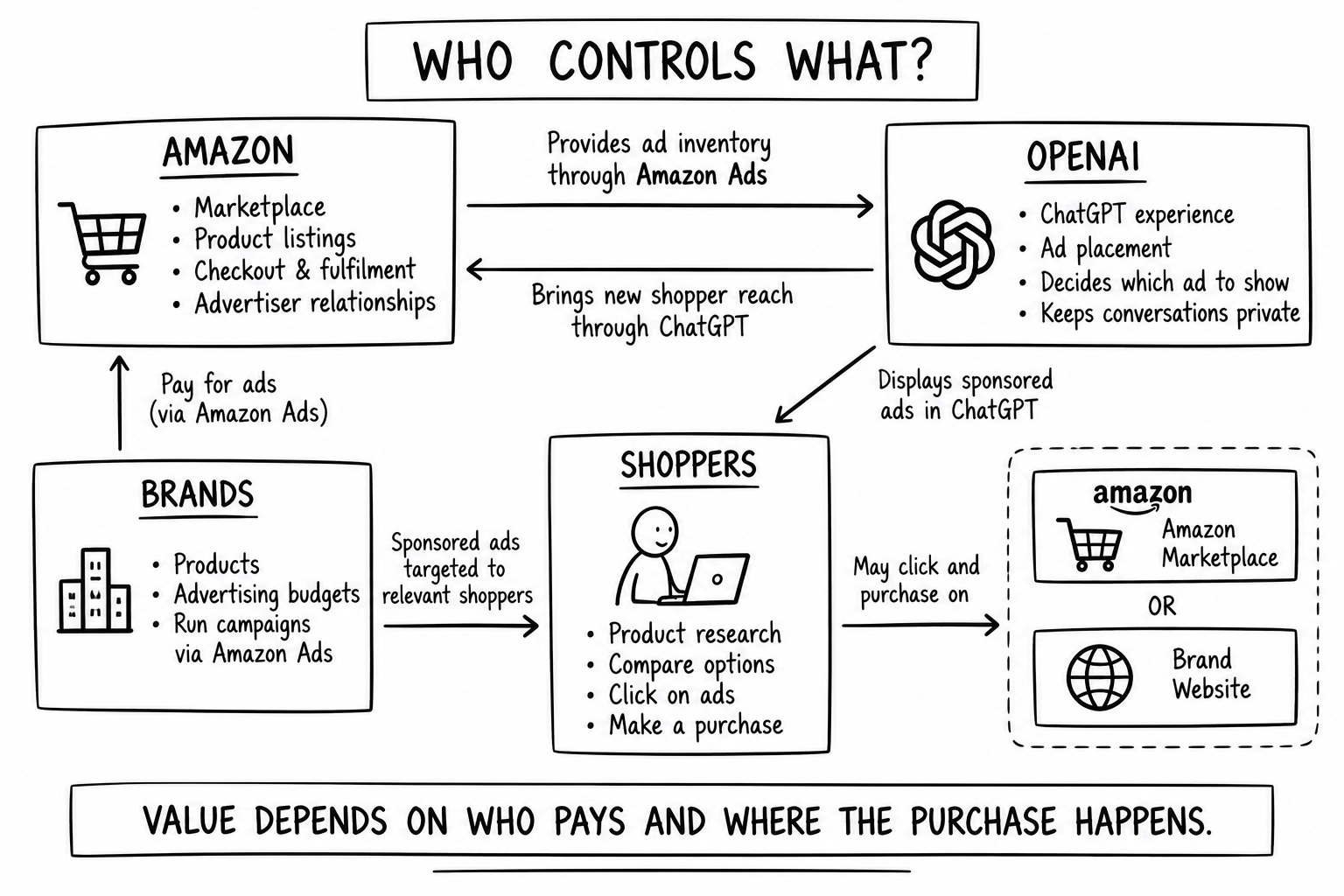
Here is why.
Amazon already has an established commerce business, a large advertiser base, and a way for brands to buy advertising. The integration lets advertisers test a new discovery channel without requiring Amazon to replace its own marketplace with ChatGPT.
OpenAI gains a monetisation route and access to advertisers through an established ecosystem. However, relying on external advertising partners could limit how much control it has over advertiser relationships in the long run.
The incentives are different:
Amazon wants to participate in AI-driven discovery while protecting its retail economics.
OpenAI wants to monetise discovery while preserving the user experience that makes people trust its answers.
Advertisers want incremental customers, not merely another place to spend money.
Customers want useful recommendations without feeling that the recommendations have been distorted by advertising.
These goals overlap, but they are not identical.
Amazon’s advantage weakens if the ads mainly direct shoppers to competitors’ websites, if advertisers do not see sufficient returns, or if ChatGPT becomes less dependent on Amazon’s advertising infrastructure.
OpenAI’s position strengthens if it builds its own direct advertiser relationships, develops effective measurement, and demonstrates that its advertising experience can scale without undermining trust.
The real outcome will depend on how the economics evolve, not on the existence of a partnership alone.
What should we watch to know whether this strategy is working?
A Product Manager analysing this launch should go beyond impressions and clicks.
I would monitor five things.
1. Incremental reach
How many relevant shoppers does ChatGPT bring into Amazon’s ecosystem who would not otherwise have entered it?
A new channel is valuable only if it creates additional opportunities or improves the economics of existing ones.
2. Incremental purchases
Do exposed shoppers make more profitable purchases than comparable shoppers who were not exposed to the advertising?
This is more informative than simply counting orders attributed to clicks. Some customers would have purchased from Amazon anyway.
A properly designed experiment or holdout group can help distinguish incremental sales from sales that would have happened regardless.
3. Advertising efficiency
Do advertisers get an acceptable return on their spending?
Track cost per incremental purchase, conversion rate, and return on advertising spend where the measurement setup supports them.
A high click-through rate is not enough if the traffic does not convert.
4. Purchase destination
Do shoppers go to Amazon product pages, or do they complete purchases on brand websites?
This helps establish whether the new channel strengthens Amazon’s retail business, primarily benefits its advertising operation, or creates value elsewhere.
5. User trust and experience
Do users continue to find ChatGPT helpful when sponsored placements appear?
If advertising makes recommendations seem less trustworthy, short-term revenue could come at the expense of long-term product usage.
The test is not simply whether ChatGPT ads get clicked. It is whether the advertising model can create durable value for advertisers and the platform without weakening the product experience.
Learn to break down AI and product strategy
In the AI Product Builder Cohort, we break down real product and AI strategy decisions using frameworks like these: business outcomes, key levers, strategic options, trade-offs, and experiments. Members also build practical AI products themselves.
About Author
Shailesh Sharma! I help PMs and business leaders excel in Product, Strategy, and AI using First Principles Thinking.
AI Learning Resources
12 Weeks LIVE AI PM Cohort (Alumni now ship AI at Google/Microsoft, etc)
Self-Paced AI PM Cohort Recordings (65 Hours of Content) | Use AIBUILDER20 for 20% Discount
Quick AI PM Course (20 Hours of Content)