

The 30-second version
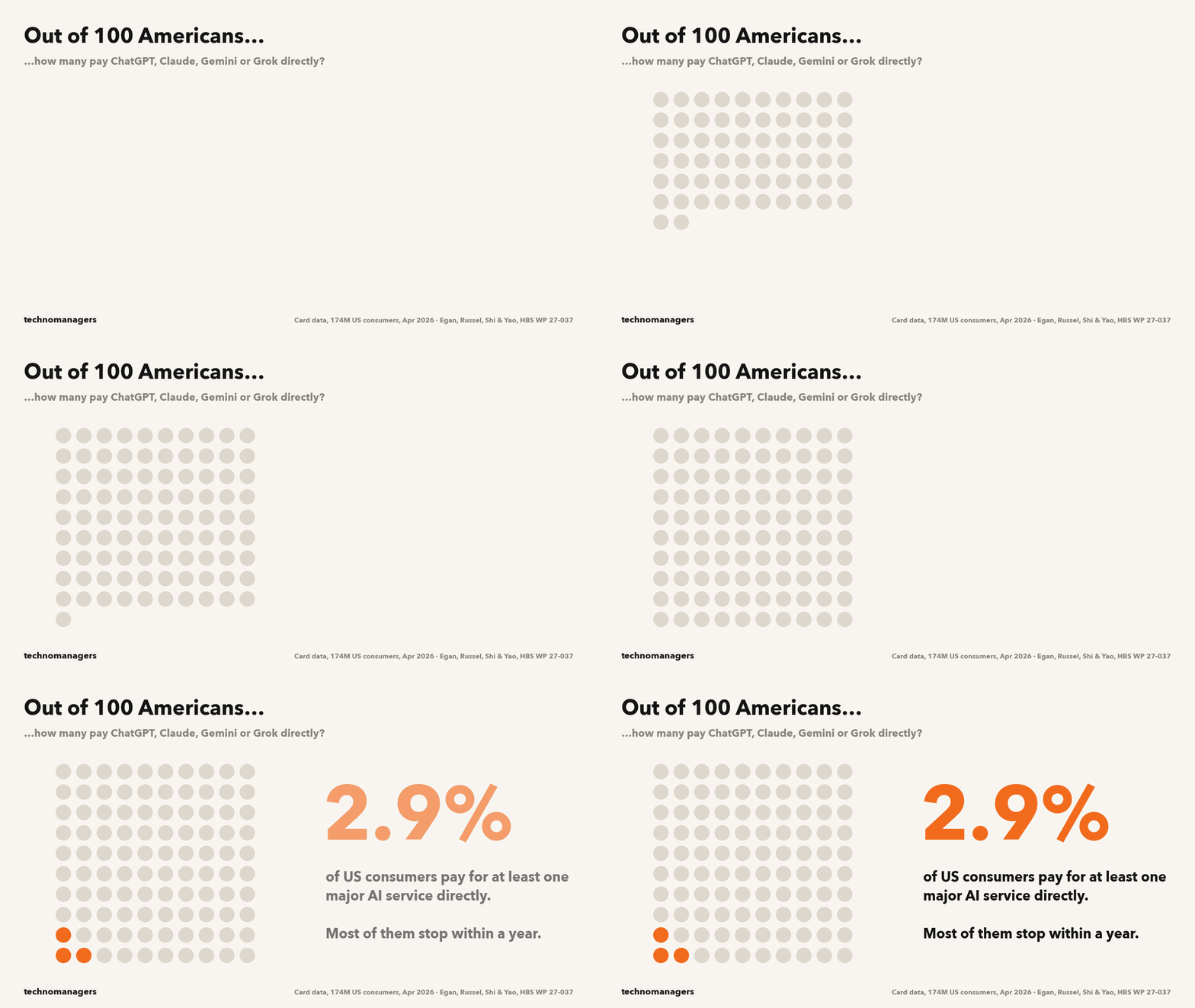
Harvard looked at real card payments from 174 million Americans. Only 2.9% pay ChatGPT, Claude, Gemini or Grok directly. Most of them stop paying within a year.
India is running the biggest free-AI experiment in the world. The free year is ending right now, one user at a time.
My read: people won’t pay for AI the way they pay for Netflix. Four wallets will pay for it, and only one of them is yours.
1. The ₹399 moment
On 4 November 2025, OpenAI made ChatGPT Go free for a year in India.
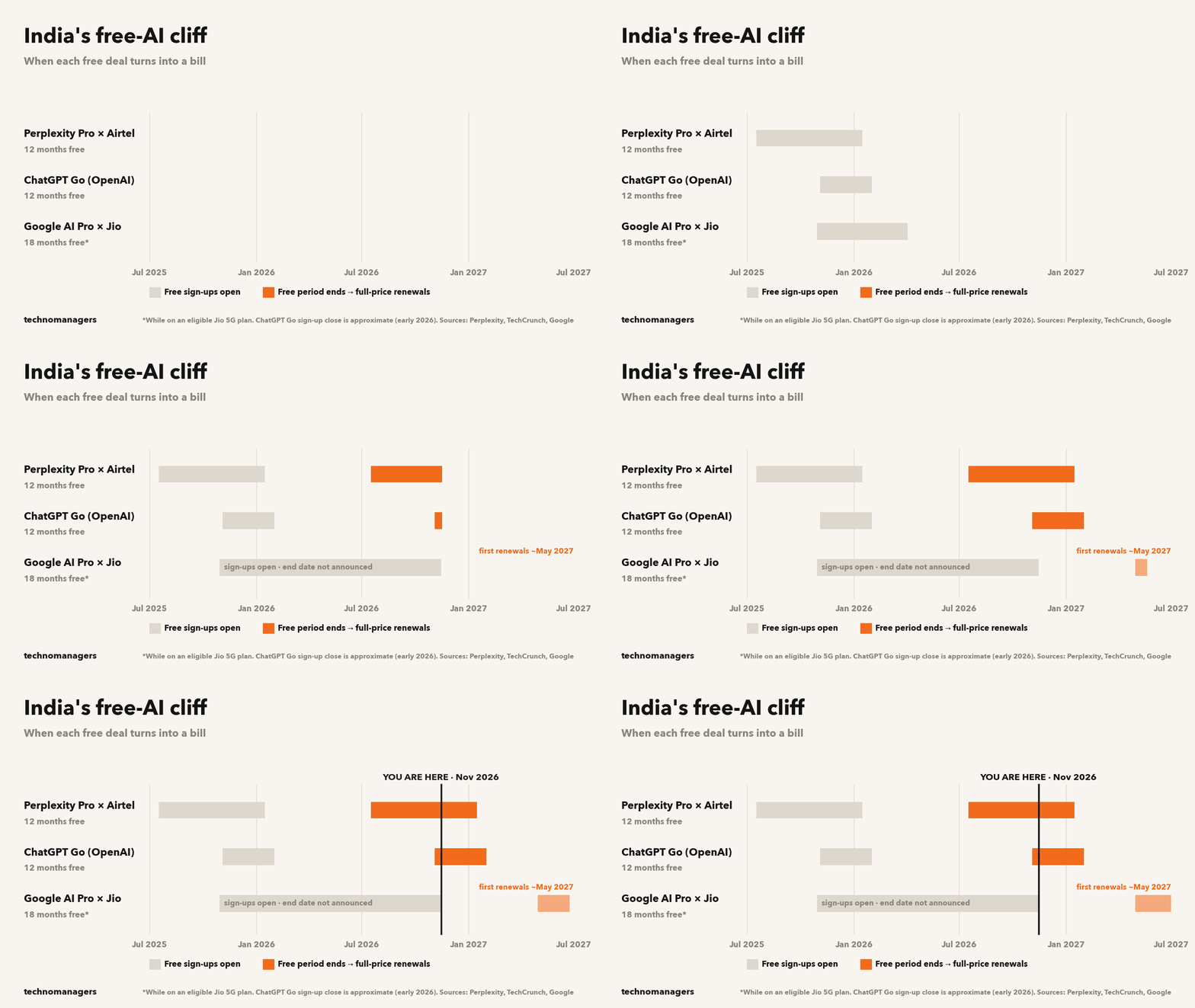
Each person got 12 months from the day they claimed it. So between now and early 2027, every one of those users hits the same moment.
The free year ends. ChatGPT Go costs ₹399 a month.
OpenAI is not the only one running this test:
Perplexity × Airtel: Perplexity Pro free for 12 months for Airtel customers. First renewals started July 2026.
OpenAI: ChatGPT Go free for 12 months. Renewals run November 2026 to early 2027.
Google × Jio: Google AI Pro free for 18 months, if you keep an eligible Jio 5G plan. First renewals around May 2027.
Before I tell you what I think happens next, I want your gut answer.
2. Two studies. Two very different answers.
Study 1: Harvard Business School, October 2026. Four economists looked at real card payments from 174 million US consumers. Answer: 2.9% of US consumers pay for at least one of the big four AI services.
Study 2: Menlo Ventures, September 2026. A survey of 5,067 US adults. Answer: 55% of AI users say they pay for at least one AI product.
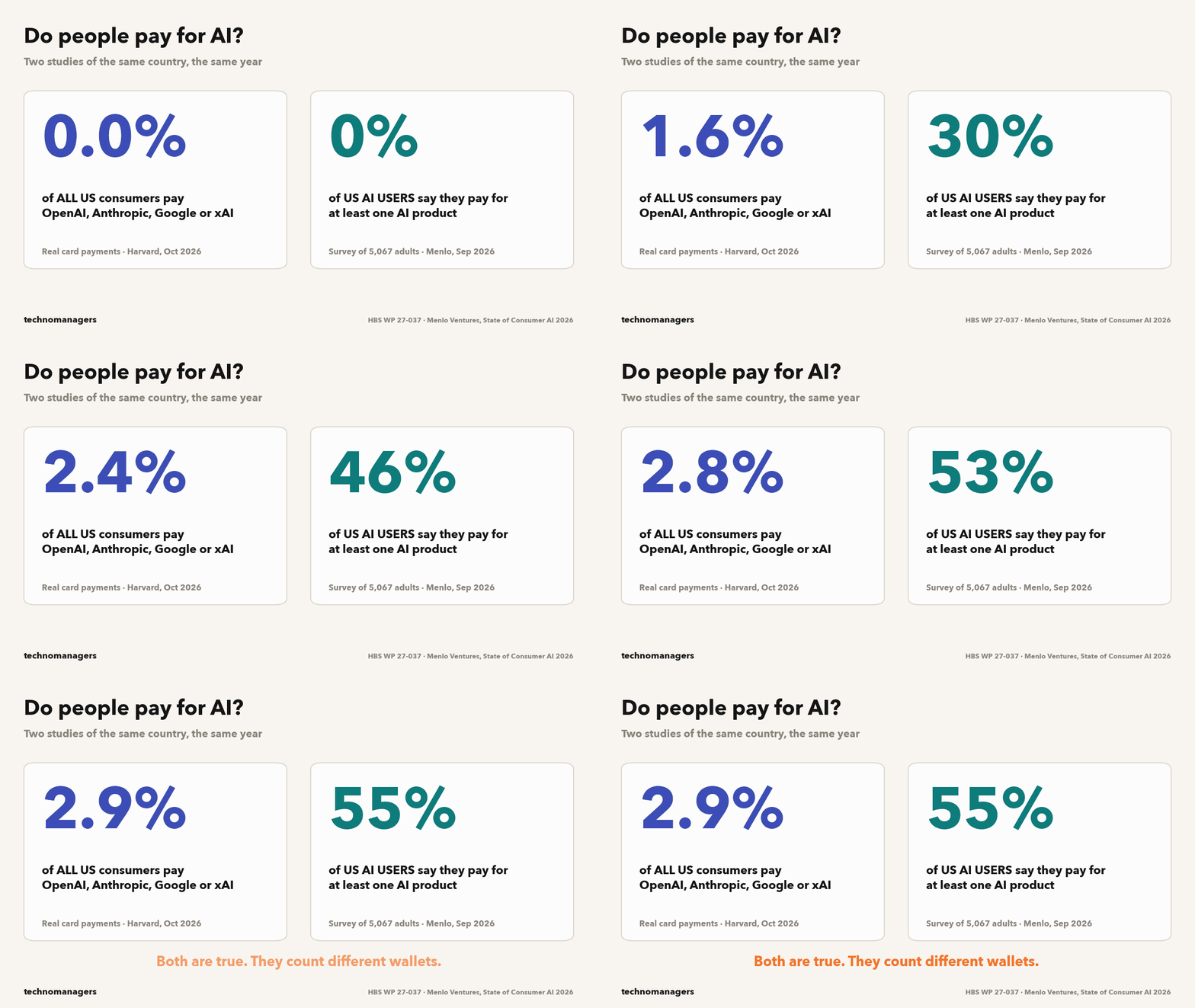
Same country. Same year. So one of them must be wrong?
No. They count different things.
Method: Harvard used real card payments. Menlo used people’s own survey answers.
Out of: Harvard counts all consumers. Menlo counts only people who use AI (64% of US adults).
What counts: Harvard counts direct payments to OpenAI, Anthropic, Google or xAI. Menlo counts any AI product.
Paid by your company? Harvard leaves it out on purpose. Menlo includes it, and even reports those users’ spending separately.
There’s one more blind spot. Harvard finds AI payments by the merchant name on card statements. If you subscribe through Apple’s App Store, your statement says Apple, not OpenAI. The paper doesn’t say how it handles those.
So 2.9% may miss people who pay through app stores. It’s not the full picture.
The lesson: “Do people pay for AI?” is the wrong question. The right one is: whose wallet?
3. What Harvard actually found (the parts nobody is posting)
Most posts stopped at 2.9%. The paper has better numbers.
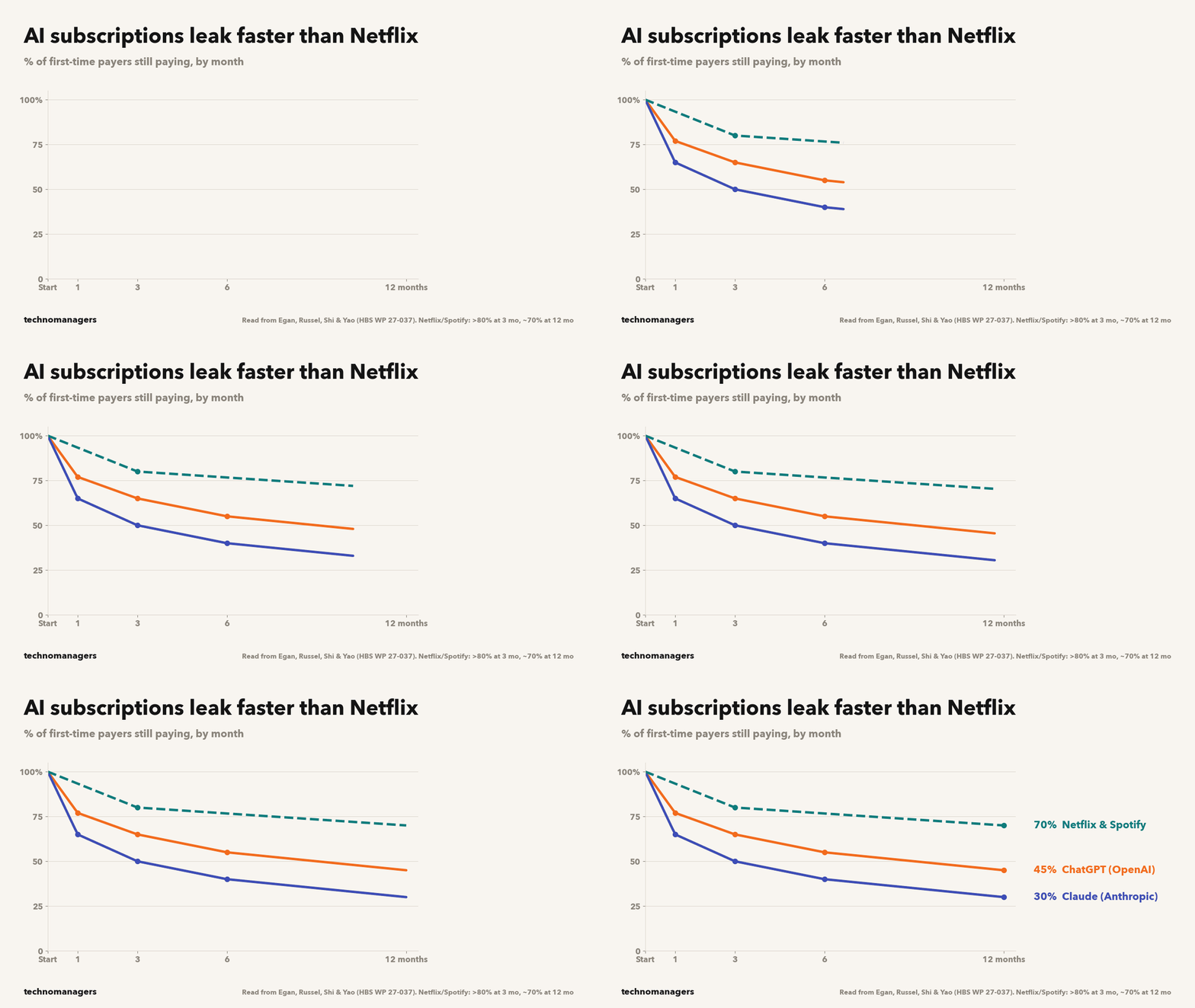
1. AI subscriptions leak. After 12 months, about 45% of first-time ChatGPT payers are still paying. For Claude, about 30%. In the same data, Netflix and Spotify keep about 70%.
2. People are loyal to AI, not to a brand. The paper measures how closely people’s liking for ChatGPT tracks their liking for Claude. The answer is 0.89, on a scale where 1.0 means perfectly in sync. In plain English: the same people want both, and they’ll swap one for the other.
3. Every model launch is a switching event. When OpenAI or Anthropic releases a better model, the share of the rival’s paying users who start paying for it jumps by about 25%.
4. Customers are very price-sensitive. Raise the price by 10% and you lose about 46% of demand.
5. Fewer people pay for two. In June 2024, about 45% of people paying Anthropic also paid OpenAI. By April 2026, it was under 30%.
The Technomanagers take: in the consumer market, the model is a feature, not a moat. If users can leave the week a rival ships a better model, you don’t have customers. You have tenants.
One more detail from the paper. It cites estimates that consumer subscriptions were about 75% of OpenAI’s revenue in 2024 and about 60% at the start of 2026. The most consumer-facing AI company in the world is already getting more of its money from businesses.
4. India: 20% of the downloads. 1% of the money.
Here’s the India problem in one line.
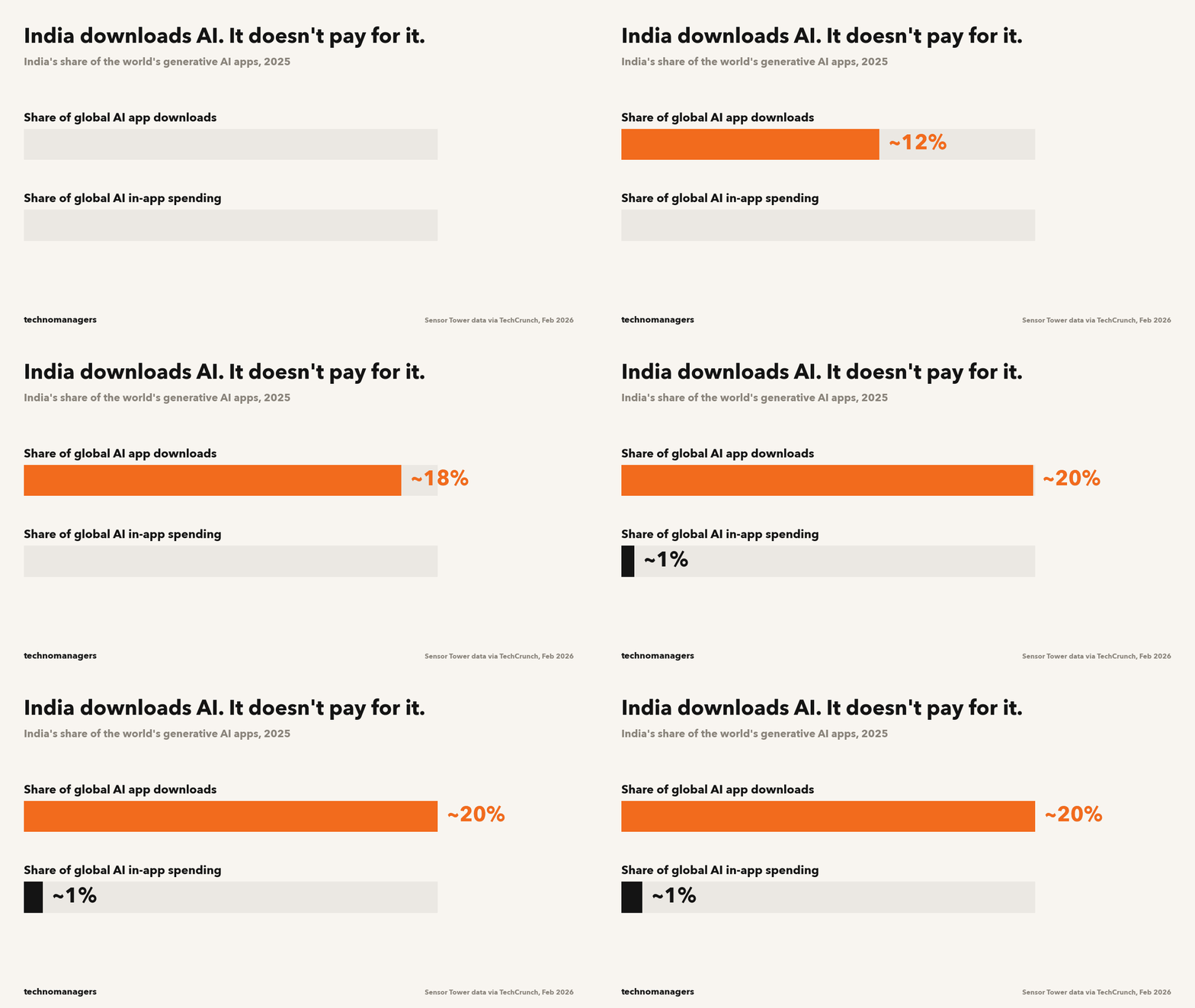
In 2025, India became the world’s biggest market for AI app downloads: about 20% of all downloads worldwide. It brought in about 1% of the in-app spending (Sensor Tower, via TechCrunch).
Across all apps, India makes about $0.03 per download. In Southeast Asia and Latin America, it’s more than $0.20.
So why give premium AI away in the world’s lowest-paying app market?
Because users are the asset. OpenAI says India has more than 100 million weekly ChatGPT users. The Harvard paper even models this logic: more users today can mean better models tomorrow, which gives companies a reason to keep prices low now.
The free year was never charity. It was a bet on growth. Now the bill comes due.
5. We already have the first result: Perplexity
Perplexity’s Airtel deal opened in July 2025. The first free years ran out in July 2026. TechCrunch, using Sensor Tower data, reported what happened next:
56 million India downloads while the offer was open, more than 9× the seven months before.
Downloads then fell more than 90% (Feb to Jul 2026 vs the six months before).
Monthly users: about 14 million in July 2026, down from a peak of 22 million, but still more than 5× the 2.6 million from before the deal.
Revenue in India: up about 60%.
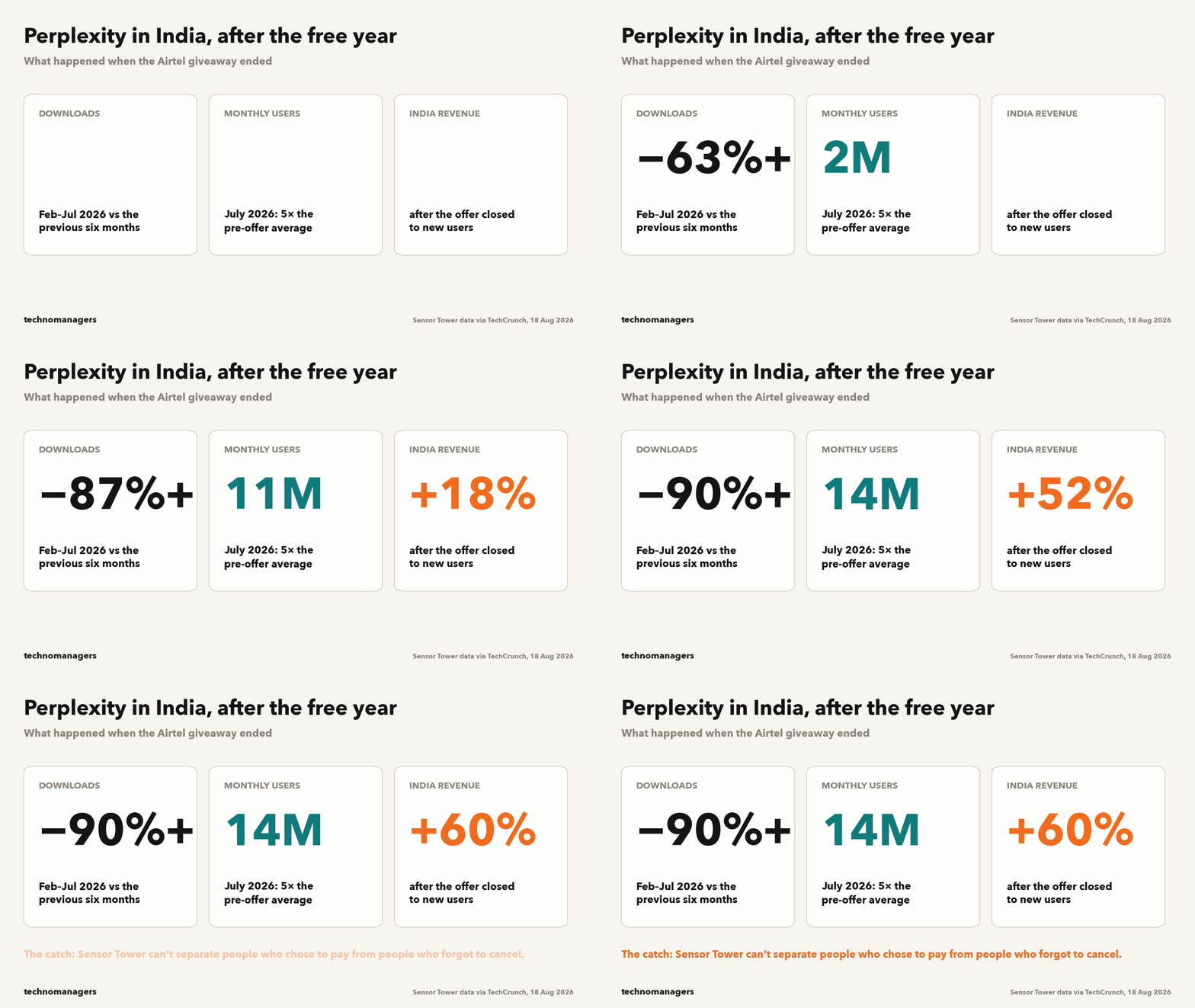
The catch: Sensor Tower itself says it cannot separate people who chose to pay from people who forgot to cancel auto-renew.
So two things are true at once:
The free year bought Perplexity a user base 5× bigger than before.
It has not yet proven that Indians will pay for AI.
6. The Four Wallets of AI
So who actually pays for consumer AI? I see four wallets.
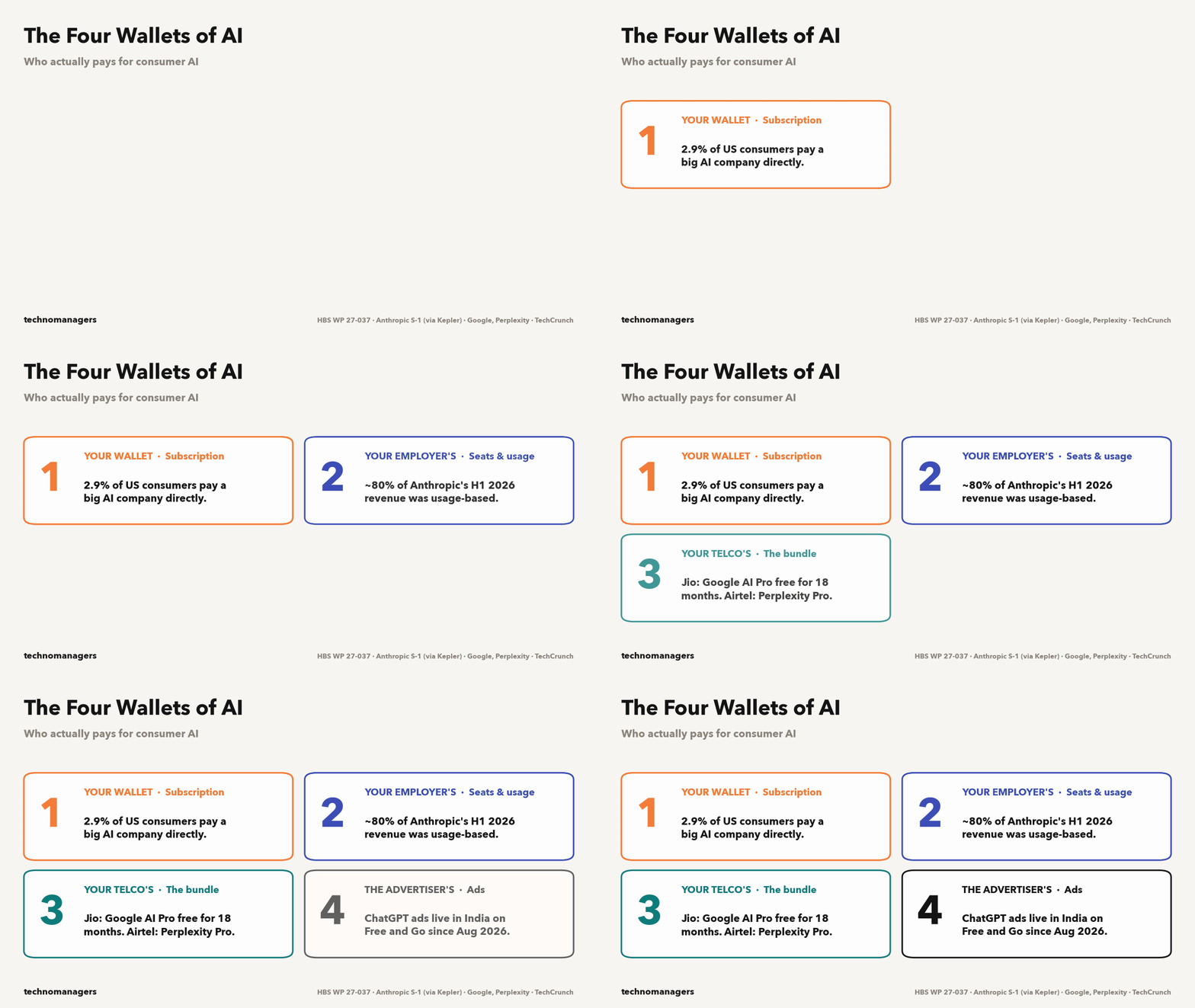
Wallet 1: Yours (the subscription) ₹399 a month. Harvard says only 2.9% of US consumers do this, and most stop within a year.
Wallet 2: Your employer’s (seats and usage) This is where the money already is. Anthropic’s S-1 filing shows about 80% of its revenue in the first half of 2026 came from usage-based billing (paying per token). Subscriptions made up about 20%, and that 20% includes Team and Enterprise plans.
Wallet 3: Your telco’s or phone maker’s (the bundle) Jio’s Google AI Pro stays free only while you keep an eligible Jio 5G plan. Airtel gave away Perplexity Pro. You pay for AI the way you paid for data: inside a recharge.
Wallet 4: The advertiser’s (ads) On 27 August 2026, OpenAI said it would start showing ads in India on the Free and Go plans, beginning with 50 brands. The US got ads in February, Europe in August.
Here’s the detail I keep coming back to.
Ads in India run on Go, the ₹399 paid plan, not just the free one.
A company that believed ₹399 alone would pay the bills wouldn’t put ads on a paid plan. My read: OpenAI is hedging. It’s using two wallets at once.
7. Now let me argue against myself
A take you can’t argue with isn’t analysis. So here are the five strongest pushbacks I could find.
Skeptic: You’re underestimating Indians. Jio gave everything away free in 2016, and people still paid.
Me: True. Jio launched free in September 2016. By 31 March 2017, Jio said 72 million customers had signed up for its ₹99 Prime membership, out of 108.9 million users. That’s real. But look at what they paid for: mobile data, something you can’t live without, sold as a bundle. Jio doesn’t disprove the Four Wallets. It’s Wallet 3 at work. (And Jio extended free benefits for Prime members, so it wasn’t a clean test anyway.)
Skeptic: Perplexity’s revenue went up 60% after the free year. Conversion works.
Me: Maybe. But Sensor Tower can’t tell a choice from a forgotten auto-renew. One payment proves nothing. A user who pays twice chose to pay. Ask me again after the second renewal.
Skeptic: Menlo says 55% of AI users pay. Your story is dead.
Me: I never said nobody pays. I said people pay through different wallets. Menlo also found that when an employer or school pays, users spend about $40 more a month. That’s Wallet 2 showing up in a consumer survey.
Skeptic: Prices will fall. At ₹99, everyone pays.
Me: Cheaper helps. Harvard shows demand is very price-sensitive. But that same finding cuts both ways: if a 10% price rise loses about 46% of demand, nobody can raise prices later. A cheap AI subscription is a business with almost no pricing power. That’s exactly why ads and bundles look so attractive.
Skeptic: All of this is US data. India is different.
Me: Fair. But India is probably more price-sensitive, not less: 20% of downloads, 1% of revenue. If anything, the US numbers are the optimistic case.
Where I could genuinely be wrong: if AI becomes something people can’t work without, like UPI or WhatsApp, people will pay directly. Some already do, mostly for coding and work. The question is whether that group grows past the people AI already makes money for.
8. The Call
Technomanagers Call #1
By December 2027, more Indians will get premium AI through someone else’s wallet (a telco, a phone maker, an employer or advertisers) than will pay for it with their own money.
How we’ll know we were wrong:
OpenAI, Google or Perplexity say most of their Indian free-year users were still paying 3 months after renewal.
Jio and Airtel stop bundling AI into their plans when the current deals end.
OpenAI removes ads from Go in India.
We’ll grade this Call in public in June 2027. Subscribe and you’ll get the scorecard.
9. What to do on Monday
If you’re a PM building AI features
Track month-3 retention, not sign-ups. In Harvard’s data, nearly 1 in 4 first-time ChatGPT payers is gone after one month.
Build stickiness your model can’t give you: memory, saved work, workflows, team integrations. A better model gets matched within one launch cycle.
In India, put AI inside something people already pay for. Don’t add a new ₹ line item.
If you’re a founder
Your distribution partner may matter more than your model. One telco deal left Perplexity with 5× more monthly users in India than before.
Plan for the end of the free year before you start it. What retention in month 13 makes the giveaway worth it?
If you’re a marketer
ChatGPT ads are live in India on Free and Go. The self-serve ads manager has a minimum budget of ₹725 a day. That’s a cheap experiment.
If you’re thinking about your career
Learn to build with AI, not just use it. People pay for AI that makes them money or saves them hours. Companies pay for people who can build that.
Build AI products people keep paying for
Everything in this piece comes down to one skill: building AI products people keep paying for. That means retention, pricing, distribution and stickiness. It’s not about who has the best model this month.
That’s exactly what the AI Product Builder Cohort is built around. It’s a 12-week weekend program with live sessions, a mentor-reviewed capstone, mock interviews and a demo day.
Not ready for a cohort? Start free: practise real AI PM interview questions with sample answers.
If this changed how you think about AI, forward it to one PM or founder who’s planning a “free for a year” launch. They’ll thank you in month 13.
Sources
Egan, Russel, Shi & Yao, Competition in Generative AI: Evidence from Consumer Demand, HBS Working Paper 27-037 / NBER w35953, Oct 2026. Paper · HBS summary
Menlo Ventures, 2026: The State of Consumer AI, Sep 2026. Link
TechCrunch, OpenAI offers free ChatGPT Go for one year to all users in India, Oct 2025. Link
TechCrunch, India’s AI boom pushes firms to trade near-term revenue for users (Sensor Tower data), Feb 2026. Link
TechCrunch, India’s app market is booming, but global platforms are capturing most of the gains (Sensor Tower data), Apr 2026. Link
TechCrunch, Perplexity’s free AI offer left it with millions more users in India (Sensor Tower data), Aug 2026. Link
Perplexity Help Center, Perplexity Pro Airtel Promo. Link
TechCrunch, OpenAI to start showing ads on ChatGPT’s Free and Go tiers in India, Aug 2026. Link
Google India Blog, Partnering with Reliance to bring the best of Google AI to more people across India, Oct 2025. Link
Anthropic S-1 revenue mix, as summarised by Kepler and Postdigitalist.
Business Standard, Jio garners 72 million Prime users, Mar 2017. Link
Jio’s 108.9 million subscribers on 31 Mar 2017, from Reliance Industries’ Q4 FY17 filing, via Behindwoods and Gizbot.
Pretty Neat!
Wallet 2 matches what software companies report on pricing. ICONIQ's July 2026 State of AI found consumption-based pricing rose from 35% to 42% in six months (https://www.iconiq.com/growth/reports/state-of-ai-2026). If employers end up paying per use, does the ₹399 plan become mostly a trial for the work account?