


Before latching onto Uber’s AI Strategy, you can read the following Articles
AI Product Metrics ( AI PM Interview Question )
Everyone talks about Artificial Intelligence these days.
But very few companies are using it to change their core business model.
Uber is one of them. To understand what Uber is doing, we first need to look at their main goal or their Northstar Metric
Uber’s NorthStar Metric
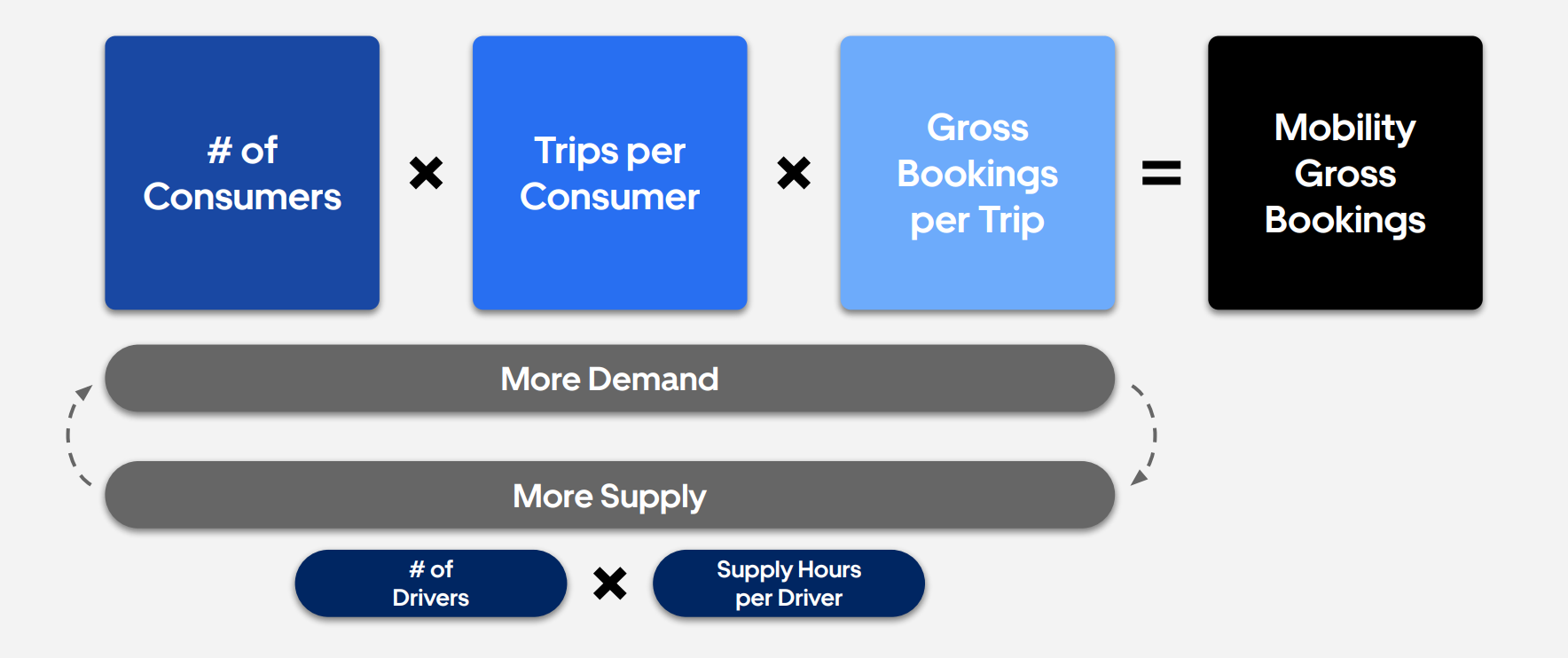
Uber says their growth comes from three things multiplied together.
Number of Consumers
Trips per Consumer
Gross Bookings per Trip.
This equals their Mobility Gross Bookings.
This means if Uber wants to grow they have three options. First they can get more people to download the app. Second they can get existing users to book more rides. Third they can make each ride more expensive.
But there is a problem. If you increase the price people will take fewer rides.
So the best way to grow is to reduce the price so that more people take more trips. This is where their AI strategy enters the picture.
How AI Changes the Equation
Right now, the supply side of Uber is limited by human drivers.
In the current model the supply is calculated by Number of Drivers X Supply Hours per Driver.
Humans limits the supply. When supply is low the price goes up and waiting time increases.
Uber is using AI to add a third variable to this supply equation.
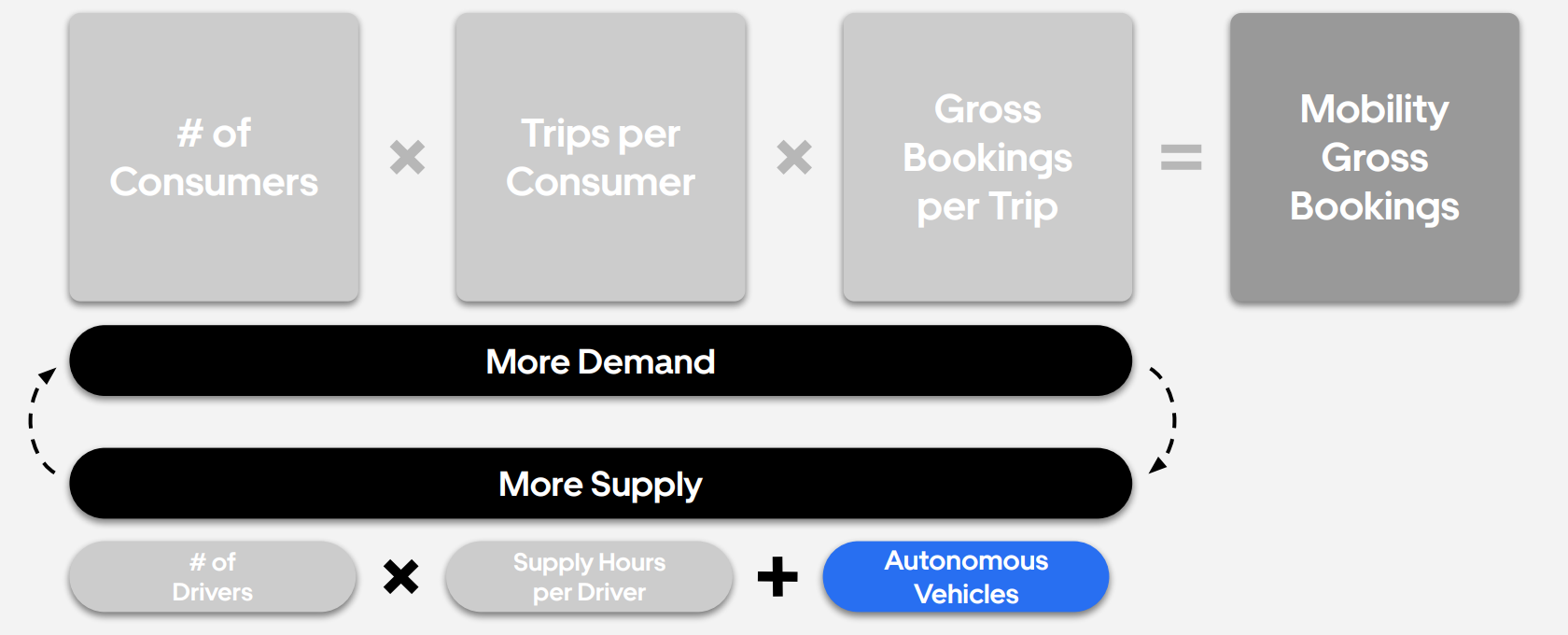
The new formula becomes Human Drivers + Autonomous Vehicles.
Autonomous Vehicles or AVs are the self-driving cars. This solves the biggest constraint in the Uber marketplace.
The New Marketplace and Booking Journey
So how will this look for you when you open the app?
Uber calls this a Hybrid Marketplace.
This means humans and robots will work together.
Imagine you are in Bangalore and you want to go to a restaurant. You open the Uber app just like you do today. You enter your destination.
Behind the scenes the Uber AI gets to work. It checks the route. It asks a simple question. Is this trip easy enough for a robot?
Some routes are too complex. Maybe there is heavy construction or the destination is inside a difficult complex. If the route is hard the AI assigns a human driver.
But if the route is standard the app might show you a new option. It will say a self driving car is close to you. It might be a car from Nuro or a Lucid electric vehicle. You can say yes to the robot or you can choose to wait for a human.
This ensures reliability. The biggest problem with robot taxis right now is that they cannot go everywhere. By mixing humans and robots Uber ensures you never get stuck.
Beyond Just Driving
Uber is not just using AI for cars, rather every part of the business.
It starts with customer service. If you have a complaint about a late food delivery an AI reviews the facts first. It checks the GPS data and the time logs. It then suggests a solution to the human agent. This makes support faster.
Then there is the pricing. AI predicts exactly how much a ride should cost based on demand and traffic.
It matches you with the right driver who is most likely to accept your trip.
What can be some of the challenges?
This journey is not going to be easy. There are some very real problems Uber has to solve.
For example, if a passenger makes a mess in a robot car as there is no driver to see it. The next passenger will get into a dirty car.
Uber has to become a fleet manager. They need a system to clean, repair, and charge these robots.
The second challenge is trust. Even though robots might statistically be safer than humans people get very angry when a robot makes a mistake.
A human driver might get distracted or tired but we are used to human errors. We are not used to computer errors in the real world.
What can be the Long Term Vision?
Uber does not want to manufacture cars. They want to be the platform.
They want to be the Operating System of your daily life.
Their competition is not the bus or the metro. Their competition is your personal car.
The vision is simple. If Uber can make rides cheap enough using AI robots you will not need to buy a car. You will not need to pay for insurance or parking.
In the future you might even buy a self driving car and let it work for Uber while you sleep. Your car could earn money for you instead of sitting in the garage.
This is the big picture. Uber is using AI to lower the cost per mile. Lower cost means more consumers. More consumers means more trips. And that brings us back to the North Star Metric. The math remains the same but the engine driving it is changing from human to hybrid.
More Resources
AI PM Course ( + AI PM Interview Questions ) - Highest Rated Course — 4.8 / 5 ( 500+ Enrollment in last 2 months) - Questions including AI Product Sense, AI Metrics, and the Reliability of AI Products ( Deterministic and Probabilistic Evals, AI Pricing, AI Strategy, ( 25 AI Casestudies) and AI/ML Algorithms and usecases
What is the meaning of gross bookings per trip ?
This breakdown is insightful