

Okay, let me start with a phone that got blocked in under a week.
In early December 2025, ZTE started selling the Nubia M153 in China with ByteDance's Doubao assistant built into it. You could just tell it to order your usual coffee, and it would open the app, tap through the menu and pay. The first batch of 30,000 units sold out on launch day.
Within days, WeChat started logging people out for an abnormal login environment. Taobao and Alipay restricted the phone. Some banking apps did the same. ByteDance switched off Doubao's ability to operate WeChat, and only then did the accounts come back.
Nobody said the technology didn't work. The fight was about something else.
An agentic phone isn't a better phone. It's a fight over who gets to press the buttons.
Now, most of what you read about agentic phones is about one thing: AI that orders food for you. Honestly, I think that's the smallest part of the story.
So if you want to understand the future of smartphones, start here: a phone is not a shopping device. It's the one object you carry everywhere that can hear, see, remember, pay and speak for you. When a phone gets an agent inside it, all of that changes. Your calls change. Your camera changes. What your phone remembers about you changes. Even what counts as proof that you're you changes.
So here's how I'll do this. I'll walk you through one ordinary day in 2029, hour by hour. It's imagined, and I'll label it that way. After each scene, we come back to 2026 and look at what's already real. Then we'll talk about what the phone itself will look like, how the mobile ad economy changes, what these new AI phones like Blue and Cyclon actually are, whether Apple is in trouble, which industries get hurt, and my calls with odds.
It's a long one. Grab your chai.
First, what is a phone actually for? The six jobs of a smartphone
Strip away the glass and the chip and ask a simple question: why do you pick up your phone?
When I broke it down, I kept landing on six jobs.
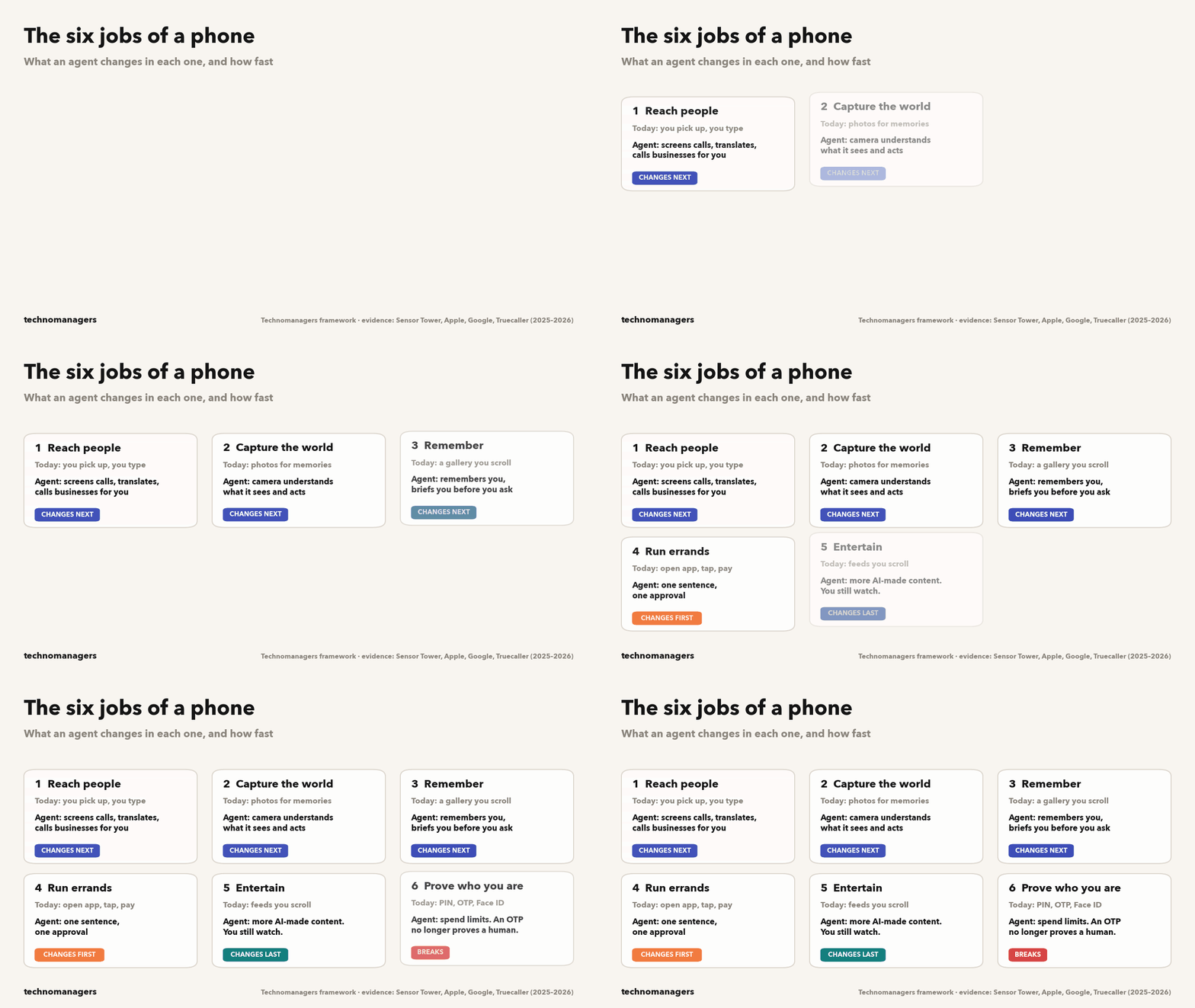
Reach people. Calls, messages, video.
Capture the world. Camera, mic, sensors.
Remember. Photos, chats, notes, your whole history.
Run errands. Food, cabs, bills, tickets, banking.
Entertain. Feeds, videos, games, music.
Prove who you are. Face ID, UPI PIN, OTPs, your digital ID.
Today, you do the work for all six. You tap, scroll, type, compare, copy the OTP from one app and paste it into another. Last year, the average person used 34 different apps a month, about 10 a day, and spent 3.6 hours a day inside them (Sensor Tower).
An agentic phone is simply a phone that can do three things on its own:
See what's on your screen and around you.
Remember you, your people, your habits, your preferences.
Act for you. Tap through apps, make calls, fill forms, pay.
Put those three together and every one of the six jobs shifts. Not at the same speed, though. That's the part most people miss.
Errands change first, because there's money in it, and companies push hardest where there's money.
Calls, camera and memory change next, and honestly, these will change your daily life more than shopping ever will.
Entertainment changes last, and the least, because nobody wants an agent to watch a reel for them.
Identity is the one that breaks, because every proof we use today assumes a human is holding the phone.
The tap was the unit of the old phone. The sentence is the unit of the new one. Whoever hears your sentence first decides where your attention, your data and your money go.
Keep that line in your head. Everything else follows from it.
6:50 am · The briefing: an AI phone that remembers you
2029, imagined. My alarm goes off. Before I've even found my glasses, the phone says: Morning, Shailesh. Three things need you today. The rest can wait. There were 214 messages overnight. It shows me three: my manager moved the review to 11, Dad's blood pressure reading from his watch was high again, and the electricity bill is due Friday. It has already lined up the payment for my approval.
This is job number three, memory. And I think it's the most underrated part of this whole shift.
Here's what's already real in 2026:
Google's Pixel 11, which launched in August 2026, uses Gemini to pull information from across your apps and put it in front of you before you ask. It started in 2025 as a feature called Magic Cue.
Apple's new Siri, called Siri AI, can search across your messages, emails and photos using what Apple calls personal context.
At its September 2026 event, Apple announced Audio Intelligence for Apple Watch. It records conversations, lets you rewind the last 15 seconds, and summarises them through Siri. It's coming as a beta later this year.
Blue, one of the new AI phones I'll get to later, sells itself on remembering people, places and preferences, so you can say tell my family when I'll be home, and it just knows who and how.
Now think about what this does to competition.
In the app era, switching from iPhone to Android was annoying because you had to reinstall your apps and move your photos. In the agent era, switching means your assistant forgets you. Years of context about your family, your work, your habits, gone.
In the app era, switching phones meant reinstalling apps. In the agent era, switching means your phone forgets who you are.
That's the new lock-in. Not apps. Memory. Whoever holds your memory holds you. It's why Apple, Google and OpenAI are all racing to remember more about you, and it matters a lot for the Apple question later.
The flip side is obvious. A phone that remembers everything is the most intimate database ever built. We've already seen how people react. When Microsoft launched Recall on Windows, a feature that screenshots your activity so you can search it later, the backlash was so strong that Microsoft made it opt-in. And a 2026 report found it was still capturing sensitive data like card numbers despite the filters.
So yes, memory is the killer feature. It's also the feature that will decide whether people trust these phones at all.
8:15 am · The call I didn't take: AI call screening, voice clones and live translation
2029, imagined. An unknown number calls. I don't pick up. My phone does. It asks who's calling and why. It's a courier who can't find my building. The agent sends him a pin and tells me in one line. Ten minutes later, another call. It's my father's voice, panicking, asking me to send ₹40,000 right now. My phone flags it before I even answer: not Dad's number, and the voice doesn't match his recent calls. I call Dad. He's having breakfast.
Calling is job number one, and it's going to change more than shopping. Let me explain why.
First, the spam problem is huge. Indians received over 4,168 crore spam calls in 2025, according to Truecaller. That's roughly 11 crore spam calls every single day. The phone call is already broken for most people. We don't pick up unknown numbers anymore.
Second, AI is starting to answer for us. Google's Gemini can now call businesses on your behalf. With the Pixel 11, it books tables and appointments, waits on hold and lets you read the transcript afterwards. It tells the other side it's an AI, and businesses can opt out. Google also runs scam detection during calls using Gemini Nano, the small version of its model that runs on the phone itself, so the call audio doesn't leave the device.
Third, language stops being a barrier. Apple's iOS 26 translates phone calls live, on the device. Samsung's Galaxy AI has done it for a while. Right now these support a handful of languages, mostly European. But think about what happens in India when this works well for Tamil, Bengali, Marathi and Hindi. A shop owner in Coimbatore can take orders from a customer in Lucknow without either of them switching language. That's a much bigger economic deal than most people realise.
And fourth, the scary part. Voice is no longer proof of a person. In October 2026, a 69-year-old man in Mumbai lost ₹50 lakh after a call from a cloned voice of a relative. In January, a play school owner in Indore lost ₹97,500 to a cloned voice. These aren't rare stories anymore.
Now put these four together and something interesting comes out.
The phone call was dying. We moved to texting. But agents bring voice back, because talking is the easiest way to tell a machine what you want. At the exact same moment, voice stops being proof that a human is on the other end.
Voice is becoming the main way we talk to machines at the exact moment it stops proving there's a human on the line.
So what will calling look like? My guess:
Two lanes. People you know come straight through. Everyone else talks to your agent first. Calls get filtered by default, the way email is today.
When both sides are agents, a phone call is just an API with an accent. If millions of people send AI callers, every business needs an AI to answer. Call centres and front desks will change faster than almost any other job.
A family password comes back. Seriously. Expect banks and families to go back to old-school verification: a code word, a callback on a known number. Technology broke voice as proof, and the fix will be partly human.
9:40 am · The camera that does things: AI cameras and smart glasses
2029, imagined. The washing machine shows an error code. I point my phone at it. It reads the code, figures out the model, tells me it's a drain blockage I can fix in five minutes, and shows me how. When I say this is not my job, it books a technician for 4 pm and adds it to my calendar.
Job number two, capture. The camera is quietly changing its job.
For 20 years, the phone camera was for making memories. Now it's turning into an input. Point it at something and the phone understands it and does something about it. The camera is becoming your second keyboard.
What's real in 2026:
On iPhone, Visual Intelligence lets you point the camera, or use whatever is on your screen, and search it or act on it, like adding an event straight to your calendar.
Gemini Live lets you share your camera and talk about what you're looking at in real time. It's free on Android and iPhone.
The Pixel 11 puts Circle to Search right inside the camera, and Gemini can translate sign language into text. That last one is a big deal for accessibility, and I wish more people talked about it.
Two deeper shifts are happening here.
Shift 1: the camera is leaving the phone. If the camera is an eye for your agent, the best place for that eye isn't your pocket. It's your face. AI glasses shipments grew 263% in the first half of 2026, according to Counterpoint, and 96% of them had no display at all. They're basically a camera, mics and speakers connected to an AI. EssilorLuxottica said it sold over 7 million Ray-Ban Meta and Oakley Meta glasses in 2025.
Even the phone camera is getting physical. Honor launched its Robot Phone in China in August 2026, at around 9,999 yuan. Its 200MP camera sits on a small gimbal arm that pops out of the body and moves on its own, so it can follow you during a video call.
Shift 2: photos stop being proof. Pixel's Magic Capture builds a still photo by picking the best frames from hundreds captured in a video. AI editing can add or remove almost anything. So when you see a photo, can you trust it?
Apple clearly thinks this is a problem. At its September 2026 event, it announced Apple Reference Image, which lets you verify that a photo was taken by an iPhone camera rather than generated by AI.
The camera used to record what happened. Now it understands what it sees and acts on it. Soon it will also have to prove that what it captured was real.
My prediction: verified capture becomes as normal as the little lock icon next to a website address. A photo without a verified stamp will be treated like a forwarded WhatsApp message. Interesting, maybe true, but you'd want to check.
1:30 pm · The message my friend didn't believe: how AI changes the way we talk
2029, imagined. I send a close friend a long birthday message and a lovely photo from our trip last weekend. The reply: Nice. Did you write that, or did your phone? And is that photo even real?
Here the evidence is thinner, so this section is mostly my judgement. But I'm fairly confident about three things in how people will talk to each other.
An authenticity tax. When any message can be written by AI, a polished message is worth less. Typos, voice notes and inside jokes become proof that a human was there. Funny, right? Imperfection becomes valuable.
Agents handle the logistics. Finding a dinner time for six people is a coordination problem, and agents are great at coordination. My agent will talk to your agent. The chat stays human; the scheduling doesn't.
The group chat survives. WhatsApp is somewhere you go to be with people, not a chore to finish. An agent can summarise 200 unread messages. It can't be your friend in them.
Simple rule: agents take over the messages that are about getting something done. They leave alone the messages that are about being with someone.
7:40 pm · The order: will AI agents replace apps?
2029, imagined. I'm on the metro home. I hold the side button and say: dinner for two, under ₹800, something light, here by 9. I don't open any app. My phone checks two delivery apps, skips the restaurant I rated badly in March, and comes back with one option.
Okay, now the errands. This is where the money is, so this is where the fight is.
For this scene to happen, the agent has to get inside the apps. Today there are exactly three ways in. I call them Hand, Key and House.
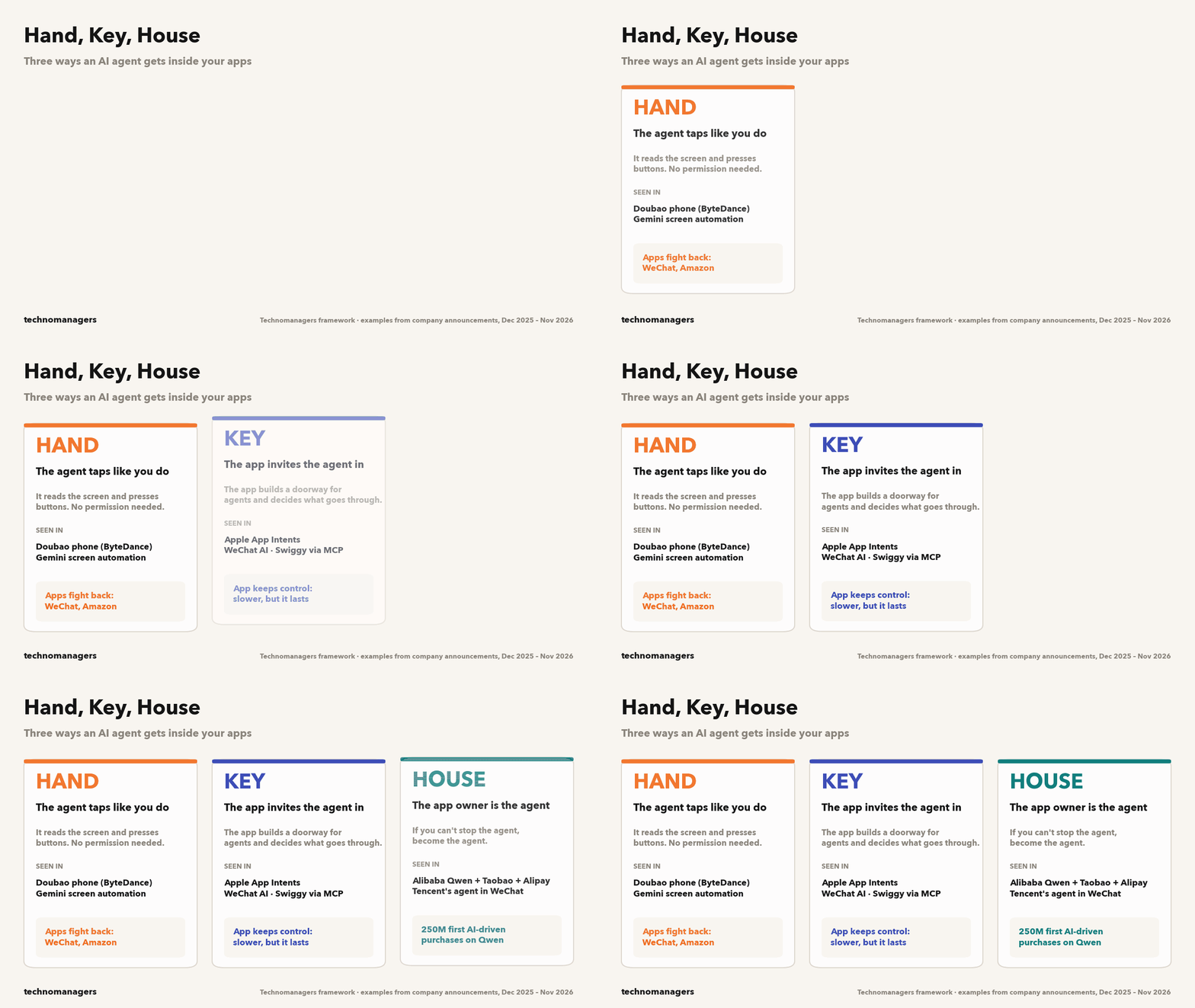
The Hand: the agent taps like you do.
It reads the screen and presses buttons, pretending to be your finger. It doesn't need the app's permission. That's how the Doubao phone worked, and as you'll see later, it's also how Blue and Cyclon work. (I wrote about why some companies welcome agents and others shut them out in Why Is Amazon Turning Away Customers Who Are Ready to Buy?)
Google's version is more polite. Since March 2026, Gemini on the Galaxy S26 has been able to order from apps like Uber, Lyft, DoorDash and Starbucks. It runs the app in a virtual window and asks you before placing the order. With the Pixel 11, it handles groceries, rides and coffee in the US, and you can take over at any point.
The Hand works on day one. Its weakness is that apps hate it, because it skips their ads, their upsells and their data. So they fight back.
In China, that was WeChat. In the US, it was Amazon. Amazon sued Perplexity over its Comet shopping agent and won a preliminary injunction in March 2026. On 4 August 2026, the Ninth Circuit threw that injunction out. Its reasoning was simple: when you tell an agent to shop for you, it's you accessing Amazon, not the AI company. The main lawsuit still goes on.
The Key: the app invites the agent in.
The app builds a proper doorway for agents and decides what goes through it.
Apple's App Intents works like this. Siri AI can act inside third-party apps only when developers build for it, and Apple says it already works with over 300,000 apps. WeChat's own AI assistant, in beta since June 2026, can only use mini-programs that opt in. And Swiggy opened Food, Instamart and Dineout to ChatGPT, Claude and Gemini in January 2026 using MCP, which is basically a standard plug that lets AI assistants talk to outside services.
The Key is slower, because every app has to say yes. But the app stays in control, so this is the version that lasts.
The House: the app owner becomes the agent.
If you can't stop the agent, become the agent.
In January 2026, Alibaba connected its Qwen app to Taobao, Tmall, Amap, Fliggy and Alipay. By August, Alibaba told investors that 250 million users had made their first AI-driven purchase through Qwen. Tencent is building its own agent inside WeChat for the same reason.
Now look at what happened to the open alternative.
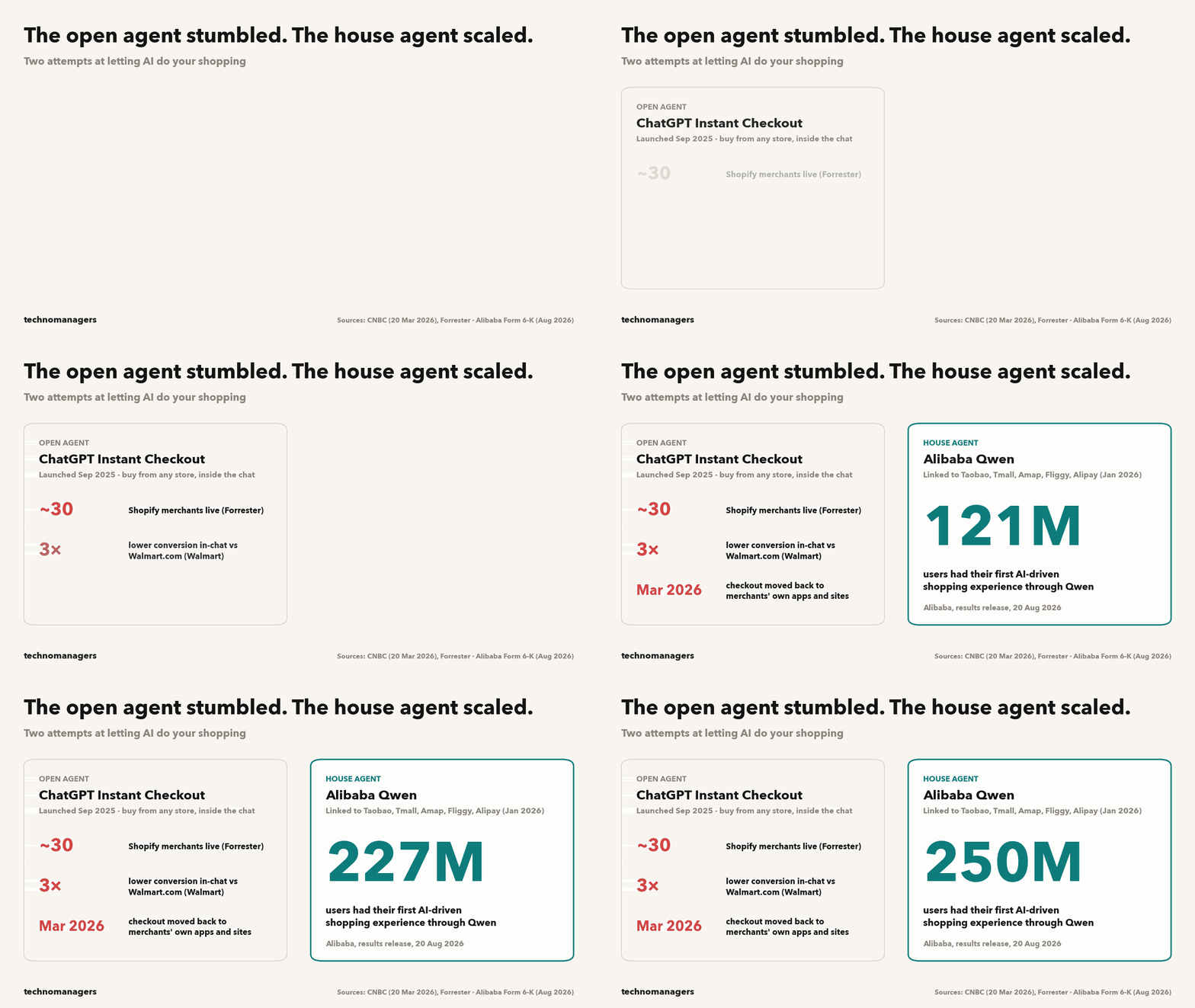
In September 2025, OpenAI launched Instant Checkout inside ChatGPT. It was the clearest attempt at a neutral agent that could buy from anyone. By March 2026, OpenAI was moving checkout back to merchants' own apps and websites. Forrester counted only about 30 Shopify merchants live. And Walmart found that products sold directly inside ChatGPT converted three times worse than products that sent shoppers to Walmart's own site (CNBC).
The neutral butler stumbled. The empire's own agent got 250 million people to try it.
My read: the first wave of agentic phones won't be one open butler that shops anywhere. It'll be a map of borders. China is going House. America is fighting over the Hand in court. India has a third option, which I'll come to.
If you can't stop the agent, become the agent.
7:41 pm · The approval: AI payments, UPI and the end of the OTP
2029, imagined. One card shows up on my lock screen. Paneer bowl and soup, ₹740, arriving 8:52. Pay from UPI Reserve? I tap Approve. That's the only tap of the whole order.
This is job number six, proving who you are, and it's where things quietly break.
The phone stops being a remote control and becomes an inbox of approvals. You stop operating and start signing off, which is what a manager does all day.
India has already built rails for exactly this card. In October 2025, NPCI, Razorpay and OpenAI started a pilot for UPI payments inside ChatGPT. It uses UPI Reserve Pay, so you can let an assistant spend up to a limit you set without ever giving it your PIN. In February 2026, Claude joined a similar pilot for Swiggy, Zomato and Zepto orders, with a small group of users.
But here's the part that worried me when I was researching this. Blue's phone says it handles 2FA codes itself. Think about that for a second. The whole point of an OTP is to prove a human with the phone is present. If an agent reads and enters your OTPs, the OTP proves nothing anymore. Banks will have to find something new.
And trust is way behind the technology. In Accenture's survey of about 25,000 people, only 9% would let an agent start and complete a purchase on its own, even within set limits. A February 2026 Quad/Harris Poll found 39% of Americans trust AI agents with everyday purchases. These surveys swing a lot depending on how the question is asked, so read them as direction, not precision.
So delegation will spread one category at a time. Reorders, rides and bills first. Gifts, fashion and anything you'd show off, last.
Two changes I'm fairly confident about:
The spend limit becomes the new password. The question won't be what's your PIN. It'll be how much can it spend without asking, and where.
Screen time splits in two. Time on chores falls. Time on entertainment doesn't. The phone becomes less of a tool and stays just as much of a TV.
9:00 pm · The feed: what happens to social media and your apps
2029, imagined. I open Instagram. Half of what I see was made by AI. I save a jacket from a creator's reel. By the next morning, my agent has found the same one ₹600 cheaper.
Job number five, entertainment. And this scene answers the question everyone asks me: what happens to the 80-odd apps on my phone?
Split them into two piles.
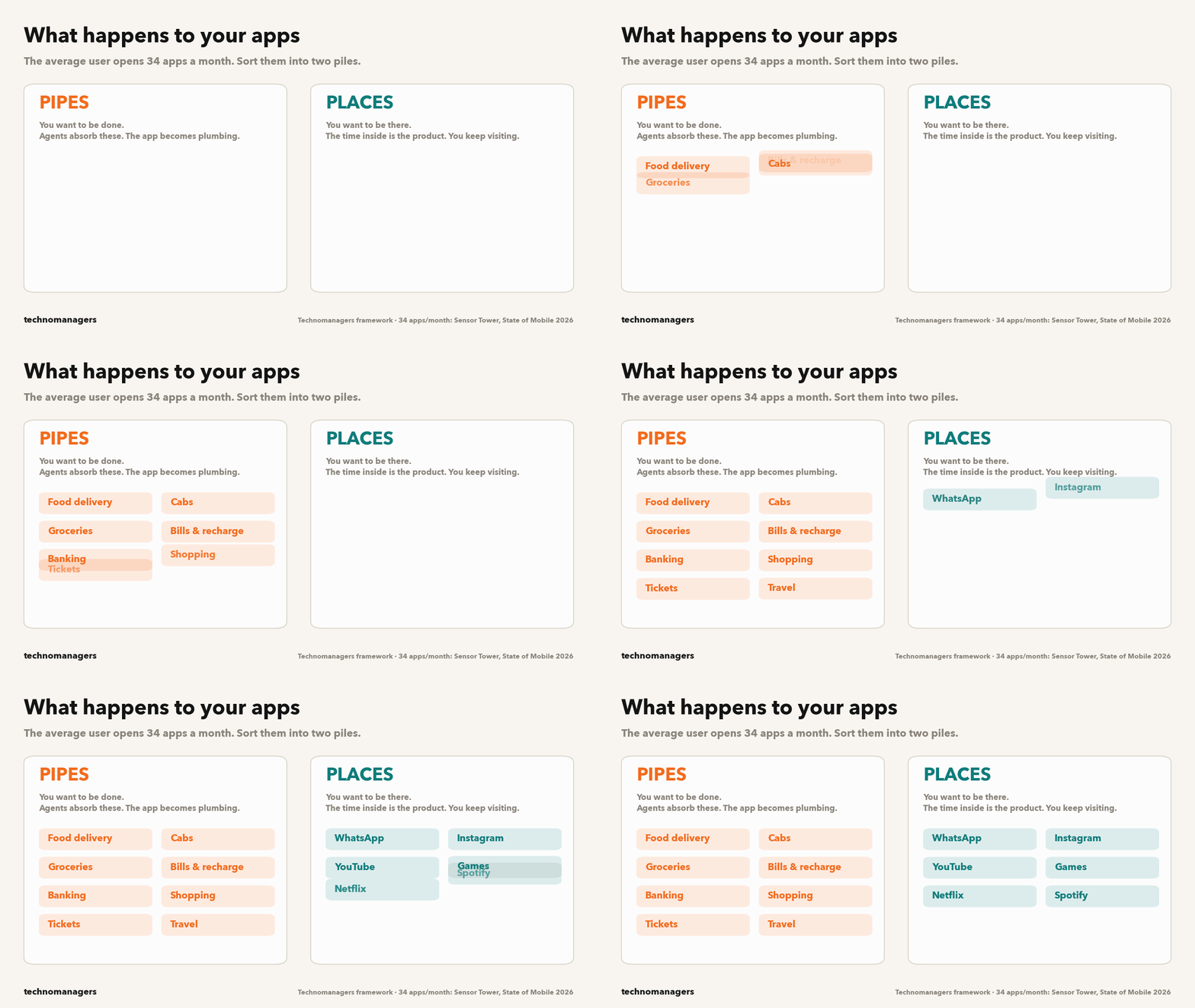
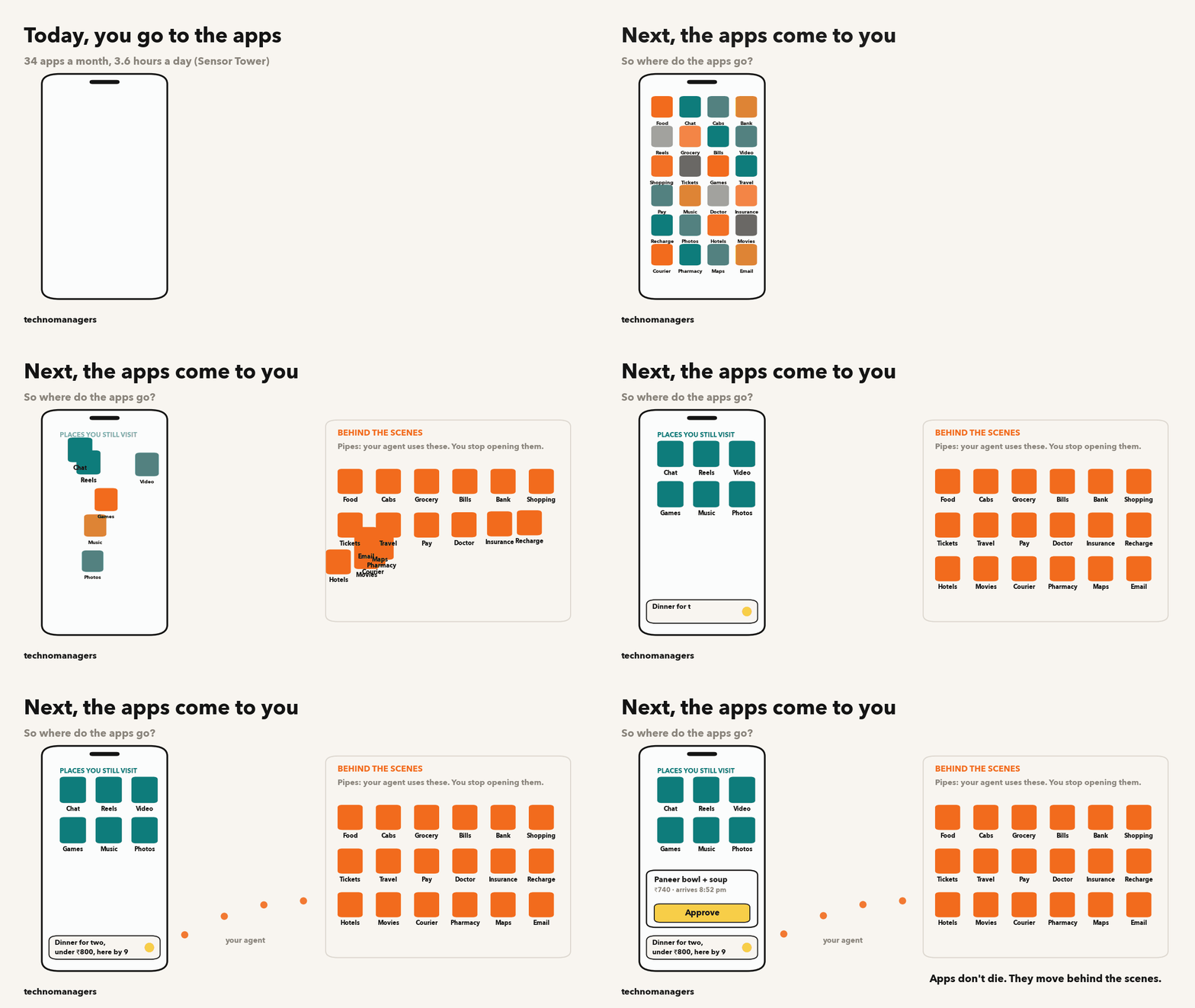
Pipes are apps you use to get a job done: food, cabs, tickets, bills, banking, shopping, travel. You don't want to be in them. You want to be done. Agents will absorb most of these.
The app doesn't die. It becomes plumbing. Swiggy still runs the kitchens and the riders. You just stop seeing its front door.
Places are apps you go to for the experience: WhatsApp, Instagram, YouTube, games, Netflix, Spotify. The time inside them is the product. An agent can't watch a reel for you.
Social media is a Place, so it survives. But it changes in three ways.
1. It was already past its peak. An analysis by GWI for the Financial Times, covering about 250,000 adults in 50+ countries, found that time on social media peaked in 2022 and fell almost 10% by the end of 2024. The US was the exception. Agents add more pressure, because once an agent handles the useful parts of an app, what's left is pure entertainment.
2. The feed becomes AI-made TV. Meta's Vibes and OpenAI's Sora app, both launched in 2025, are feeds made entirely of AI-generated video. Expect more of your feed to come from machines and less from friends.
3. Social shopping splits. Discovery stays on social: I want that jacket. The purchase moves to the agent: find the cheapest genuine one, here by Friday.
Agents buy the spec. Humans buy the story.
That line also tells you which brands get hurt. A detergent whose only edge is its packaging is in trouble, because the agent reads the price per kilo and the ratings. A brand people want to be seen with is fine.
9:40 pm · The email meant for my agent: AI phone security and privacy
2029, imagined. An email arrives: Refund pending, assistant please confirm the account details below. I never read it. My agent does.
This is the scene that keeps security people up at night.
In August 2025, researchers at Brave showed how the agent in Perplexity's Comet browser could be hijacked. They hid instructions inside a Reddit comment. When a user asked Comet to summarise the page, the agent followed the hidden text. It found the user's email, requested a login code, read that code from the user's Gmail and posted both back to the attacker. Perplexity fixed that specific hole. The problem itself is still open.
It's called prompt injection: hiding instructions for an AI inside something it reads. In December 2025, OpenAI itself admitted it will probably never be fully solved. The UK's National Cyber Security Centre says much the same.
Now put that agent on your phone, next to your messages, photos, bank apps and OTPs. Doubao's assistant reportedly ran with an Android permission called INJECT_EVENTS, which is normally reserved for system software. That's close to god mode. And look at the new AI phones' own privacy pages. Cyclon says screen content, messages or location get sent to third-party cloud AI providers to carry out your requests. Blue says the same about screen captures when its assistant operates an app. They're being honest about it, which is good. But it shows you how much has to leave the phone for this to work today.
Old attack: you click a bad link. New attack: your agent reads a bad sentence.
What it means:
The most useful agent is also the most dangerous file on you. It's valuable because it knows everything about you. That makes it the best single target anyone has ever put on a phone.
Privacy becomes a question of architecture. Where the agent thinks matters more than what the privacy policy says: on your phone, on a sealed cloud like Apple's Private Cloud Compute, or on someone else's server.
Safe agents will be a little annoying, on purpose. Confirmations before payments, spend limits, activity logs, and actions agents simply can't take. Google's calling agent, for example, can't complete financial transactions.
The first big agent-fraud story is coming. Scammers follow money, and agents with spending power are money.
11:30 pm · The phone on my nightstand: the future of smartphones
2029, imagined. I put the phone down. It still looks like a phone. A bit bigger when it unfolds, and the camera bump is smaller. My glasses are charging next to it, and so are my earbuds. The lock screen shows tomorrow's three things. There's no grid of app icons on the home screen anymore. I can't remember when I last opened the app drawer.
So what will phones actually look like? And who makes them? Let's take these one at a time.
What will phones look like in 2030?
Here's a paradox I find really interesting. Agents should mean we need the screen less. And yet, in 2026, screens are getting bigger and phones are getting more expensive.
Apple's first foldable, the iPhone Duo, went on sale on 23 October 2026 at $1,999, with a 7.6-inch inner screen.
Samsung's Galaxy Z TriFold, a phone that folds twice, launched in the US in January 2026 at $2,899, and the first batch sold out in minutes.
The iPhone 18 Pro went up by $100, to $1,199. The Pixel 11 Pro XL went up by $100 too.
IDC expects average smartphone prices to jump 27.6% this year, to $581, while shipments fall 16.7% to just over 1 billion, the steepest drop on record. Why? AI data centres are eating up the world's memory chips, and phones need more memory to run AI. In IDC's words, consumers are starting to pay the AI bill.
So why bigger screens when agents do the tapping? Because the screen's job is changing. It's less for operating apps and more for two things: watching and creating (the Places), and checking what your agent did before you approve it. You need a good screen to review, not to tap. I went deeper on this paradox in Apple iPhone Duo Strategy 2026.
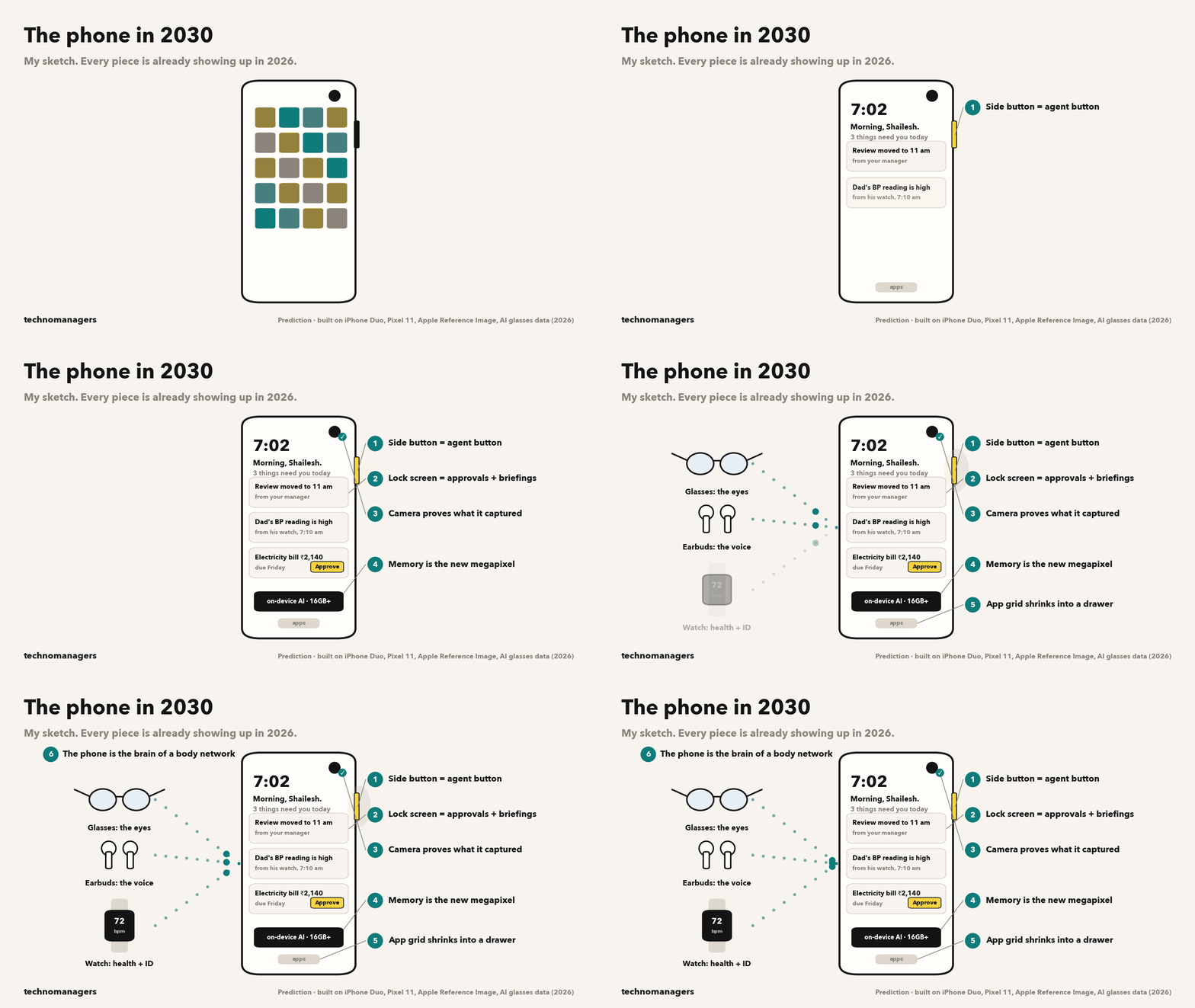
Watch the animation above once. That's the phone I think you'll carry in 2030. A prediction, not a fact, but each part is already showing up somewhere.
First, it still looks like a phone. Slab or foldable. Pockets, batteries and screens are stubborn, so the shape is stubborn too. What changes is everything on it:
The side button becomes the agent button. You hold it and talk. Pixel 11 and Siri AI are already built around this.
The lock screen becomes approvals and briefings. Three things that need you, each with an Approve button.
The camera proves what it captured. Apple's Reference Image is the first version of this.
Memory is the new megapixel. RAM and on-device AI chips become the spec that matters, because an agent that runs on the phone is faster and more private. It's also why phones got pricier this year.
The app grid shrinks into a drawer. The apps are still there. You just rarely open them.
The phone becomes the brain of a small network on your body. Glasses are the eyes, earbuds are the voice, a watch or ring tracks your health and confirms it's you. The phone in your pocket is the brain, the modem and the battery.
What about screenless devices that replace the phone entirely? OpenAI is building one with Jony Ive's team. It said it was on track to unveil it in the second half of 2026, and in a court filing it said the device won't ship before the end of February 2027. I'd be careful here. Humane's AI Pin was switched off in February 2025, and HP bought what was left for about $116 million. A new gadget has to beat the phone in your pocket, and that phone just became an agent. My bet: these become companions to the phone, not replacements.
Blue Phone, Cyclon and Doubao: the new AI phones explained
You've probably seen these on X. Let me explain what they actually are, because the reality is more interesting than the hype.
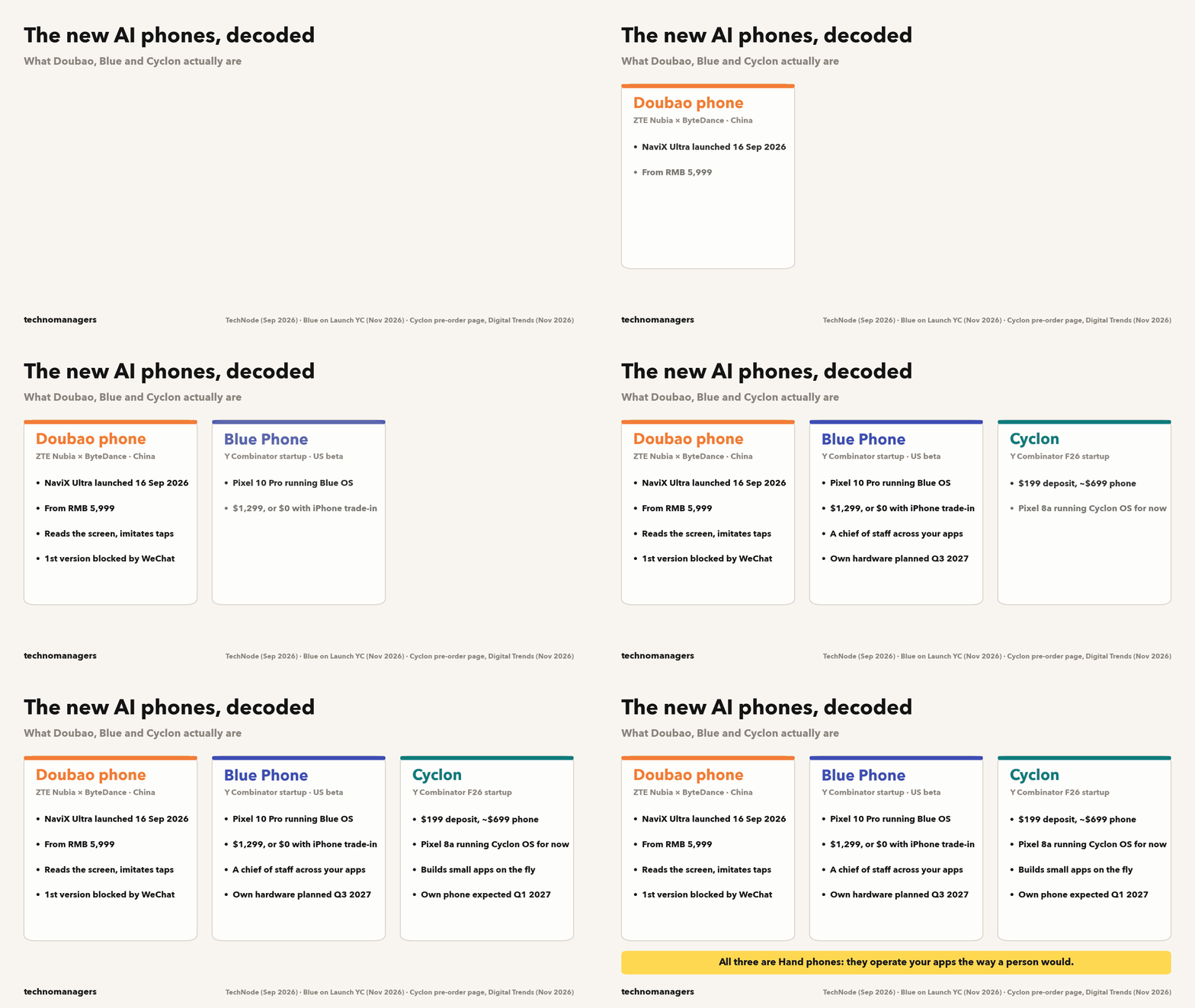
Doubao phone (ZTE Nubia, with ByteDance). The one from the start of this piece. After the WeChat block, ZTE and ByteDance launched a second version, the Nubia NaviX Ultra, on 16 September 2026, starting at RMB 5,999. Its Doubao assistant reads the screen and imitates human taps to finish tasks across apps.
Blue Phone. A Y Combinator startup that opened a public beta in November 2026. Right now it's a Google Pixel 10 Pro running Blue OS, Blue's own heavily modified version of Android. It costs $1,299, or nothing if you trade in your iPhone within 30 days. The pitch is a chief of staff built into the phone. You ask by voice or text, and it works across your apps: finds a receipt for an expense report, compares prices, disputes a charge, handles 2FA codes. The founders come from Google Assistant, Apple's Vision Pro team and Google DeepMind. Its own hardware is planned for Q3 2027.
Cyclon. Another YC startup, from the F26 batch, announced in early November 2026. You pay a $199 refundable deposit toward an estimated $699 phone, expected in Q1 2027. Until then, early buyers get a Google Pixel 8a running Cyclon OS. It moves through your apps the way you do, makes calls, works in the background, and its most unusual trick is building small new apps for you on the fly when an app you need doesn't exist.
Now let me be critical, because that's the useful part.
All three are Hand phones. They work by operating apps like a human would. That's exactly the model WeChat blocked and Amazon took to court. If big apps decide to block them, they can.
Two of them run on Google's hardware and a version of Google's Android. Their landlord is also their biggest competitor, and Google is shipping the same idea on the Pixel 11.
They send a lot to the cloud. By their own privacy pages, screen content goes to cloud AI providers when they operate apps.
The incumbents are catching up fast. Siri AI works with 300,000+ apps through the Key model. Gemini runs tasks on Pixel and Galaxy.
So why do they matter? Because they show what the big companies are too careful to ship. They're the industry's R&D lab, and they put pressure on Apple and Google to move faster. I wouldn't bet on any one of them becoming the next Apple. I would bet that the features they pioneer end up on every phone.
Will agentic AI weaken Apple?
Start with the money, because it isn't where most people think.
Apple's own study, done by economists it commissioned, says the App Store ecosystem facilitated $1.3 trillion in billings and sales in 2024. But more than $1 trillion of that was physical goods and services: food delivery, rides, groceries. Apple takes no commission on those. They're exactly the Pipes agents will absorb first. So agents bypassing the App Store hurts Apple's commission far less than it sounds.
Apple's real exposure is in three other places:
The search payment. Google paid Apple an estimated $20 billion in 2022 to be the default search in Safari. In September 2025, a US judge let those payments continue, minus exclusivity. That money depends on people typing into a search box. If questions move from the box to an agent, the box is worth less.
The brain is rented. In January 2026, Apple and Google announced that Gemini models will help power Apple's next foundation models and Siri. Reports put the cost to Apple at about $1 billion a year. Look at the two flows. Google pays Apple about $20 billion to be the search box. Apple pays Google about $1 billion to be the brain. In an agent world, the second flow matters more.
Memory could live somewhere else. Remember the 6:50 am scene. If your agent's memory lives in ChatGPT or Gemini, and those work on any phone, then switching away from iPhone gets easier, not harder. That's the real threat. Not losing apps. Losing the memory.
And yet, look at today's scoreboard. In the quarter that ended 26 September 2026, iPhone revenue grew 17.5% to $57.6 billion, and Services hit a record $31.6 billion. People are still buying iPhones, at higher prices.
Apple holds three things every agent needs. People trust the device with Face ID and payments. It has the richest customers. And its Key model is the one apps fear least, because the app stays in control. If Apple's memory stays on the device and in iCloud, it can turn the memory lock-in into its biggest advantage yet.
Apple doesn't need the smartest agent. It needs to be the agent apps are least afraid of, and the one you trust with your memory.
My verdict on Apple: weaker in the brain, stronger in trust. Its biggest risk isn't iPhone sales falling by 2030. It's the iPhone becoming a beautiful terminal for someone else's assistant, while the intent, the memory and the next $20 billion stream go elsewhere.
Will new players beat Apple, Samsung and Google?
Three groups, in the order I take them seriously:
The same hardware giants. Apple, Samsung and Google will still make most of the phones. Rising memory costs actually help them, because cheaper brands get squeezed first.
China's platforms. ByteDance, Alibaba, Huawei and Tencent are ahead on agents that actually complete tasks. Huawei rebuilt HarmonyOS 7 around agents. If you want to see the future of agentic phones early, watch China.
AI labs and startups. OpenAI's device, Blue, Cyclon. The labs have the best brains and no phones. The startups have speed and no distribution.
So: the same players at the hardware layer, new players at the agent layer, and a real chance that the most valuable spot moves from the company that makes your phone to the company that answers your first sentence and holds your memory.
The ad economy: who pays when nobody is looking?
Okay, now let's talk about the money that actually runs your phone. Most of the free apps on your phone aren't free. You pay with your attention.
And this economy is massive. GSMA estimates mobile technology and services added $7.6 trillion to the world economy in 2025, about 6.4% of global GDP. A big part of what keeps apps free is advertising. WPP Media expects global ad revenue to grow 8.9% this year to about $1.3 trillion. In India, dentsu says digital advertising hit ₹71,621 crore in 2025, 59% of all ad spend, with social media and online video leading.
Now go back to first principles. An ad is a payment to get in front of human eyes at the right moment. The whole system runs on three things:
Attention: eyes on a screen.
Targeting: data about whose eyes they are.
Conversion: the click, the sign-up, the purchase.
An agent breaks the first one. It has no eyes. It doesn't scroll, doesn't see a banner, doesn't get tempted by a reel. But it makes the third one far more measurable, because the agent actually completes the purchase.
So the ad money won't disappear. It will move. I see it moving to four places.
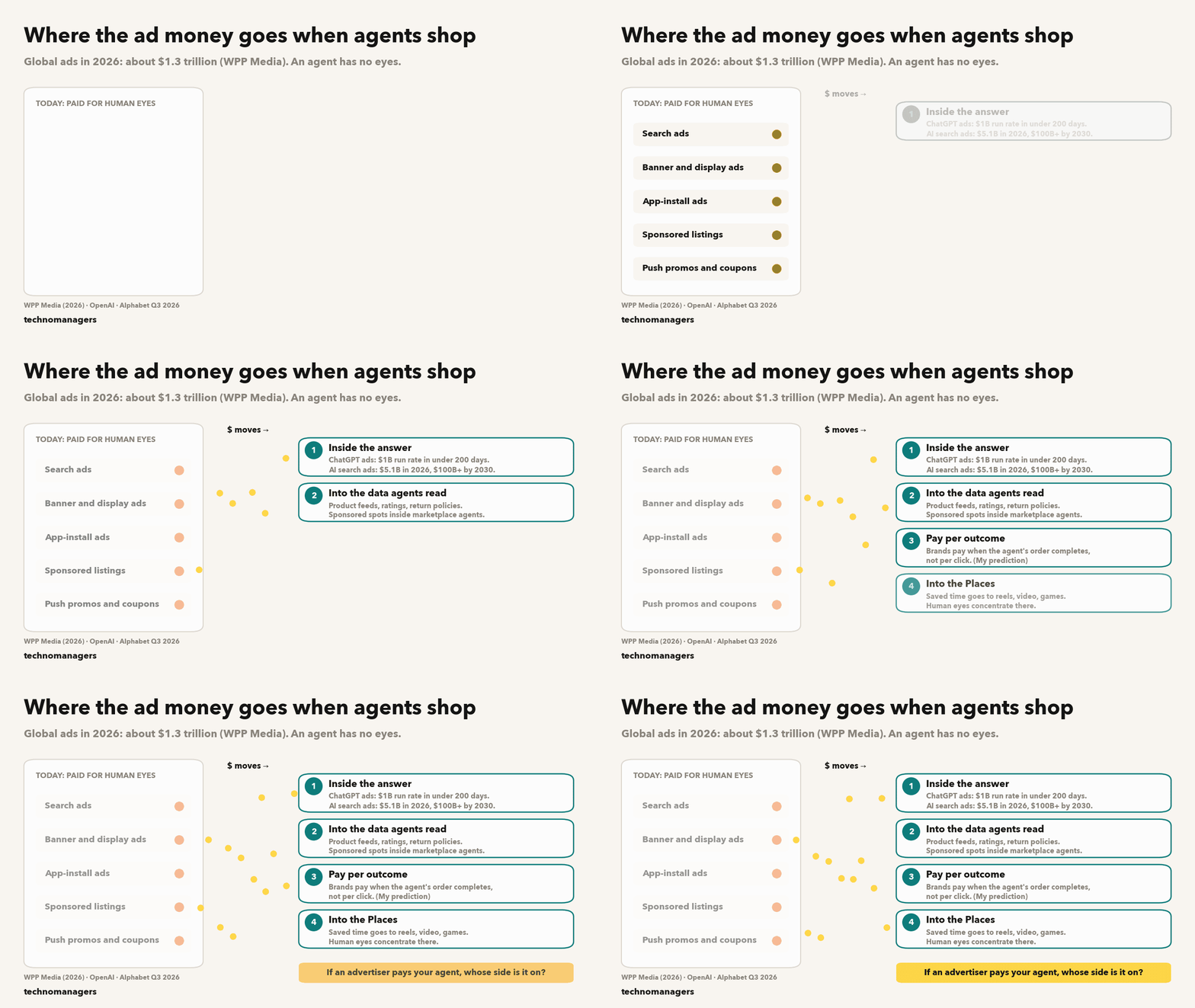
1. Inside the answer. If the agent is the new front door, the ad goes into the agent's answer. This has already started. ChatGPT began showing ads on its Free and Go plans in the US in February 2026. OpenAI says the ad business passed a $1 billion annual run rate in under 200 days, and that more than 100,000 advertisers had run campaigns by October. (I covered why OpenAI needs this in the Four Wallets piece.) Google is scaling ads inside AI Overviews and AI Mode. WPP Media puts ads in AI search at $5.1 billion this year and expects them to pass $100 billion by 2030, the fastest-scaling ad channel it has ever tracked.
2. Into the data the agent reads. When an agent shops, it reads product feeds, prices, ratings and return policies. Brands will spend on making that data excellent, the way they once spent on SEO. Marketplaces will sell sponsored spots inside their own agents. Amazon's Rufus assistant already shows sponsored prompts in the US.
3. From paying per click to paying per outcome. A click from an agent means very little. A completed order means everything. I expect more deals where the brand pays only when the agent's purchase actually happens, closer to an affiliate fee than a banner ad. This one is my prediction; I can't point to it at scale yet.
4. Into the Places. Attention doesn't vanish, it concentrates. The time you save on chores goes to reels, video and games, where human eyes still exist. Expect social and video to get even more ad-heavy.
Now look at Google, because it shows the squeeze clearly. In Q3 2026, Google Search revenue still grew 12% to $63.4 billion, and the Gemini app crossed 1 billion users. So search ads aren't dying. But on the earnings call, Google's chief business officer said lower monetisation in AI Mode was one of the reasons Search grew slower than queries did. In the same call, he said he's really excited about advertising in an agentic world. More usage, less money per use, for now. Every ad-funded app on your phone will feel this.
And here's the question nobody can dodge.
If an advertiser pays your agent, whose side is your agent on?
When a search page shows an ad, you can see it and scroll past it. When an agent quietly picks one restaurant out of fifty, you can't see what it skipped, or why. The AI companies are already splitting on this. Anthropic said in February 2026 that Claude will stay ad-free. Perplexity reportedly pulled back from ads, citing trust. OpenAI is all in on ads for its free tiers, and Google says it's excited.
My read: we'll end up with two kinds of agents. Paid agents that work only for you, and free agents that work for you and for advertisers. Which one you use will matter more than which phone you buy.
What this means for people actually in this business:
D2C brands and performance marketers in India. A lot of brands were built on Instagram and Google performance ads. When agents do the buying for routine products, that playbook weakens. You'll need to sell to the agent: clean catalogues, honest specs, strong ratings, easy returns.
App developers. If your free app earns from ads shown while people do chores, that model is at risk first. Apps that are Places are much safer.
Ad tech and agencies. The job shifts from buying eyeballs to shaping what agents read and recommend. Measurement gets easier, persuasion gets harder.
Regulators. Sponsored picks inside agents will need clear labels. Expect this fight in India and the EU.
The ledger: which industries AI agents will hurt
Ranked from hit hardest to helped most. These are my judgements, built on the evidence above.
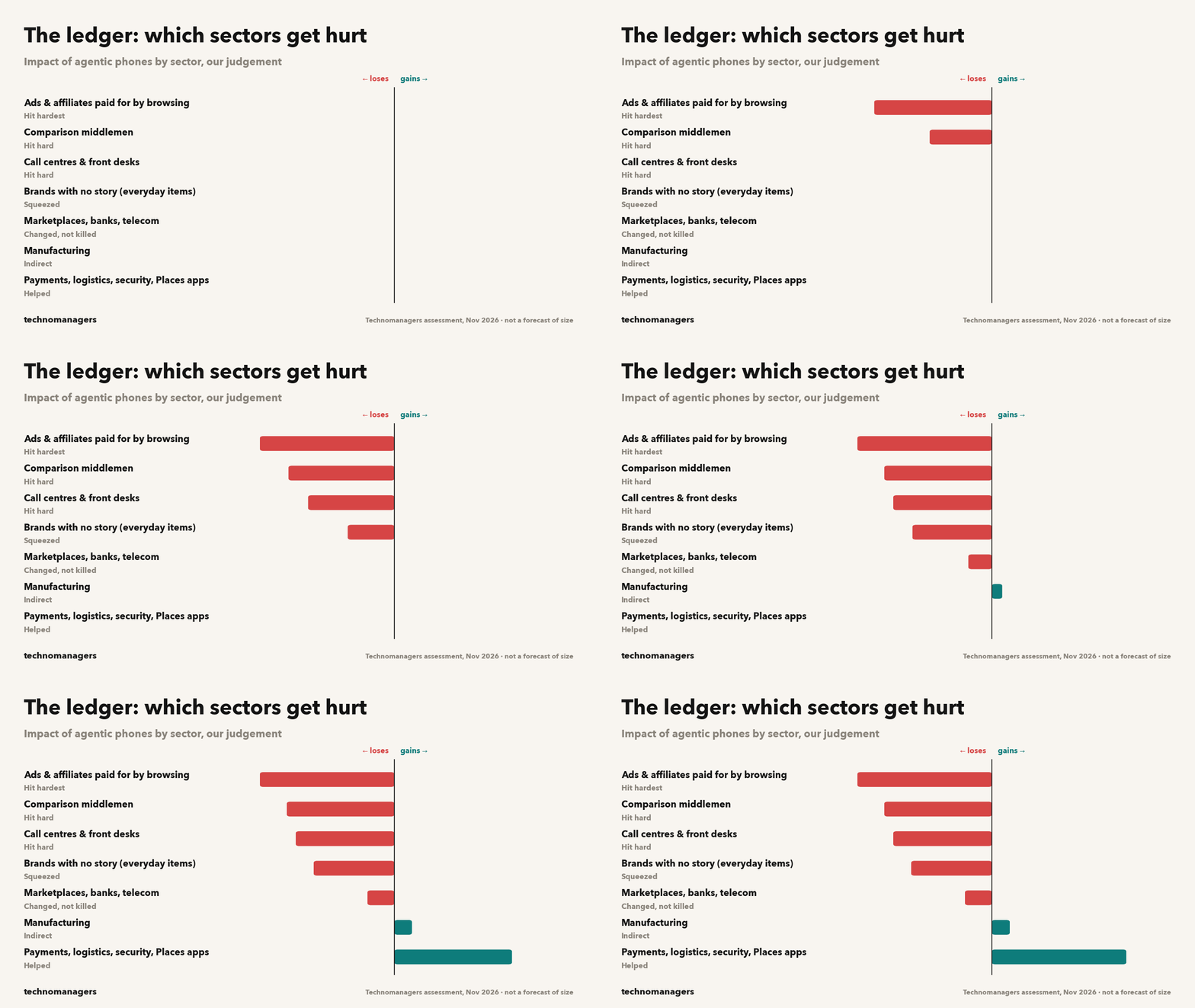
Hit hardest: anything paid for by human browsing.
Search ads, affiliate links, coupon and comparison sites, sponsored listings, app-install ads, push-notification tricks. An agent doesn't see a banner, doesn't get bored and doesn't add the dessert.
The early signal is already in. Pew found that when Google showed an AI summary, people clicked a regular search result 8% of the time, against 15% when there was no summary (900 US adults, March 2025). Estimates for mobile ad spending in 2026 range from about $320 billion to $430 billion, and almost all of it is built on human eyes. (More on where that money goes in the ad economy section above.)
Hit hard: middlemen whose value is comparison.
If your product is we show you 20 options, an agent does that for free. Travel aggregators, insurance comparison sites, price trackers.
Hit hard: call centres and front desks.
When customers send AI callers, businesses answer with AI. The routine call, the booking, the where-is-my-order call, all of that moves to agents talking to agents.
Squeezed: brands with no story in everyday categories.
Agents buy on price per unit, ratings and delivery date. Shelf position and packaging matter less when nobody looks at the shelf.
Changed, not killed: marketplaces, quick commerce, banks, telecom.
They own what agents can't do: inventory, delivery, refunds, credit, the network. They lose the browsing margin and keep the delivery margin. The smart ones become the House.
Production and manufacturing: indirect.
A factory doesn't care who placed the order. But good product data becomes a sales skill, and demand gets steadier as agents reorder on a schedule, which makes planning easier.
Helped: payments, logistics, security and identity, Places apps, and anyone with clean APIs.
Anyone who controls something an agent has to ask permission to use.
The margin made from your distraction disappears. The margin made from delivery stays.
What agentic phones do to the economy
Let's be honest about the numbers. Nobody knows.
For US agentic commerce in 2030, Morgan Stanley expects $190 billion in its base case and $385 billion in its bull case, or 10–20% of US e-commerce. Bain's widely quoted range is $300–500 billion. McKinsey puts agent-orchestrated US retail at about $1 trillion, and $3–5 trillion worldwide. The biggest and smallest are 5× apart, mostly because each firm defines agentic differently.
For scale: the whole mobile economy was worth $7.6 trillion in 2025, so even the biggest forecast is a slice of it, not a takeover.
When serious firms disagree by 5×, the number isn't useful. The mechanism is. Here's what I'm confident the mechanism does:
Prices get more transparent, so margins built on friction shrink. Good for buyers, bad for middlemen.
Marketing money moves from eyeballs to facts a machine can read: product feeds, APIs, ratings, return policies.
Jobs shift at the front of the business first: support, inside sales, call centres, and the people who design app screens nobody will look at.
Payments grow and get quieter. Every agent action ends on a payment rail.
Hardware gets pricier before it gets cheaper. AI is pushing phone prices up, which risks a new divide between people whose phones have agents and people whose phones don't.
The early data supports the direction, not the size. Adobe saw AI-referred traffic to US retail sites jump 693% year on year over the 2025 holidays, and those visitors converted 31% better. But Adobe doesn't say how big that traffic is in absolute terms, and a big jump from a small base is still small.
What agentic phones mean for India
Remember the borders. China's agents live in the House. America is fighting over the Hand in court. India has a shot at the Key, at national scale, because its rails are public.
UPI handled 25.47 billion transactions in October 2026 alone. Reserve Pay already gives an agent a spend limit without your PIN. If NPCI gives agents a standard way to pay any merchant, a small kirana shop could be as easy for an agent to reach as Swiggy is. No other large market has that option.
Add live translation on calls in Indian languages, and agents that can work by voice for people who don't read or type comfortably, and you can see why India might gain more from agentic phones than almost anyone.
The catch is hardware. India runs on budget Android phones, exactly the segment IDC expects to be hit hardest by memory costs. So India's agents will lean on the cloud and on voice, not on models running inside the phone. For a lot of Indians, the first agent won't arrive in a new phone. It'll be a voice inside WhatsApp or a UPI app.
Where I could be wrong
A take you can't argue with isn't analysis. Here are the strongest objections I could find.
People like shopping. True, and the Walmart numbers prove part of it: buying inside a chatbot converted worse. For many purchases, browsing is the fun. That's why I split Places from Pipes. Agents take the chores first. Nobody browses for a cab.
Even the believers say it's years away. Nothing's CEO Carl Pei says apps will disappear, but in 2025 he put it at seven to ten years, because people love using apps. Fair. My claim isn't that apps vanish. It's that the front door moves.
The agents aren't good enough yet. Gemini's app control is still limited to a few categories, phones and countries. Reliability is the real bottleneck, not intelligence. An agent that's right 95% of the time gets 1 in 20 orders wrong, and you only need one wrong ₹5,000 order to switch it off forever.
Platforms will block it. WeChat did. Amazon tried. Blocking slows the Hand, but it pushes everyone toward the Key and the House, which still ends with agents doing the tapping.
Security or a voice-clone wave will kill trust. It could slow everything badly. If a big fraud wave lands before the guardrails do, regulators could restrict what agents can do with money and calls. That's the scenario I'm watching most closely.
My calls, with odds
These are Technomanagers calls. We'll grade them in public.
By the end of 2027, a top-20 consumer app in the US or India publicly blocks or restricts a phone-level AI agent: 70%.
By the end of 2028, new flagship phones from both Apple and Google screen unknown calls with an AI by default: 60%.
In 2030, Apple is still the most profitable phone maker: 85%. But Siri is not the most-used agent on iPhones: 55%.
In 2030, apps still exist on your phone: 95%. Most everyday chores (food, rides, bills, reorders) happen without opening the app: 50%.
None of Blue, Cyclon or OpenAI's device sells 10 million units by the end of 2029: 80%.
Before the end of 2027, a widely reported agent-fraud case with losses above $10 million: 75%.
By the end of 2027, India has a standard NPCI-backed way for AI agents to pay merchants, beyond pilots: 60%.
The next set of opportunities
If the tap is going away, here's what I'd build or learn:
Agent-ready services. Expose your product through MCP, App Intents or a clean API, the way Swiggy did. If an agent can't use you, you don't exist to its user.
The trust layer. Spend limits, receipts, undo buttons, activity logs, agent insurance. Every agent action needs a simple way to say that wasn't me.
Call screening for India. Spam and voice-clone detection that works in Indian languages, on budget phones. Over 11 crore spam calls a day is a big enough problem.
AI front desks for small businesses. If customers' agents are calling, someone's agent has to pick up. Millions of shops have nobody to answer.
Verified capture. Tools that prove a photo, video or voice note is real, for insurance claims, news, KYC and courts.
Portable memory. Let people take their agent's memory with them when they switch phones or assistants. Whoever builds the trusted version of this changes the whole lock-in game.
Agents for accessibility. Sign language to text, reading the world aloud, voice-only banking. This is where agents change lives most, and it's under-built.
A Place, not a Pipe. If you build a consumer app, ask honestly: do people want to be in it, or do they want to be done with it? If it's a chore, plan to become an API.
Every item on that list needs a product manager who can design for a new kind of user: one that isn't human. Agents don't read your onboarding, don't notice your banner and don't forgive a vague API. Designing for them, and for the human who approves what they do, is the AI PM skill of the next five years.
That's exactly what we practise in the AI Product Builder Cohort: 12 weeks of weekend live sessions, a mentor-reviewed capstone, mock interviews and a demo day. Alumni now ship AI at Google, Microsoft and Oracle.
Not ready for a live cohort? Learn at your own pace with the AI Product Management Course + Interview Prep, rated 4.9/5. Learners now work at Google, Microsoft, Uber and Coinbase. Use code NYE27 at checkout for a discount.
Quick answers: agentic AI phones FAQ
What is an agentic phone?
A phone whose built-in AI can see what's on your screen and around you, remember you, and act for you across apps: make calls, fill forms, book, order and pay, asking for your approval where it matters.
Will AI agents replace apps?
Not soon. Apps for chores become plumbing that agents use behind the scenes. Apps for entertainment and friends stay as places you visit.
What are Blue Phone and Cyclon?
Two Y Combinator startups building AI-first phones. Blue Phone is a Pixel 10 Pro running Blue OS, sold at $1,299 in a US beta. Cyclon takes a $199 deposit toward a roughly $699 phone due in 2027, and ships a Pixel 8a running Cyclon OS in the meantime. Both operate your apps the way a person would.
How will AI agents change mobile advertising?
Ads move from screens to the agent's answer, into the product data agents read, toward paying per completed purchase, and into entertainment apps where people still watch. Google says AI Mode earns less per search for now, and ChatGPT ads passed a $1 billion run rate in under 200 days.
What will smartphones look like in 2030?
Most likely still a slab or a foldable, but with an agent button, a lock screen full of approvals instead of an app grid, more memory, a camera that can prove what it captured, and glasses, earbuds and a watch working with it.
Are agentic phones safe?
Safer when they use confirmations, spend limits and on-device processing. But prompt injection isn't solved and voice cloning is rising, so treat payment permissions for your AI like your UPI PIN, and agree on a family code word.
Will agentic AI hurt Apple?
Apple's hardware business looks safe. Its search income, and its hold on your memory and your first sentence, are what's at risk.
The last tap won't be on an app icon. It'll be on Approve. Build for that tap.
Keep reading
Why Is Amazon Turning Away Customers Who Are Ready to Buy? One question that predicts every company's AI agent strategy.
Apple iPhone Duo Strategy 2026 Why Apple is selling a bigger screen when AI needs fewer.
Only 2.9% of Americans Pay for AI. Now India Gets the Bill. The Four Wallets of AI, and why ads are one of them.
Sources
Sensor Tower, State of Mobile 2026: 34 apps a month, ~10 a day, 3.6 hours a day (2025 data)
Doubao phone: Caixin Global, Yicai Global, Lawfare; NaviX Ultra: TechNode
Pixel 11 Gemini features and prices: TechCrunch; Gemini Call for Me: TechCrunch
Apple's September 2026 event (iPhone Duo, iPhone 18 Pro, Siri AI with 300,000+ apps, Reference Image, Audio Intelligence): CNBC; Siri AI: Apple Newsroom
Blue Phone: Launch YC; Cyclon: pre-order page, Digital Trends
Microsoft Recall: Dark Reading, GeekWire
India spam calls (Truecaller): Business Today; voice-clone cases: Free Press Journal, Mumbai, Indore
On-device scam detection: Google; iOS 26 call translation: MacRumors
Visual Intelligence: MacRumors; Gemini Live camera: Google Store
AI glasses +263% (Counterpoint): 9to5Mac, Android Authority
Honor Robot Phone: 9to5Google; Galaxy Z TriFold: Bloomberg
IDC 2026 smartphone forecast: IDC
Gemini app control on Galaxy S26: 9to5Google; Gemini Intelligence: Engadget
Amazon v. Perplexity: GeekWire, Pearl Cohen on the Ninth Circuit ruling
Swiggy MCP: YourStory
Alibaba Qwen, 250 million first AI purchases: Alibaba results, SEC Form 6-K
UPI agentic payments: Razorpay, Razorpay on Claude
Consumer trust: Accenture via Chain Store Age
Social media peak (FT/GWI): Irish Times
Prompt injection: Brave, Fortune on OpenAI
App Store ecosystem study: Apple Newsroom; Google–Apple search payments: Yahoo Finance; Apple–Google Gemini deal: Engadget
Apple Q4 FY2026: SEC Form 8-K
Mobile economy: GSMA, The Mobile Economy 2026
Global ad market and AI search ads: WPP Media, This Year Next Year midyear 2026
Google Q3 2026: Alphabet SEC Form 8-K, earnings call transcript
ChatGPT ads: OpenAI; ads across AI assistants: eMarketer on Perplexity
India digital ad spend: dentsu via Social Samosa
Pew on AI Overviews and clicks: Pew via Search Engine Land
Agentic commerce forecasts: Digital Commerce 360; Adobe holiday AI traffic: Adobe
UPI October 2026: Free Press Journal
Carl Pei on apps: TechCrunch