

Most aspiring AI product managers are collecting certificates.
Hiring managers are collecting evidence.
That gap explains almost every rejection I see. I get some version of this message almost every week:
“I’ve finished three AI courses, I have a GenAI certificate, and I’ve applied to 100+ AI PM roles. Barely any callbacks. What am I doing wrong?”
Nothing is wrong with the effort. It’s pointed at the wrong target.
Here’s a number that should change how you prepare. Axial Search, an executive search firm, analysed about 12,400 US AI product job postings from 2026. 93% were senior level or above. Junior roles made up about 2%.
So AI PM isn’t a door you walk through from zero. It’s a layer you add on top of what you already are: your domain, your PM craft, your technical background. Plus proof that you can ship AI that actually works.
That’s what this guide gives you. Not “10 AI skills to learn”. The whole path, end to end.
The whole playbook in 7 lines
AI PM is a layer, not a restart. Pick the lane where your past is an asset.
The job is judgment under uncertainty: decide how good is good enough, design for when the AI is wrong, and measure it.
Learn 7 skills to decision depth, not research depth. Go deepest on evals.
Build one Proof Pack: a PRD, a prototype, an eval report, a 2-minute demo and a write-up.
Rewrite your resume around AI decisions and numbers, not AI enthusiasm.
Go deep on 30 companies with proof-first outreach, not 300 cold applications.
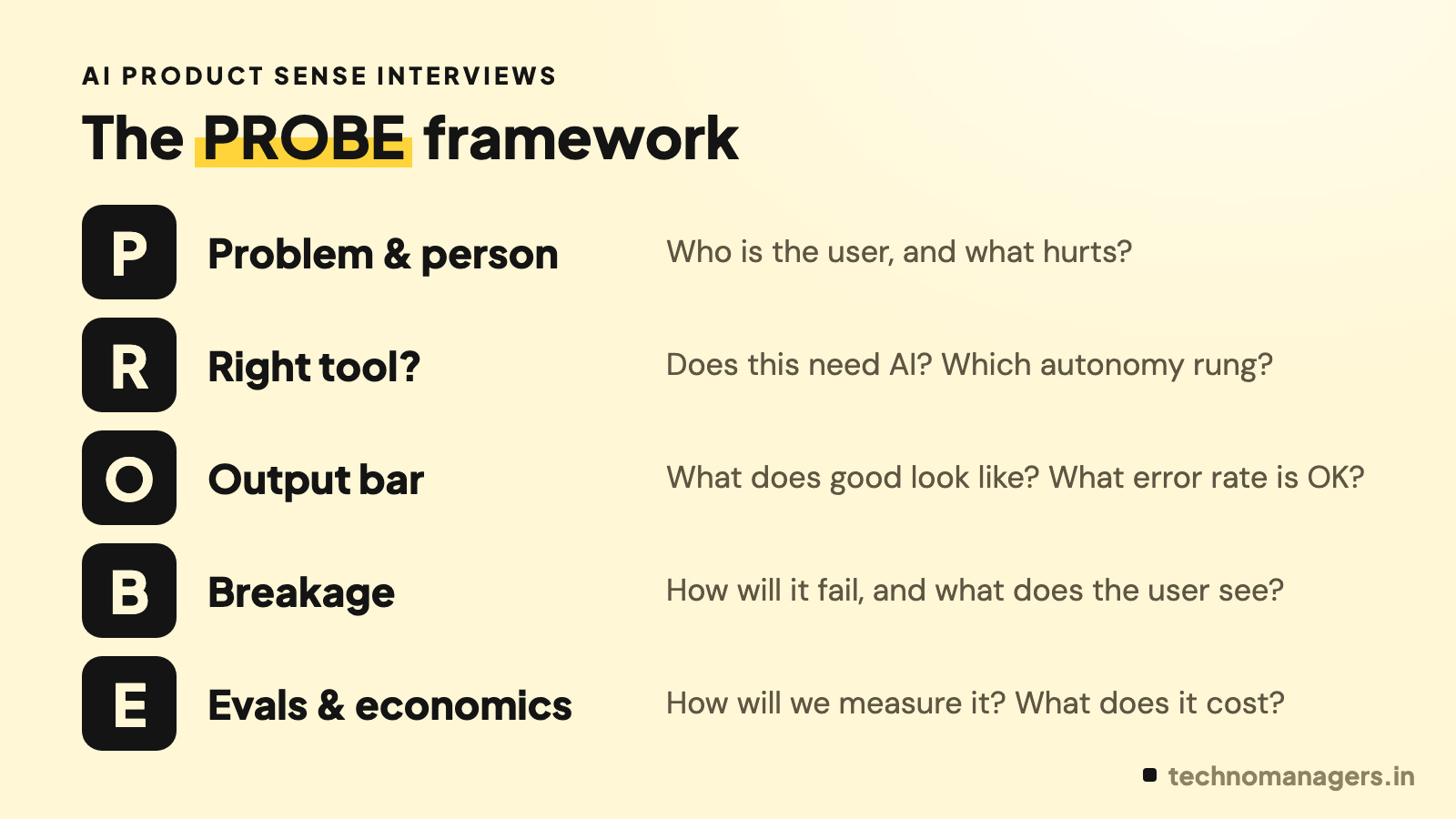
In interviews, use PROBE: Problem, Right tool, Output bar, Breakage, Evals and economics.
Grab a coffee and bookmark this. It’s long because it’s complete. Let’s go.
Part 1: What an AI product manager actually does
Forget the title for a second. Here’s the job in one sentence:
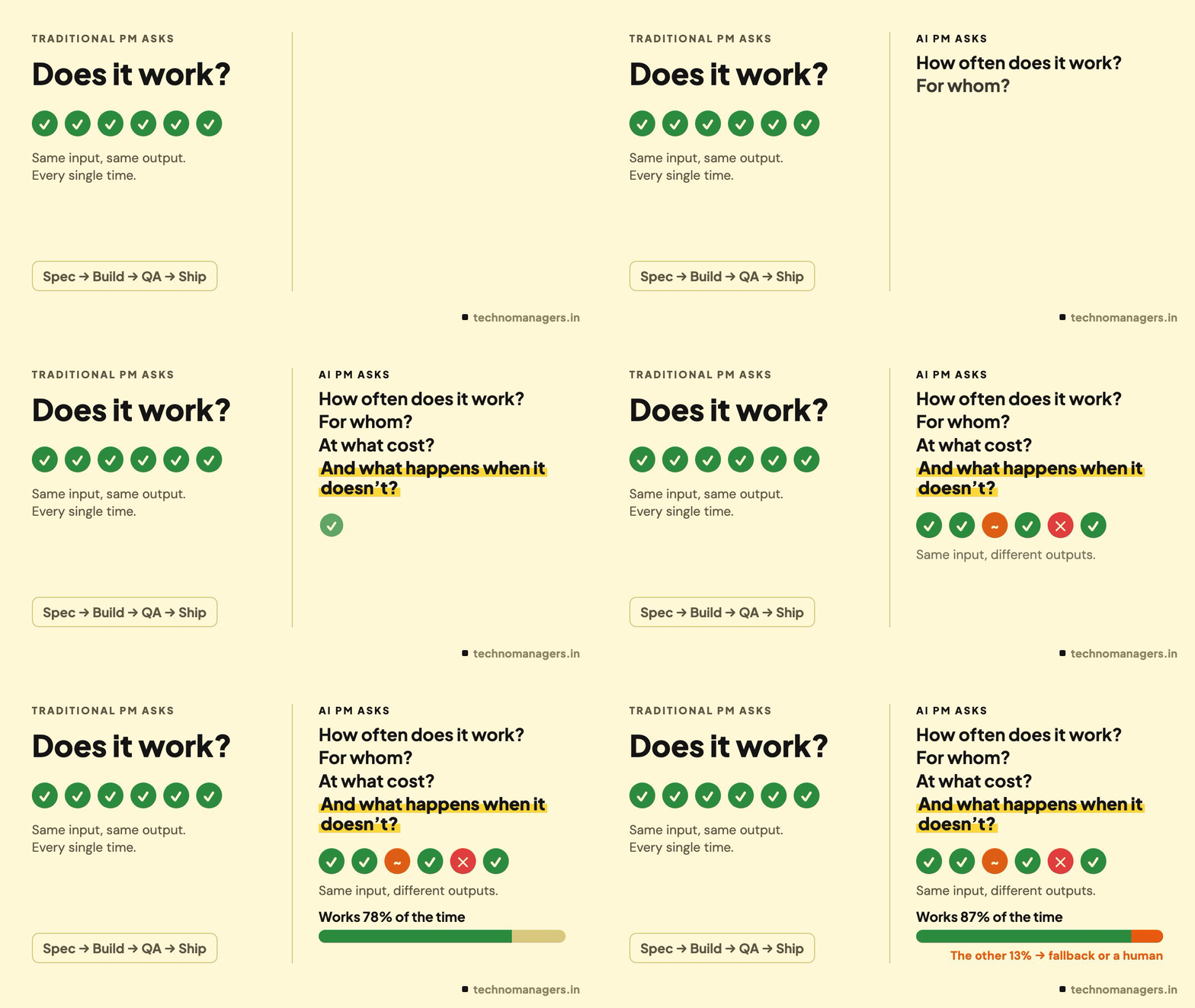
A traditional PM asks “does it work?” An AI PM asks “how often does it work, for whom, at what cost, and what happens when it doesn’t?”
That’s the whole shift. Let me show you why it matters.
When you ship a “Forgot password” button, it behaves the same way every single time. You write the spec, engineers build it, QA tests it, done. Deterministic.
When you ship an AI feature, say a support assistant, it answers the same question slightly differently each time. It’s right 87% of the time. Sometimes it’s confidently wrong. It gets worse when users type in Hinglish. It costs money every time someone uses it. And next quarter your model provider ships an update that quietly changes its behaviour.
Nobody can QA that into perfection. Someone has to decide:
Is 87% good enough to ship? (For a recipe app, yes. For a medicine-dosage app, absolutely not.)
What happens in the other 13%? Show sources? Hand over to a human? Say “I’m not sure”?
How do we even know it’s 87%? (That’s evals. We’ll get there.)
Can we afford it at 10x the traffic?
That someone is the AI PM.
The 4-way tradeoff you’ll live inside
Every AI product decision is a negotiation between four things:
Quality: how often is the output right and useful?
Latency: how long does the user wait?
Cost: what does each request cost you?
Risk: what’s the damage when it’s wrong? Wrong answers, leaked data, biased output, a viral screenshot of your bot saying something stupid.
Here’s a realistic example (numbers illustrative). You’re choosing a model for a support assistant:
Model A: 92% correct, 4 seconds to respond, ₹2.10 per conversation
Model B: 86% correct, 1.2 seconds to respond, ₹0.30 per conversation
Which one do you ship?
The junior answer: “Model A. It’s more accurate.”
The AI PM answer: “At 1 million conversations a month, Model A costs about ₹21 lakh and Model B about ₹3 lakh. So I’d route the simple 70% of questions (order status, refund policy) to B and send the complex or high-risk 30% to A. That’s roughly ₹8.4 lakh a month, about 60% cheaper than all-A, with top quality where it matters. Low-confidence answers go to a human. Then we measure whether resolution rate holds.”
Routing, numbers, fallback, measurement. That’s the answer interviewers are listening for.
The autonomy ladder
Every AI feature sits somewhere on this ladder:
Suggest: AI recommends, the human decides. (Autocomplete, “you might like”.)
Draft: AI creates, the human edits and sends. (Email drafts, first-draft PRDs.)
Act with approval: AI does the task, the human confirms before it’s final. (An agent prepares a refund, you click approve.)
Act on its own: AI does it, humans audit later. (Spam filtering, auto-tagging.)
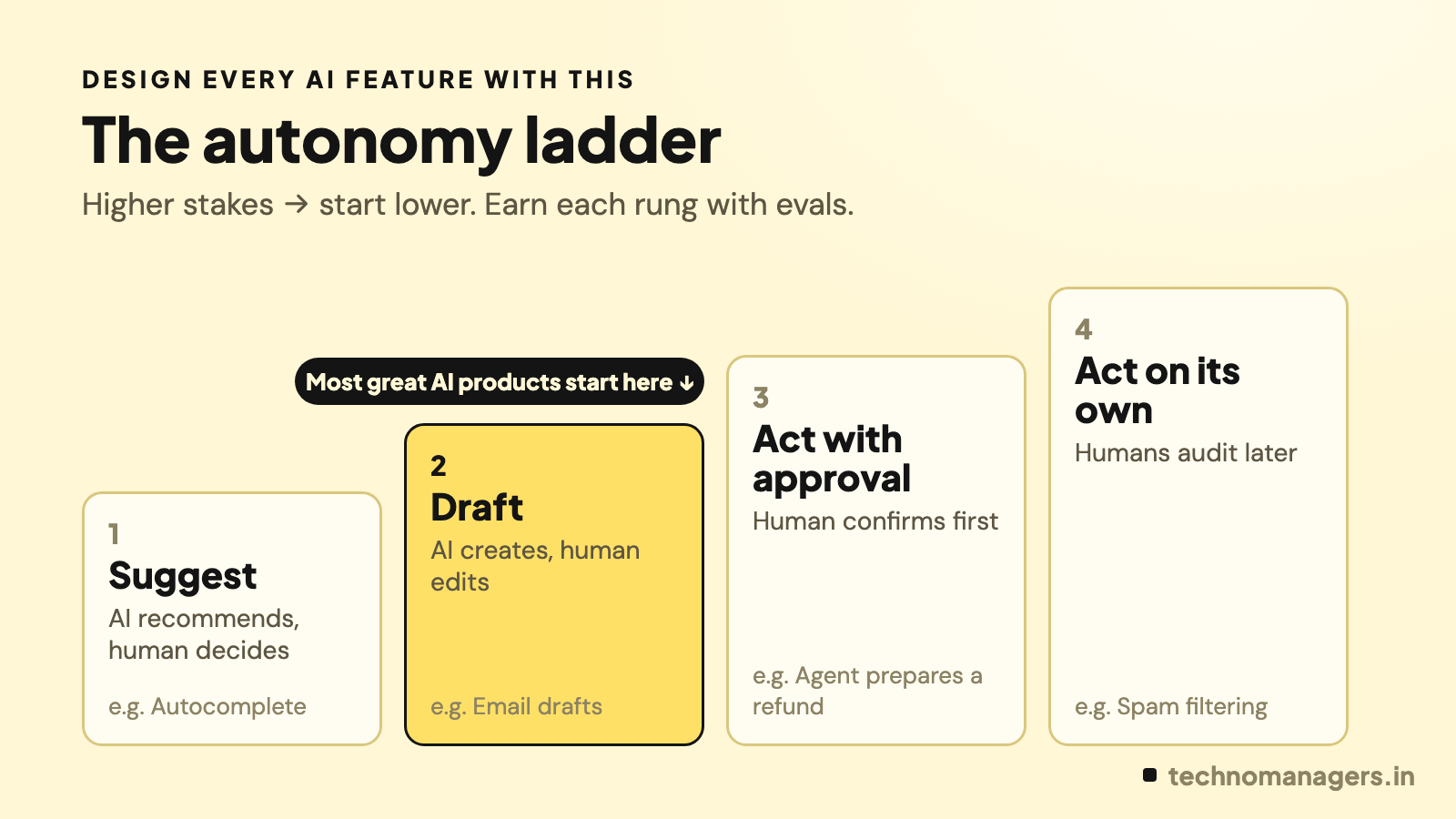
The higher the stakes and the lower your measured quality, the lower you start. Most great AI products start at “Draft” and earn their way up. Bring this ladder into every interview where you design an AI feature. It signals maturity instantly.
The 3 types of AI PM: pick one lane
“AI PM” on a job board can mean three very different jobs.
1. AI-enabled product PM. You add AI to an existing product: the assistant inside a banking app, smarter search in a shopping app, AI summaries in a CRM. This lane has the most jobs, and it’s the best entry point for existing PMs because your domain knowledge is the weapon. (In the Axial Search data, 43% of AI product postings came from companies with 10,000+ employees. That’s this lane.)
2. AI-native product PM. AI is the product: AI coding tools, AI legal assistants, AI support agents. It’s fast and intense, and you’re expected to prototype things yourself. Best for PMs who already ship fast and like being hands-on.
3. AI platform PM. You build what other builders use: model APIs, eval platforms, agent frameworks, developer tools. It’s the most technical lane, and your customers are developers. Best for engineers turned PMs and technical PMs.
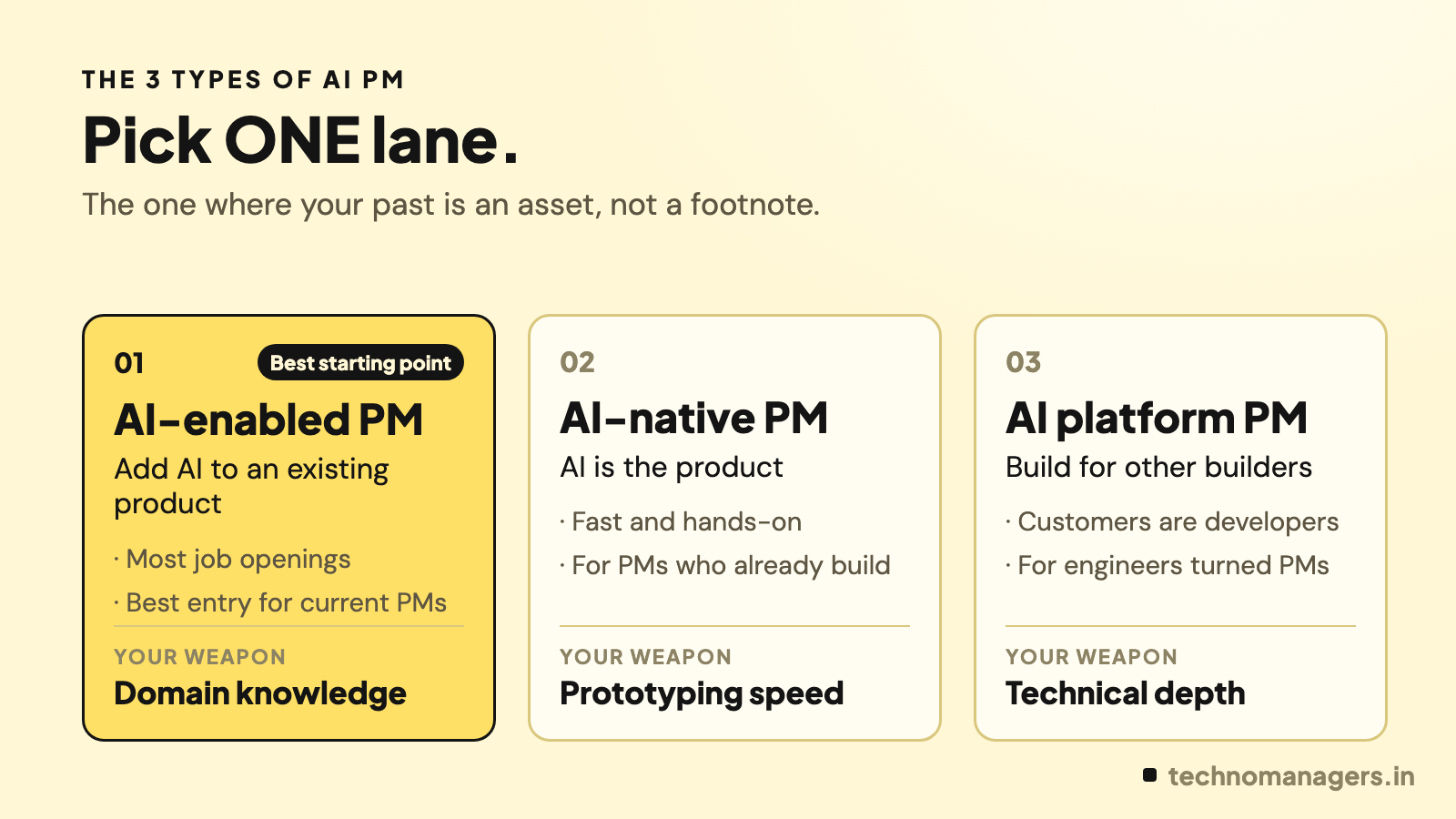
Mentor’s note: Don’t try to be all three. A payments PM pitching for “AI in fintech” has a strong story. The same PM pitching for “model platform PM at a frontier lab” is a long shot. Domain plus AI beats AI alone, every time.
Part 2: Upskilling. The 7 skills that matter, and what to skip
Here’s what most AI courses get wrong: they teach you about AI. Hiring managers want to know whether you can make decisions with AI.
So for each skill I’ll give you three things: what it is, how deep to go, and a test that tells you you’ve got it.
Skill 1: How LLMs actually behave
You don’t need the math. You need the mental model.
Know these cold: tokens, context windows, temperature, why models hallucinate (they predict plausible text, not true text), why answers vary from run to run, knowledge cutoffs, the difference between pre-training, fine-tuning and prompting, and what embeddings are (meaning turned into numbers, the backbone of AI search).
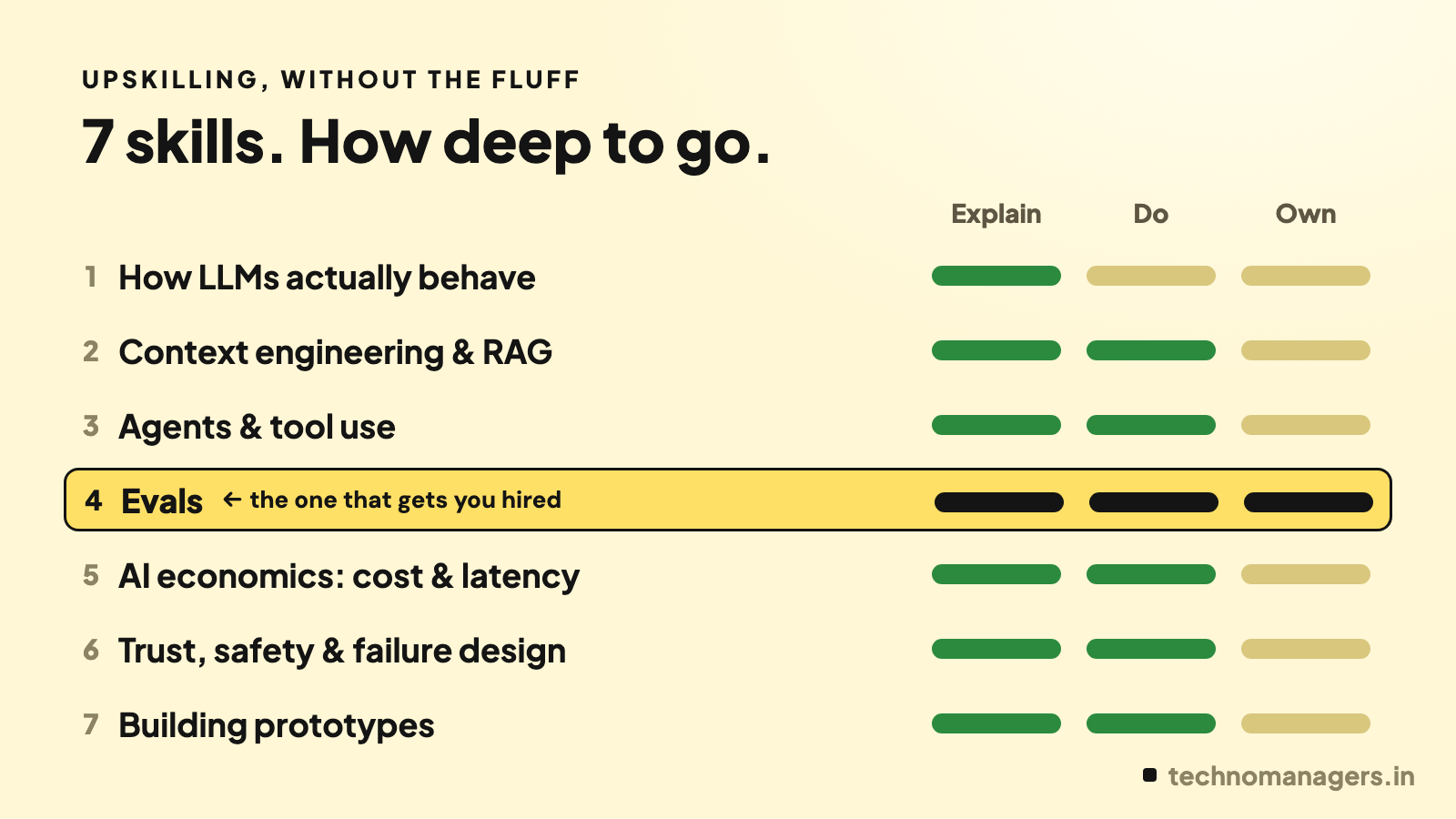
How deep: Explain-it level.
You’ve got it when: you can explain to a non-tech friend why a chatbot invented a fake court case, and what you’d change in the product so it doesn’t happen again.
Learn from: Andrej Karpathy’s free one-hour talk “Intro to Large Language Models” on YouTube. If you want more, his “Deep Dive into LLMs like ChatGPT” is the best free explanation on the internet.
Skill 2: Context engineering (prompting, grown up)
Prompting is writing a good instruction. Context engineering is deciding everything the model sees before it answers: instructions, examples, retrieved documents, conversation memory, tool results and the output format you demand.
Most “the AI is dumb” problems are really “we gave the AI the wrong context” problems.
Inside this sits RAG (retrieval-augmented generation): fetching the right facts from your own data and putting them in front of the model, so it answers from your sources instead of its memory.
The decision rule every AI PM should know:
Better prompts come first. Always. They’re the cheapest fix.
RAG changes what the model knows. Use it for fresh, private or citable facts: help docs, policies, catalogues.
Fine-tuning changes how the model behaves. Use it for consistent format or tone, or a narrow skill at scale.
Long context is brute-force RAG. Fine when your data is small and cost doesn’t matter.
How deep: Do-it level. You should write system prompts and structure context yourself.
You’ve got it when: you can take a messy prompt, add three good examples and a structured output format, and measurably improve the results.
Learn from: Anthropic’s free interactive prompt engineering tutorial on GitHub, plus the prompting guides in Anthropic’s and OpenAI’s docs.
Skill 3: Agents and tool use
An agent is a model, plus tools it can call (search, a database, a calendar, a payments API), running in a loop until the task is done.
That’s it. The hype makes it sound mystical. It isn’t.
What matters for a PM:
Workflow or agent? If you can draw the steps as a flowchart, build a workflow: predictable, cheap, testable. Use an agent only when the path genuinely can’t be predicted.
MCP (Model Context Protocol) is the emerging standard for plugging AI into tools and data. Think of it as USB-C for AI apps. Know what it is and why it matters for integrations.
How agents fail: picking the wrong tool, calling the right tool with wrong inputs, looping forever, taking irreversible actions without confirmation, and obeying malicious instructions hidden in text they read (prompt injection).
How deep: Do-it level for workflows, explain-it level for agent architecture.
You’ve got it when: you can look at a use case and say “this should be a 3-step workflow, not an agent, and here’s why”, and you can point to exactly where a human must approve.
Learn from: Anthropic’s essay “Building Effective Agents” and OpenAI’s free guide “A Practical Guide to Building Agents”. Then build one workflow in n8n or Zapier with an LLM step.
Skill 4: Evals, the skill that gets you hired
If you go deep on only one thing in this entire guide, make it this one.
Evals are how you measure whether your AI product is good. Without them, every prompt change is a vibe check and every model upgrade is a gamble. With them you can say:
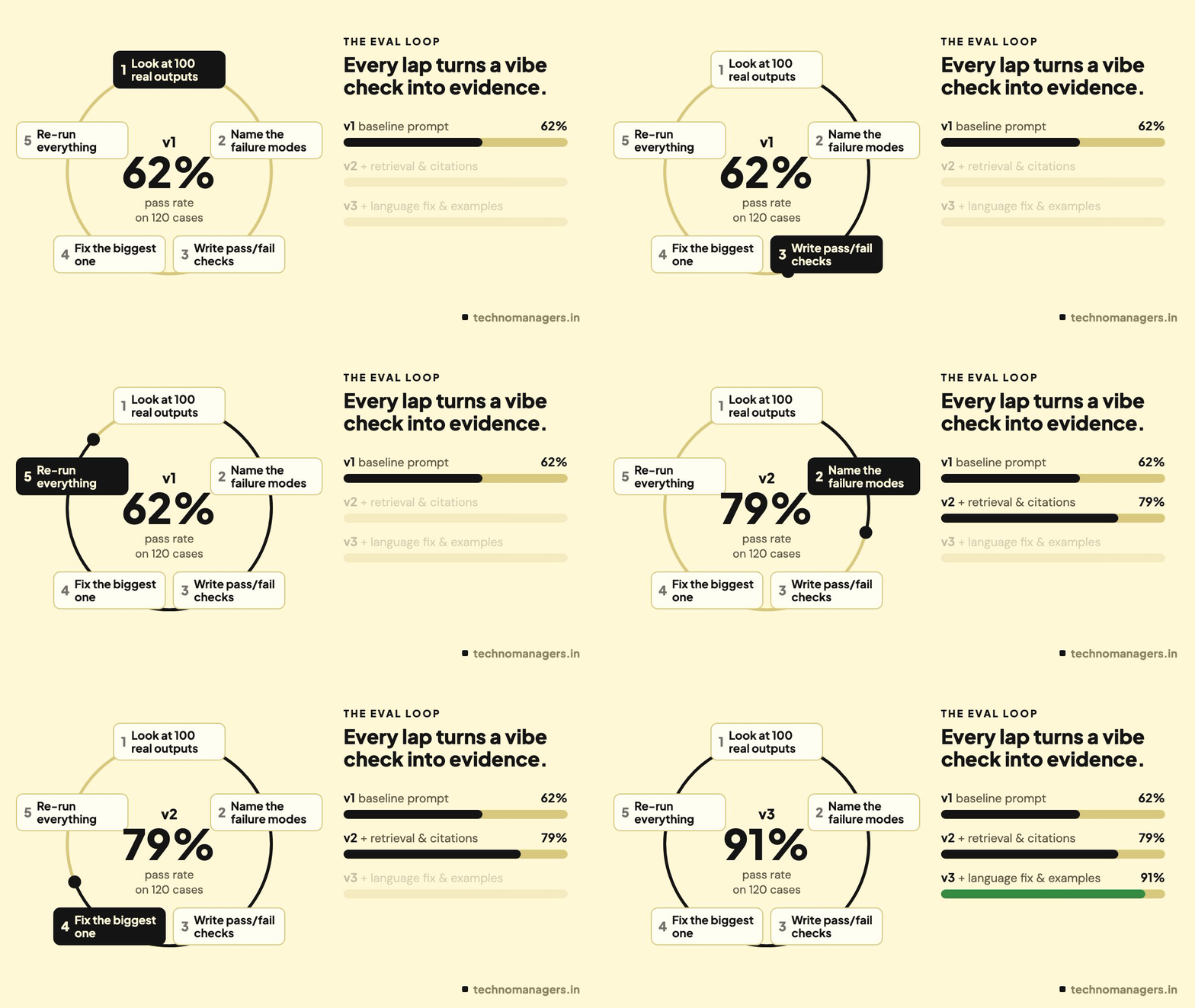
“v3 passes 91% of our 120 test cases, up from 62%, and it no longer invents refund policies.”
That sentence gets people hired.
Here’s the practical process, popularised by Hamel Husain and Shreya Shankar, whose work on evals every AI PM should read:
Look at the data. Run your AI on 50 to 100 realistic inputs and read every output. Yes, by hand. Everyone wants to skip this step, and it’s the one that matters most.
Write notes on what went wrong, in plain words. “Missed the actual question.” “Made up a refund window.” “Replied in English to a Hindi question.”
Group the notes into failure modes and count them. Now you have a ranked list: invented policy details 14 out of 100, ignored order context 9, wrong language 6.
Fix the biggest failure mode first, through the prompt, the context, retrieval or the product design.
Write a check for each failure mode. Use simple code checks where you can (format, length, required fields). For judgment calls, use an “LLM-as-judge”: a model that grades one specific thing as pass or fail. Not a 1-to-5 score. Pass or fail.
Validate each judge against your own labels before you trust it.
Re-run everything on every change. Congratulations: you now have regression tests for an AI product.
In production, add online metrics: task success rate, how often users accept the AI’s output versus edit it, how often they escalate to a human, retries, and guardrail metrics such as hallucination reports. (Thumbs up/down is a weak signal. Few people click it, and the ones who do are usually annoyed.)
How deep: Own-it level. This is your job, not engineering’s.
You’ve got it when: you’ve built an eval set of 50+ cases for your own project, found its failure modes through error analysis, and moved the pass rate with evidence.
Learn from: Hamel Husain’s blog (start with “Your AI Product Needs Evals” and the evals FAQ he wrote with Shreya Shankar) and the evaluation chapters in Chip Huyen’s book AI Engineering.
Skill 5: AI economics (cost, latency, margin)
In normal software, serving one more user costs almost nothing. In AI, every request has a real cost. Price a ₹299 monthly plan for users who burn ₹400 of model costs and you’ve built a beautiful product that loses money on every customer.
Know how to:
Estimate cost per task: input and output tokens multiplied by price, times the average number of model calls per task.
Think in latency budgets. Time to the first word matters more than total time, which is why chat apps stream their answers.
Pull the levers: smaller models for easy tasks, routing, caching, shorter context, batching.
Connect all of it to gross margin and pricing.
How deep: Do-it level, in a spreadsheet.
You’ve got it when: you can tell me what 1,000 uses of your project cost, and how you’d cut that in half.
Skill 6: Trust, safety and designing for failure
AI-first companies increasingly test this directly, and good interviewers notice when you bring it up without being asked.
Cover these: hallucinations and grounding (citations), privacy (which user data goes to which model provider, and how long it’s kept), bias (who does this fail for?), prompt injection, harmful content, and the UX of failure: confidence signals, “I’m not sure”, easy undo, a route to a human.
How deep: Explain-it level plus design-it level.
You’ve got it when: for any AI feature, you can name its top three ways to cause harm and the product decision that reduces each one.
Skill 7: Building. Yes, you.
Here’s the shift most people still haven’t absorbed: AI PMs are now expected to build.
LinkedIn made it explicit. It replaced its well-known Associate Product Manager program with an Associate Product Builder track, a shift its CPO at the time, Tomer Cohen, explained on Lenny’s Podcast. And according to interview coaches and candidate reports, several companies now run live prototyping rounds where you build something with AI tools in under an hour.
Building doesn’t mean becoming an engineer. It means you can go from idea to working prototype in a weekend with AI coding tools like Claude Code, Cursor, Lovable, v0, Bolt or Replit, and workflow tools like n8n.
Why it matters: a PM who walks in with a working prototype and eval results wins the argument in every meeting. And in every interview.
How deep: Do-it level. Prototype quality, not production quality.
You’ve got it when: you’ve shipped two or three small AI tools that real people (even five friends) have used.
What you can safely skip
Backpropagation math and training models from scratch
Kaggle competitions
Your fifth prompt engineering certificate
Tracking every model launch (follow the big shifts, ignore the noise)
Three months of Python before you build anything (build with AI tools, learn code as you need it)
Mentor’s note: Certificates aren’t useless. They just aren’t proof. Use courses to learn fast. Use projects to prove it.
Part 3: The 90-day AI PM roadmap (for people with a full-time job)
This plan assumes 8 to 10 hours a week: about an hour on weekdays and a few hours at the weekend. Change the pace if you need to. Don’t change the order.
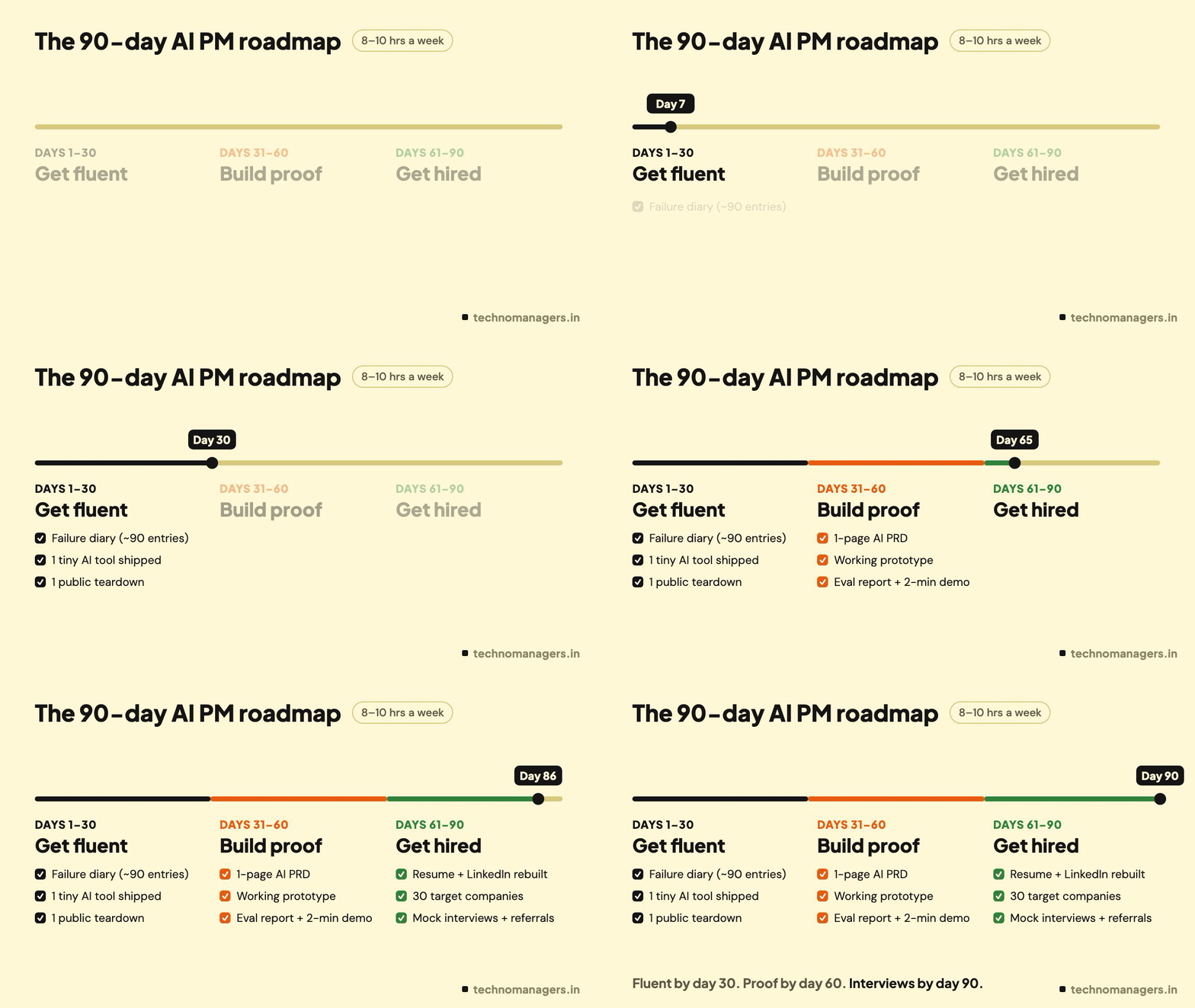
Days 1–30: Get fluent
Week 1: How LLMs behave. Watch Karpathy’s intro talk. Start a failure diary: use Claude, ChatGPT or Gemini for real work every day and write down three times it got something wrong, and why. By day 30 you’ll have about 90 entries and an intuition most candidates don’t have.
Week 2: Context engineering and RAG. Do Anthropic’s prompt engineering tutorial. Load your own documents into NotebookLM or a Claude Project and stress-test it. Where does it make things up? What happens when the answer isn’t in the documents?
Week 3: Agents and tools. Read “Building Effective Agents”. Build one n8n or Zapier workflow with an LLM step, for example “summarise new support emails and tag their urgency in a sheet”. Connect one MCP server to Claude Desktop and watch the tool calls happen.
Week 4: Ship something tiny, and publish a teardown. Use Lovable, v0 or Claude Code to ship a one-page AI tool over a weekend. Then post a public teardown of an AI product you use: what job is the model doing, where does it fail, how does the product handle failure, and what would you change?
Day 30 checkpoint: a failure diary with about 90 entries, one tiny shipped tool, one public teardown.
Days 31–60: Build your proof
Week 5: Pick your problem and write the AI PRD. (The template is in Part 4.)
Week 6: Build v1. Ugly is fine. Working is the bar. Collect 50 to 100 realistic test inputs.
Week 7: Error analysis and evals. Read every output. Name the failure modes. Fix the top two. Re-run. Record the before and after.
Week 8: Economics, users and story. Work out the cost per use. Get five real people to try it and write down what they say. Record a 2-minute demo. Write the case study.
Day 60 checkpoint: your Proof Pack is done.
Days 61–90: Get hired
Week 9: Rebuild your resume and LinkedIn around the AI work (Part 5). Build a target list of 30 companies.
Week 10: Start conversations, not applications. Aim for five conversations a week with AI PMs (the scripts are in Part 6).
Weeks 11–12: Interview reps. Two mock interviews a week. Practise the PROBE framework on 20 questions. Do three timed, 45-minute prototyping drills.
Week 13: Apply through referrals, with proof attached. Follow up. Keep building in public.
The shortcut: become the AI PM where you already work
If you’re already a PM, the fastest AI PM job is often the one you already have. Companies are desperate for people who can make AI work inside their existing products. Be that person.
Find the AI-shaped problem in your product. Look for high-volume, text-heavy, repetitive work: support tickets, search, onboarding questions, review moderation, sales call notes, data entry.
Prototype it over a weekend, using public or dummy data only. Never paste confidential company data into tools your company hasn’t approved. Getting this wrong ends an AI PM career before it starts.
Run a mini eval on 30 to 50 realistic cases.
Pitch a 2-week experiment to your manager. Something like this:
Hey [Manager], I've been digging into our [support tickets / search drop-offs].
About [X]% of them are [repetitive question type].

Over the weekend I built a rough prototype that drafts answers from our public
help docs (2-min demo: [link]). On 40 sample questions it got 33 right, and
the misses were all [pattern]. Estimated cost: about ₹[Y] per 1,000 tickets.

Could I take 2 weeks to test it with the support team in shadow mode?
I'd report back on accuracy, time saved and risks.
Ship that, and “AI PM” stops being a goal and becomes a line on your resume.
Part 4: The Proof Pack. One project that does the work of 50 applications
This is the heart of the guide. If you skim everything else, don’t skim this.
A hiring manager reading AI PM applications is asking one question: “Can this person ship an AI product that actually works?” A certificate can’t answer that. A Proof Pack can.
What makes a good project
Run your idea through five filters:
A real user with a real problem, ideally from your own domain. Not “a chatbot for everything”.
AI is essential. Rules or a simple search couldn’t do the job.
Quality is measurable. You can tell a right output from a wrong one.
It has failure modes worth managing. That’s where you get to show judgment.
It’s small enough to ship in four weeks.
Project ideas by background
Fintech or banking PM: a dispute-resolution copilot that reads a transaction history and the policy, then drafts a response with citations. Evals: policy correctness, citation accuracy, tone.
E-commerce PM: a review-to-insights agent that turns 5,000 product reviews into a ranked list of issues. Evals: does it catch the issues a human finds in a 100-review sample?
SaaS or B2B PM: support ticket triage that classifies urgency and drafts replies from help docs. Evals: routing accuracy, whether answers stick to the docs, correct escalation.
Engineer moving to PM: a plain-English-to-SQL analyst for a sample database, with a 60-question eval set. Evals: query correctness, and asking for clarification when a question is ambiguous.
Ed-tech, ops or non-tech: a homework tutor that guides students without handing over answers. Evals: did it reveal the final answer, is it accurate, is it age-appropriate?
The 5 artifacts in a Proof Pack
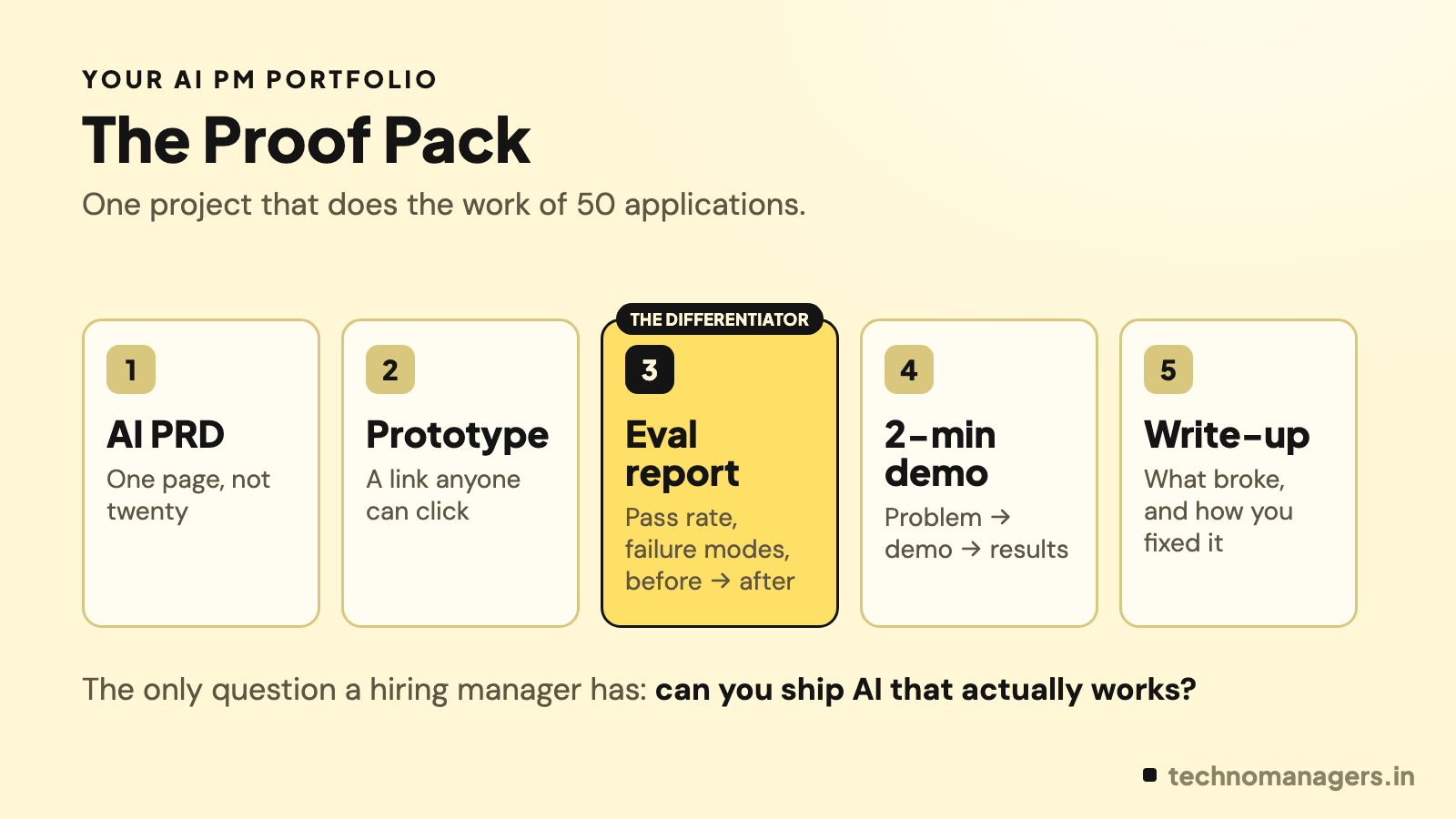
1. A one-page AI PRD. Not a 20-page document. Use this skeleton:
AI PRD: [Project name]

1. Problem & user: who, what job, how they do it today, what it costs them
2. Why AI, and why not rules or search
3. Autonomy level: suggest / draft / act with approval / act on its own
4. Quality bar: 3 examples of a great output, 3 of an unacceptable one
5. Failure modes & fallback UX: what breaks, and what the user sees when it does
6. Eval plan: test set (size, sources), checks, the pass rate needed to ship
7. Success metric + guardrail metric
8. Model, cost & latency: model choice, cost per task, latency budget
9. Data & privacy: what data, where it goes, how long it's kept
10. Launch plan: shadow mode → 5% → 50% → 100%, with rollback criteria
2. A working prototype. A link anyone can click, or a recorded walkthrough if it can’t be public.
3. An eval report. This is the artifact that separates you from almost everyone else applying. Something like this:
Eval set: 120 real-world inputs
(40 easy, 50 typical, 30 edge cases including Hinglish)

v1  baseline prompt                 pass rate 62%
    Top failure modes:
      Invented policy details       17 / 120
      Ignored order context         11 / 120
      Replied in the wrong language  7 / 120

v2  + retrieval and citations       pass rate 79%
v3  + language detection, examples  pass rate 91%

Cost: ₹0.38 per query   |   p95 latency: 2.1s
Still failing: questions about multiple orders → routed to a human
(These numbers are illustrative. Use your real ones. Honest numbers with a clear story beat impressive numbers every time.)
4. A 2-minute demo video. Problem, demo, eval results, what you’d do next. Hiring managers will watch two minutes. They won’t read twenty pages.
5. A public write-up. A LinkedIn post or Medium article: “I built X. Here’s what broke, and how evals helped me fix it.” It becomes your interview story, your outreach hook and your inbound magnet, all at once.
Want to build your Proof Pack with structure and feedback? That’s what the capstone in our AI Product Builder Cohort is built around: 12 weekends of live sessions, a mentor-reviewed capstone, mock interviews and a demo day where you present it.
Part 5: Your AI product manager resume and LinkedIn
Recruiters spend seconds, not minutes, on a first scan. TheLadders’ eye-tracking study clocked it at about seven. In those seconds they’re looking for one thing: evidence that you’ve shipped AI that worked.
The bullet formula
Action + AI mechanism + quality proof + business outcome.
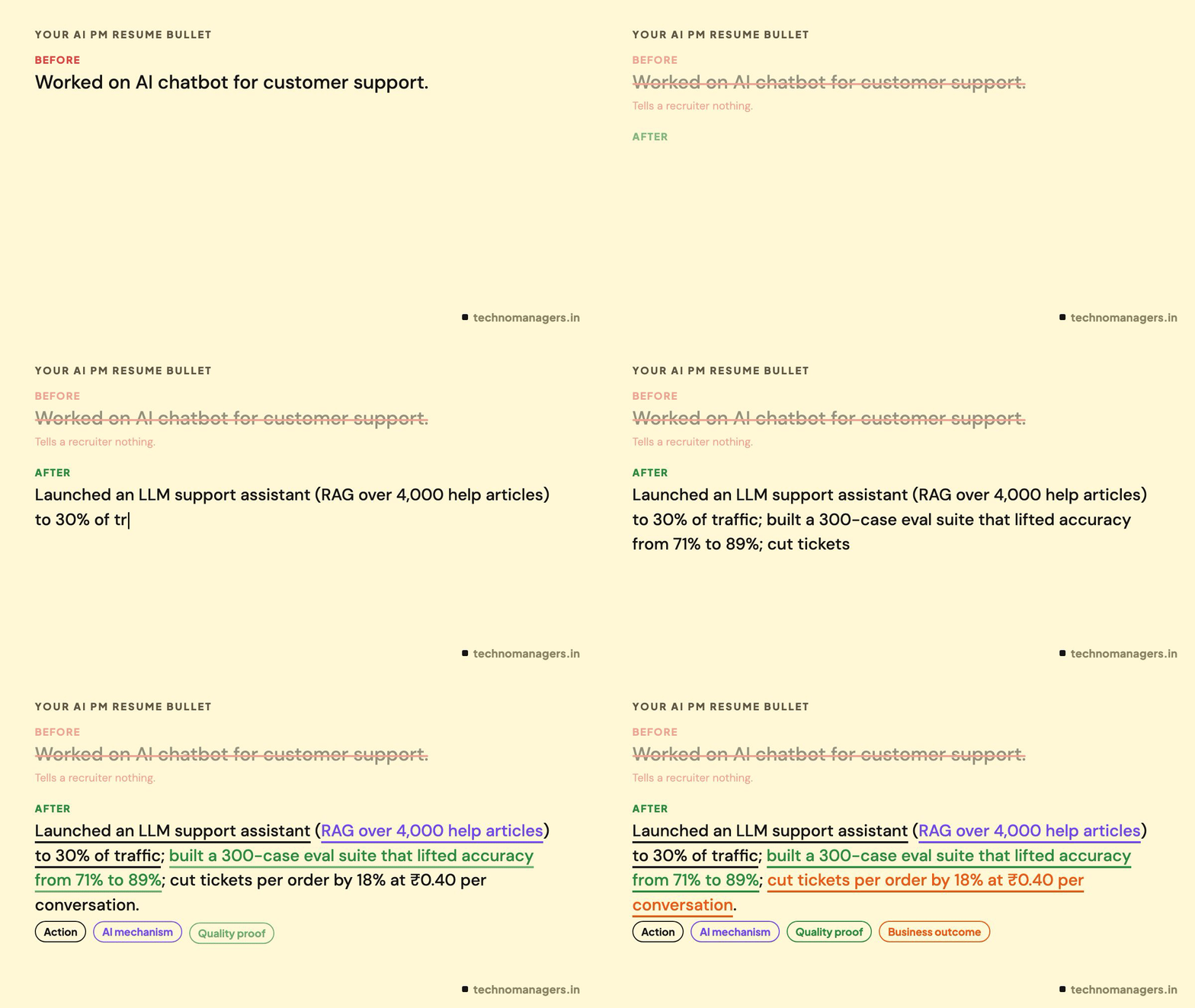
Three before-and-afters (illustrative):
❌ “Worked on AI chatbot for customer support.”
✅ “Launched an LLM support assistant (RAG over 4,000 help articles) to 30% of traffic; built a 300-case eval suite that lifted answer accuracy from 71% to 89%; cut support tickets per order by 18% at ₹0.40 per conversation.”
❌ “Used ChatGPT to improve team productivity.”
✅ “Built an AI workflow (n8n + Claude) that drafts weekly competitor briefs from 40 sources; cut analyst prep time from 6 hours to 45 minutes; adopted by 3 teams.”
❌ “Led recommendation feature.”
✅ “Owned ML-ranked recommendations for 2M monthly users; defined offline and online quality metrics with data science, ran 6 A/B tests, and lifted add-to-cart by 9%.”
That third one matters more than you think. Lots of PMs already have AI and ML experience and never claim it. Search ranking, recommendations, fraud detection, forecasting, personalisation: if a model was in the loop and you made decisions about its quality, that’s AI product experience. Translate it. Never fabricate it.
Fix your skills section
Weak: “AI/ML, ChatGPT, Generative AI, Prompt Engineering”
Strong: “LLM evals (error analysis, LLM-as-judge) · RAG · agent workflows (n8n, MCP) · prototyping (Claude Code, Cursor, Lovable) · AI unit economics · A/B testing”
Mirror the wording of the job description. Screening software and recruiters both search for it.
LinkedIn in 3 moves
Headline: “Product Manager | Building AI products for [your domain] | Evals · RAG · Agents”. Never “Aspiring AI PM”. Drop “aspiring” forever.
Featured section: your Proof Pack. Demo video, case study, eval report.
Build in public: one post a week on something you built, broke or learned. Your failure diary is a content goldmine.
Resume red flags
A wall of course certificates at the top
“Passionate about AI” (everyone is)
AI in your skills section and zero AI in your experience
Accuracy numbers with no context. “95% accurate” on what? Measured how?
Part 6: Approaching companies, and actually getting interviews
Most job searches look like this: apply to 300 roles on LinkedIn, wait, feel rejected, repeat.
Here’s better math: 30 companies, deep. Not 300, shallow.
Pick targets in three tiers
AI-enabled companies in your domain. Your highest-probability bet, because your domain knowledge is the edge.
AI-native startups. They hire builders, so your Proof Pack matters more than your pedigree.
AI labs and big tech AI teams. The stretch. Go for it, but don’t put every egg here.
A good split is 15, 10 and 5.
Spend your time like this
70% on conversations and referrals. Research from the New York Fed found that referred applicants are more likely to be hired. And a warm intro gets your Proof Pack actually opened.
20% on targeted applications, each with a tailored resume and a proof link.
10% on building in public, so some opportunities start coming to you.
Script 1: The insight ask (to an AI PM at a target company)
Hi [Name], your post on how [Company] evaluates its [AI feature] stuck
with me, especially [specific point]. I'm a [fintech] PM moving into AI
products and just built [project] (2-min demo: [link]).

Would you be open to a 15-min chat about what separates strong AI PMs on
your team? Happy to work around your calendar.
It’s specific, short, comes with proof, and asks for insight, not a job.
Script 2: The proof-first note (to a hiring manager)
This is the most effective cold outreach I know for AI PM roles:
Hi [Name], I saw the AI PM opening on your [team].

I used [their product] for a week and noticed [a specific AI failure, e.g.
the assistant ignores order history for repeat customers]. I prototyped a
fix: [one line]. Tested on 60 cases, the pass rate went from 58% to 87%.
2-min walkthrough: [link]

I'd love to talk about how I'd approach this on your team.
Resume attached.
You’re not asking for a chance. You’re showing you’ve already started doing the job.
Script 3: The referral ask (after a good conversation)
Thanks again for yesterday. Your point about [X] was really useful.

Based on what you shared, I'm applying for [role + job ID]. Would you be
comfortable referring me? To make it easy, here's a 2-line blurb:

"[Your name] is a [domain] PM who built [project], an AI [X] with a
120-case eval suite (62% → 91% pass rate). Strong fit for [team]."
Make referring you a 30-second job. People are kind, and they’re also busy.
The follow-up rhythm
Day 0: send. Day 4: a short nudge with something new, like a new result or a relevant post. Day 10: a final, gracious close. Then stop. Track everything in a simple sheet: company, person, date, status, next step.
Part 7: Cracking the AI PM interview
The interview loops have changed. Based on interview coaches and candidate reports through 2026:
AI product sense rounds are now common at AI-first companies. OpenAI reportedly made one a required round.
Meta has reportedly added a “product sense with AI” round for some PM roles, including live prototyping.
Live “vibe coding” rounds, where you build a working prototype in about 45 minutes with AI tools, show up at a growing number of companies.
Safety and responsible AI come up everywhere, and at some labs (Anthropic, reportedly) as a dedicated round.
Always confirm the exact loop with your recruiter. But prepare for these question types.
Type 1: AI product sense. Use PROBE.
“Design an AI feature for X.” This is the big one. Here’s the framework I teach:
P: Problem and person. Who’s the user, what’s the job, how do they do it today, and what hurts?
R: Right tool? Does this actually need AI, or would rules, search or better UX solve it? Where on the autonomy ladder should you start?
O: Output bar. What does “good” look like? Give examples. What error rate is acceptable given the stakes?
B: Breakage. How will it fail: hallucination, bias, latency, prompt injection, misuse? What does the user see when it fails? Where’s the human?
E: Evals and economics. How will you measure quality offline and online? What does each task cost? How will you launch safely?
Worked example: “Design an AI feature to help small sellers on a marketplace like Etsy or Meesho.”
P: First-time sellers listing products from a phone, often in a regional language. Their pain: weak titles and photos lead to poor discoverability, few sales, and churn. The metric that matters: the share of new sellers who make a sale within 30 days.
R: AI genuinely helps here. Turn a product photo plus a voice note in Hindi into a complete listing: title, description, category and attributes. Rules can’t do that. Start on the “Draft” rung, so the seller reviews everything before it goes live.
O: Good means the right category, accurate attributes, no invented claims (no “100% cotton” unless the seller said so), and wording buyers actually search for. Wrong categories kill discoverability, so the bar there is high.
B: The risks are invented product claims (returns and legal risk), wrong categories, brand-infringing or offensive content, and prohibited items. Mitigations: never generate claims the seller didn’t state, and ask a follow-up question instead; when category confidence is low, show the top three options; run a policy check before anything is published.
E: Offline, use 300 real listings labelled by category experts, with pass/fail checks for invented claims, category accuracy and language match. Online, track listing completion rate, how much sellers edit the AI’s draft, time to first sale, and return rate as a guardrail. On economics: if one model call per listing costs around a rupee or two, it pays for itself many times over if first-sale rates move. Launch to 5% of new sellers in one category and compare against a holdout group.
Notice what happened there. The answer isn’t “use GPT to write descriptions”. It’s a product decision with failure design and measurement built in. That’s the bar.
Type 2: Evals. Here’s a full sample answer.
“How would you evaluate an AI meeting-notes summariser?”
Here’s what a strong answer sounds like:
“First, I’d define what users actually need from a summary. For most meetings that isn’t nice prose. It’s decisions, action items and owners. So my quality bar is built around those.
Second, before I define any metric, I’d read 100 real summaries next to their transcripts and note what goes wrong. My guess is we’d see missed action items, the wrong owner assigned, ‘decisions’ that were only discussed, summaries that run too long, and sensitive details surfacing in widely shared notes. But I’d let the data tell me.
Third, offline evals. A golden set of about 150 meetings covering 1:1s, stand-ups, sales calls, bad audio and code-mixed languages like Hinglish. Code checks for structure and length. Then one LLM judge per failure mode, each pass/fail. For example: ‘Was every decision in this summary explicitly agreed in the transcript? Yes or no.’ I’d check each judge against human labels before trusting it.
Fourth, online metrics: action-item acceptance rate, edit rate, how often summaries get shared, and a ‘report an error’ signal. Guardrails: reported hallucinations and p95 latency.
Fifth, a ship gate. A new prompt or model ships only if it doesn’t regress on invented decisions, even if it improves everywhere else. A summary that invents a decision is worse than no summary at all.”
That last line is what makes an interviewer lean forward. It shows judgment, not just process.
Type 3: Metrics and debugging
“Thumbs-down on your AI assistant jumped 40% after a model upgrade. What do you do?”
The skeleton: confirm it’s real (volume, logging changes). Segment it by query type, language, user group and platform. Find what changed: the model, the prompt, retrieval, or the mix of traffic. Pull 50 thumbs-down conversations and do error analysis. Run the old and new models on your eval set side by side. Decide between rolling back and fixing forward based on severity. Then add the new failure mode to your eval set so it can never regress silently again.
Type 4: Technical depth
Expect questions like “RAG or fine-tuning for a legal Q&A product?”, “How would you cut latency in half?”, “Why does the model give different answers to the same question?” and “How do you reduce hallucinations?”
Use the decision rules from Part 2. Talk in tradeoffs, not buzzwords.
Type 5: Strategy
“Everyone uses the same foundation models. Where’s the moat?” Strong answers cover proprietary data and feedback loops, deep workflow integration, distribution, trust, and one people underrate: the quality of your evals. The team that measures quality best improves fastest.
Type 6: Safety and responsibility
“You’re building an AI tutor for 10-year-olds. What could go wrong?” Cover age-appropriate content, not simply handing over answers, privacy for minors’ data, visibility for parents, escalation when a child seems distressed, red-teaming before launch and monitoring after it.
Type 7: Behavioural, AI edition
The classic questions now come with an AI twist: “Tell me about a time a model’s performance dropped in production”, or “a time you chose between accuracy and latency”. Your Proof Pack and failure diary are your story bank.
Type 8: The live prototyping round
Have your stack ready and practised. For example, Lovable or v0 for the interface and Claude Code or Cursor for the logic.
Spend the first five minutes on the user and the one thing the prototype must prove.
Build the thinnest working slice first. Polish last, if at all.
Narrate your tradeoffs out loud. They’re grading your judgment as much as the output.
Throw one or two tricky inputs at it before you present. Showing you looked for failure is a strong signal.
6 mistakes that sink AI PM interviews
Jumping to “use an LLM” without asking whether AI is needed at all
Treating “accuracy” as the only metric
Never mentioning failure modes, or what the user sees when the AI is wrong
Ignoring cost and latency
No human in the loop for high-stakes actions
Buzzword soup (”agentic RAG with fine-tuned embeddings”) with no reasoning behind it
Want to practise? Our free question bank has real AI PM interview questions with sample answers, filterable by company and difficulty. Practise AI PM questions here.
Part 8: Not a PM yet? Your path by background
Software engineer. Your edge: technical depth and building speed. Your gap: user problems and prioritisation. Aim for AI platform or AI-native PM roles, and lead with a project where you made product calls, not just wrote code.
Data analyst or data scientist. Your edge: metrics and evaluation thinking, which is gold for evals. Your gap: product sense and leading stakeholders. Aim for AI-enabled PM roles in data-heavy domains, and make your Proof Pack evals-heavy.
Designer. Your edge: AI UX. Trust, failure states and the autonomy ladder are design problems. Your gap: metrics and technical tradeoffs. Aim for AI-native startups.
Consultant, business or ops. Your edge: domain and workflow knowledge. Your gap: technical fluency and shipping. Build two prototypes instead of one, and aim for AI-enabled companies in the industry you know.
Fresher or student. Be honest with yourself: junior AI PM roles are rare (about 2% of postings in that analysis). Better routes in are APM- or APB-style programs, product or founder’s-office roles at AI startups, and AI builder roles. Your Proof Pack matters even more for you, because it’s your only experience. Make it excellent.
FAQ: Becoming an AI product manager
Do I need to know coding to become an AI product manager?
You don’t need to write production code. You do need to build prototypes with AI coding tools, follow an architecture discussion, and understand tradeoffs like RAG versus fine-tuning. Today, “can’t build anything” is a real disadvantage.
How long does it take to become an AI PM?
For a working PM putting in 8 to 10 hours a week, about 90 days to be interview-ready with a strong Proof Pack, then one to three months of active searching. If you’re not a PM yet, budget 6 to 12 months, often through an internal move first.
Can a fresher become an AI product manager?
Yes, but rarely straight away, because most AI PM postings are senior. Freshers get in through APM- and APB-style programs, AI startups and exceptional public proof of building.
What is the salary of an AI product manager?
It varies widely by company, level and source. In India, Glassdoor data from mid-2026 puts the average around ₹30 LPA, with the middle half roughly between ₹18 and ₹45 LPA, and senior roles at top companies going well beyond that. In the US, median base pay across salary sources sits around $160,000 to $175,000, and analyses of Levels.fyi data put senior AI PM total compensation at top AI labs and big tech at roughly $450,000 to $570,000.
Is an AI PM certification worth it?
As a structure for learning, yes. As a hiring signal on its own, no. Choose learning that ends in a project you can show, because that’s what hiring managers evaluate.
What’s the difference between an AI PM and a regular PM?
A regular PM manages deterministic software. An AI PM manages probabilistic systems: defining quality, designing for failure, running evals, and balancing quality, latency, cost and risk.
Which tools should an AI PM learn?
One or two general assistants (Claude, ChatGPT, Gemini), one prototyping tool (Lovable, v0, Bolt), one AI coding tool (Claude Code or Cursor), one workflow tool (n8n or Zapier), and a way to run evals, even if it’s just a spreadsheet at first. Depth in a few beats a shallow tour of twenty.
Your next 24 hours
Don’t close this tab and “start on Monday”. Do three things today:
Start your failure diary. Use an AI tool for one real task. Write down one thing it got wrong, and why.
Pick your lane: AI-enabled, AI-native or AI platform. Write one sentence on why your background fits it.
Name your Proof Pack problem. One real problem in your domain that AI could solve. Just the sentence.
Then come back to this guide on day 30 and check yourself against the checkpoint.
The AI PM market isn’t short of people who’ve learned about AI. It’s short of people who can prove they’ve shipped it. Ninety days from now, you can be one of them.
See you on the other side.
If this helped, tap the heart, restack it, and forward it to one friend who keeps saying “I want to move into AI”. Subscribe if you want the deep dives on each part of this playbook in your inbox.
Want to go faster, with a mentor and a cohort? The AI Product Builder Cohort at Technomanagers is a 12-week weekend program built around exactly this playbook: live sessions, a mentor-reviewed capstone (your Proof Pack), mock interviews and a demo day.
Not ready for a cohort? Start free: practise real AI PM interview questions with sample answers.
"Start low on the ladder. Earn your way up with evidence." is advice for anyone rolling out agents, not only PMs. The automations I trust most all started at Draft and moved up only after a run of clean results.
the proof pack idea with a prd, prototype and eval report is so practical. have you seen it get someone hired yet?