

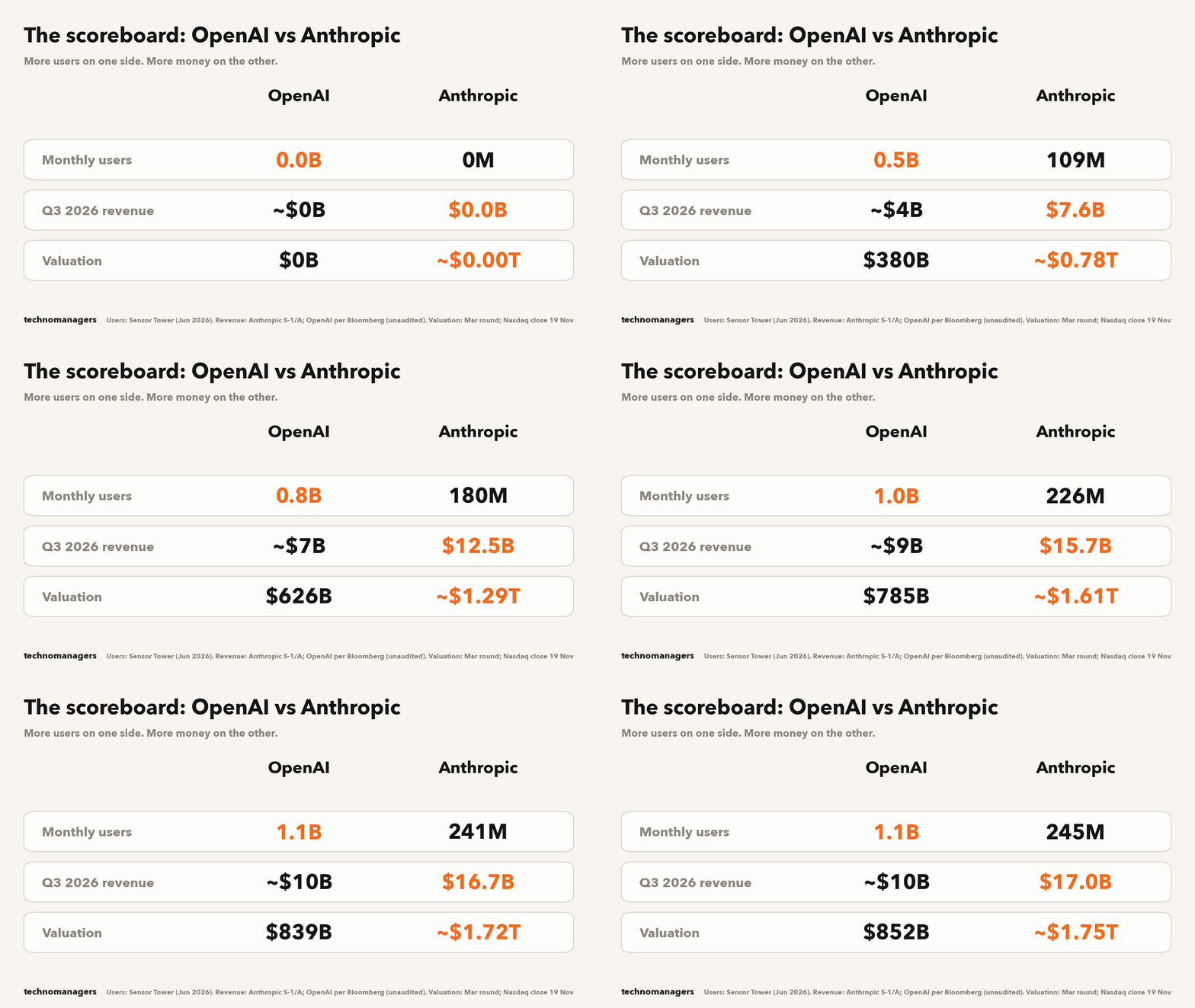
ChatGPT has more than 1.1 billion monthly users. Claude has about 245 million.
So OpenAI has roughly 4.5 times as many users.
Now look at revenue. From July to September 2026, Anthropic made $17.0 billion. OpenAI made about $10 billion.
The company with about a fifth of the users made 70% more money.
Most people read this one of two ways. Either “OpenAI is in trouble”, or “Anthropic has won”. Both are too simple. The real story is that these two companies run very different businesses, and each one has a weak spot the headlines skip.
Before we get into it, your gut call.
The scoreboard
Here are the numbers side by side.
Users. ChatGPT has more than 1.1 billion monthly users. Claude has about 245 million. These are Sensor Tower’s estimates from June 2026.
Revenue. Anthropic made $17.0 billion in July to September, according to its amended IPO filing. OpenAI made about $10 billion in the same quarter. That figure was reported from documents shared with investors, and it isn’t audited.
Value. Anthropic listed on Nasdaq on 19 November. It priced its shares at $83 and closed the first day at $97.17, which valued the company at about $1.75 trillion. OpenAI’s last price was $852 billion, set in its March funding round.
So the market values Anthropic at about twice OpenAI, with a fifth of the users.
If you think of AI as a popularity contest, this makes no sense. It makes sense once you see what each company actually sells.
The toss: two different businesses
OpenAI and Anthropic both build large language models. So we compare them like two brands of the same product. They aren’t.
Think about how you pay for things at home.
Your electricity has a meter. You pay for exactly what you use. Use more, pay more. The electricity company doesn’t need you to love it. It needs you to keep the lights on.
Now think about YouTube. Hundreds of millions of people watch it free. YouTube makes money by showing them ads, and by getting some of them to pay for Premium. That’s an audience business. It’s worth a lot, but only once you find a way to charge for the attention.
OpenAI built an audience. ChatGPT is a place people go. Most of them use it for free.
Anthropic built a meter. In the first half of 2026, 80% of its revenue was usage-based. Companies plug Claude into their own products and pay for every token, which is the small chunk of text the model reads or writes.
Here’s what that looks like in practice. Imagine you’re the PM for the customer support bot at Swiggy. Every time someone asks “where’s my order?”, your bot sends the question to Claude and gets an answer back. Swiggy pays for every one of those calls. During an IPL final, when orders spike, the bill spikes too. Nobody at Swiggy ever opens the Claude app. But Anthropic gets paid on every order.
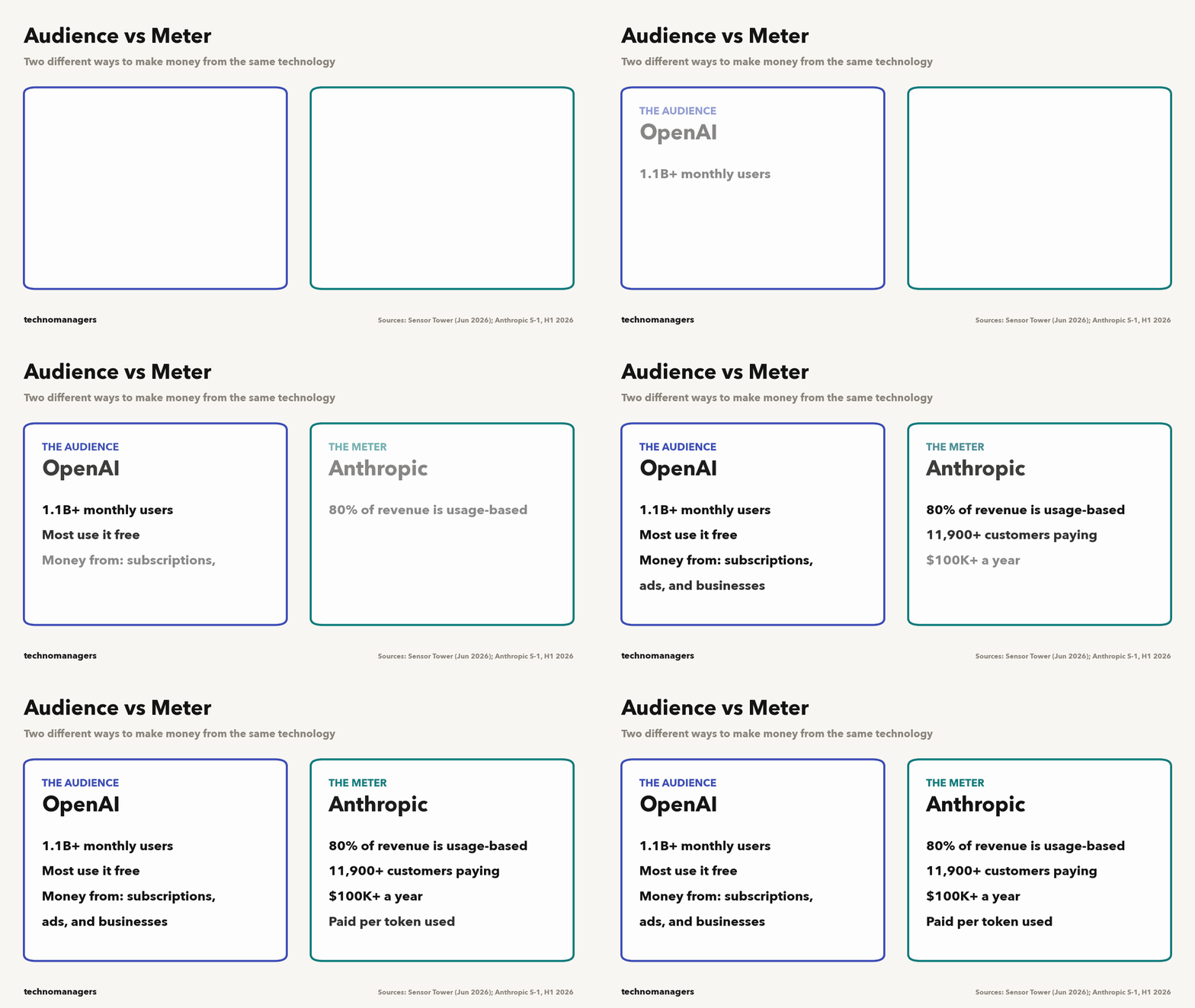
That’s the whole match in one line. OpenAI owns the audience. Anthropic owns the meter. In 2026, the meter is ahead on the scoreboard.
First innings: OpenAI bats for users
OpenAI’s innings is one of the fastest consumer launches in tech history. More than a billion monthly users in under four years.
The problem is how few of them pay.
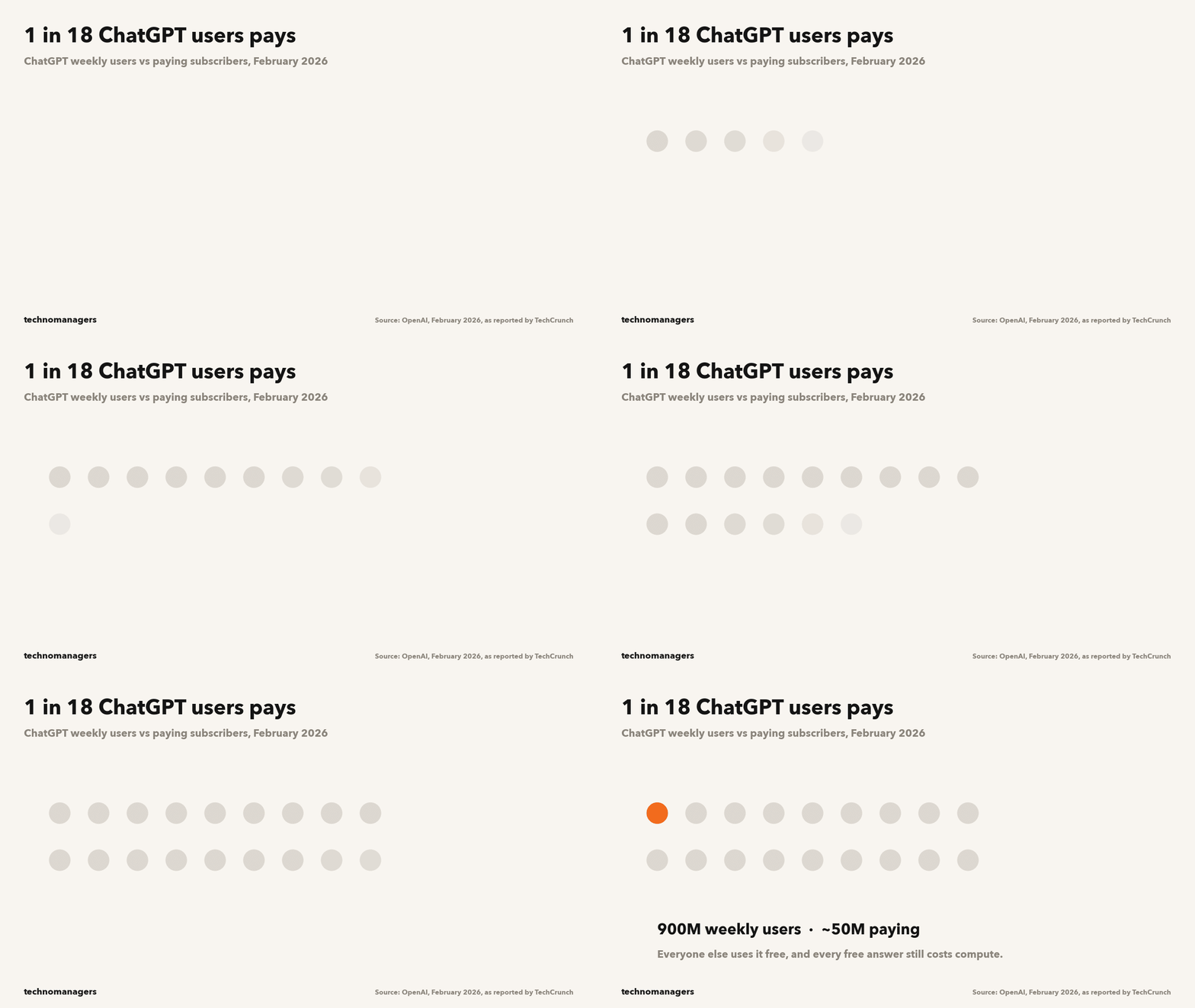
In February, OpenAI said ChatGPT had 900 million weekly users and about 50 million paying subscribers. That’s roughly 1 in 18 weekly users paying anything.
Our last piece covered the other side of this. Harvard tracked real card payments from 174 million Americans and found that only 2.9% pay ChatGPT, Claude, Gemini or Grok directly. (Full analysis here.)
Free users aren’t free to serve. Every answer runs on expensive chips. And you can see that cost in OpenAI’s numbers.
In July to September, OpenAI lost about $10.9 billion on an adjusted operating basis, on about $10 billion of revenue. Put simply, it spent roughly $2.09 to earn every $1. That adjusted figure also leaves out $2.6 billion of stock-based pay, so the real gap is a little wider.
To be fair, the loss is shrinking as a share of revenue. In April to June, it was about $1.50 lost for every $1 earned. In July to September, about $1.09.
OpenAI is working on this from two directions.
Selling to businesses. Estimates cited in the Harvard paper put consumer subscriptions at about 75% of OpenAI’s revenue in 2024 and about 60% at the start of 2026. The most consumer-facing AI company in the world is slowly turning into a business vendor.
Ads. ChatGPT ads are live. Writesonic found an ad in 16.1% of the ChatGPT answers it checked on 17 November. Sacra estimates the ad business was running at about $1 billion a year by August.
A billion dollars a year sounds big. Next to $10 billion a quarter, it’s a start.
Second innings: Anthropic bats for the meter
Anthropic’s innings is less exciting to watch, and far more efficient.
Its filing says more than 11,900 customers paid it at least $100,000 over the past year. More than 1,900 paid over $1 million. About 250 paid over $10 million.
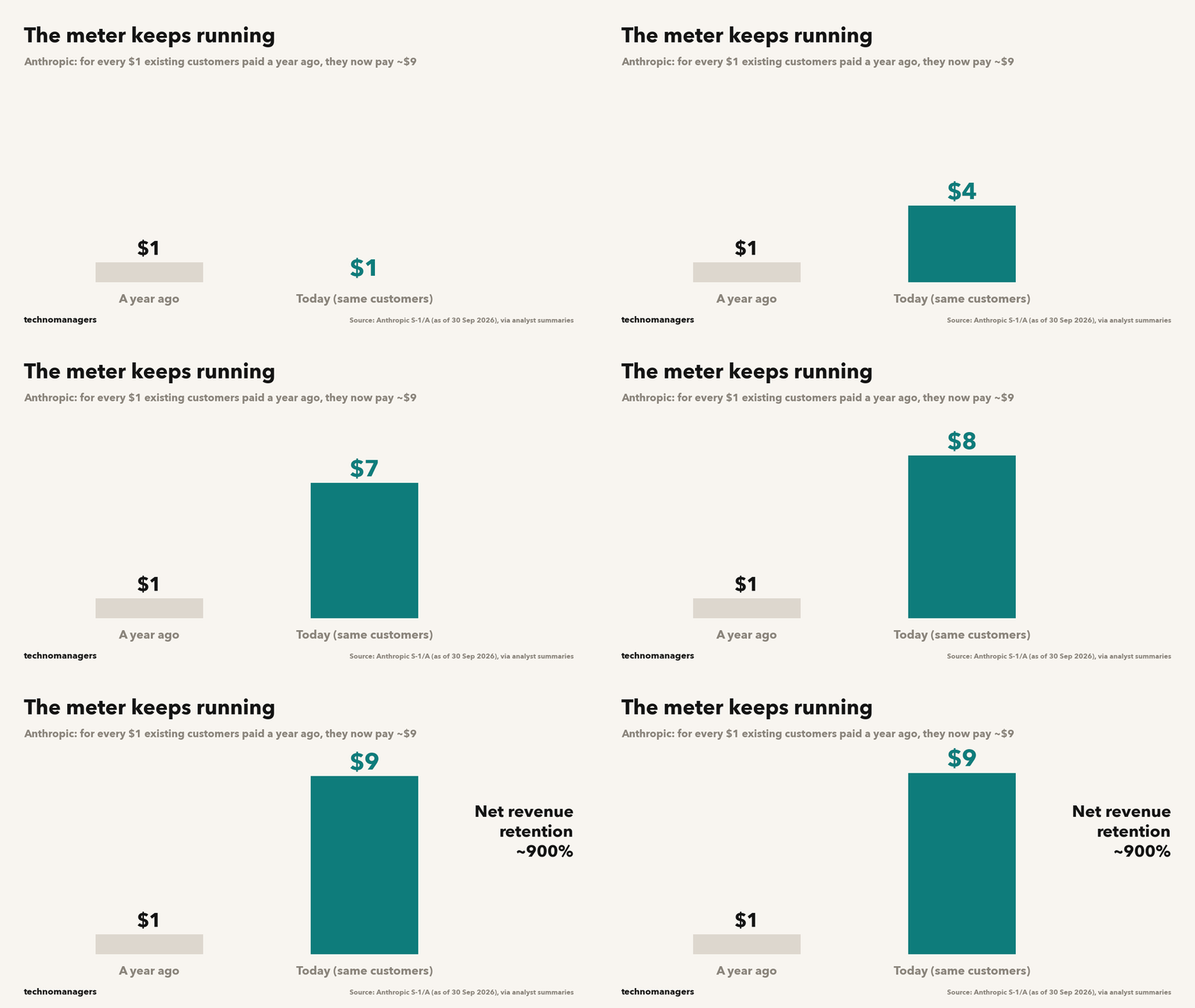
But the most important number in the filing is a different one. Anthropic reports net revenue retention of about 900%.
Here’s what that means in plain words. Take all the companies that were paying Anthropic a year ago. For every $1 they paid then, they now pay about $9. And that’s from the same customers, before counting a single new one.
That’s what a meter does when your customers grow. Swiggy’s support bot handles more chats. A coding tool adds more developers. A bank moves another team onto Claude. Nobody signs a new contract. The meter just keeps running.
The meter is also why the costs look so different. Anthropic made an operating profit of $974 million in April to June, its first profitable quarter in the filing. In July to September it slipped back to an operating loss of about $567 million, as reported from the amended filing. That works out to about $1.03 spent for every $1 earned.
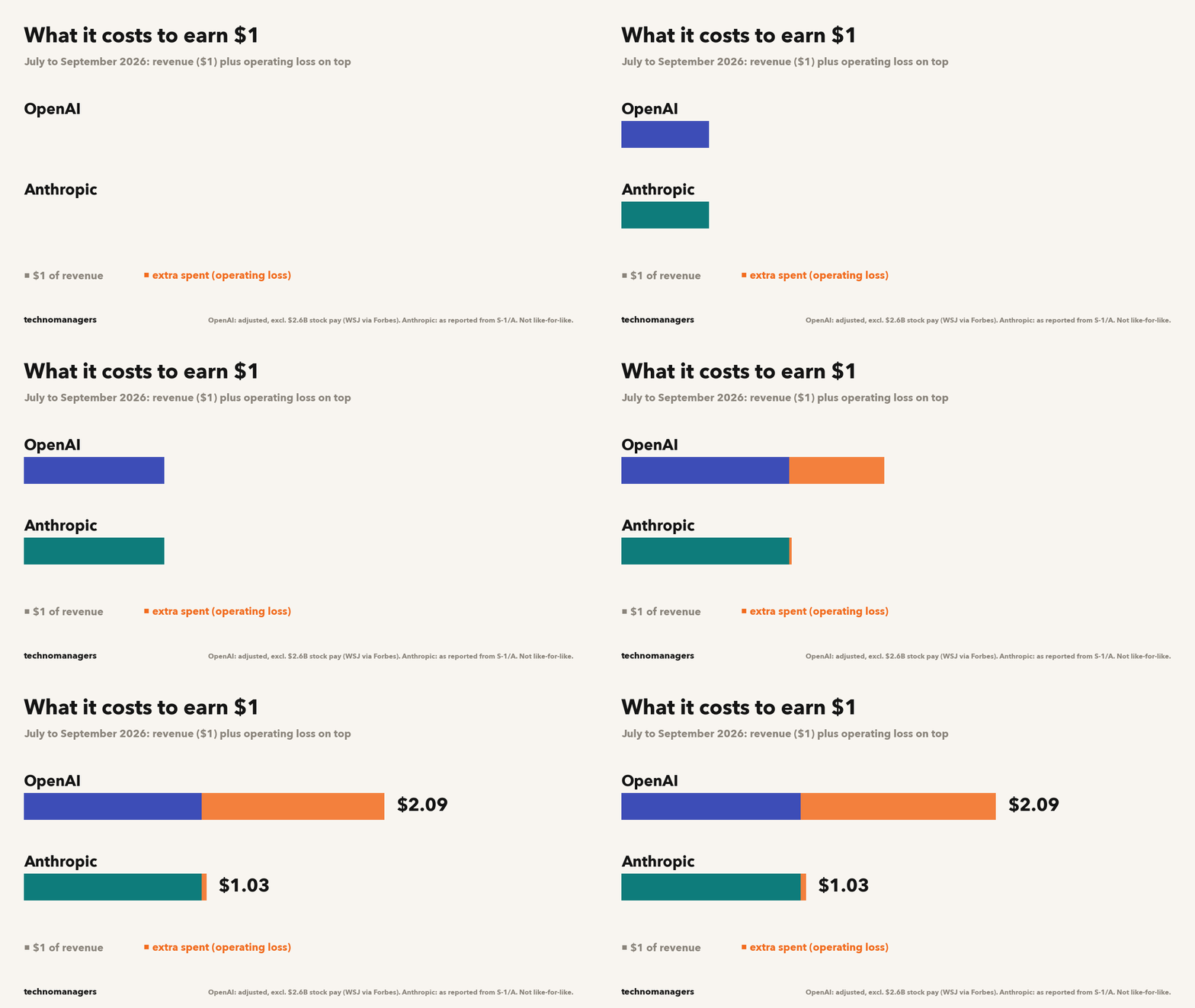
Compare the two. OpenAI spent about $2.09 to earn a dollar. Anthropic spent about $1.03. The two numbers aren’t measured in exactly the same way, because OpenAI’s is an adjusted figure. But the gap is too big to be an accounting quirk.
New here? Every week, we take one AI headline and work out who actually wins. We’ll update this scoreboard when the Q4 numbers land.
The DRS review: is the result real?
A good match report checks the umpire’s call. Here are the four strongest objections to “Anthropic is winning”, and how each one holds up.
Review 1: “They don’t count revenue the same way.”
This one is real. About 48% of Anthropic’s revenue in the first half of 2026 came through cloud marketplaces like AWS, Google Cloud and Azure. Anthropic counts the full amount the customer pays, before the cloud company takes its cut. OpenAI, according to analyses of both companies’ reporting, counts its revenue after Microsoft’s share.
So the comparison flatters Anthropic. One report, citing a person familiar with Anthropic’s finances, estimates that counting the same way would cut Anthropic’s revenue by 6 to 10%. In the worst case, $17.0 billion becomes about $15.3 billion.
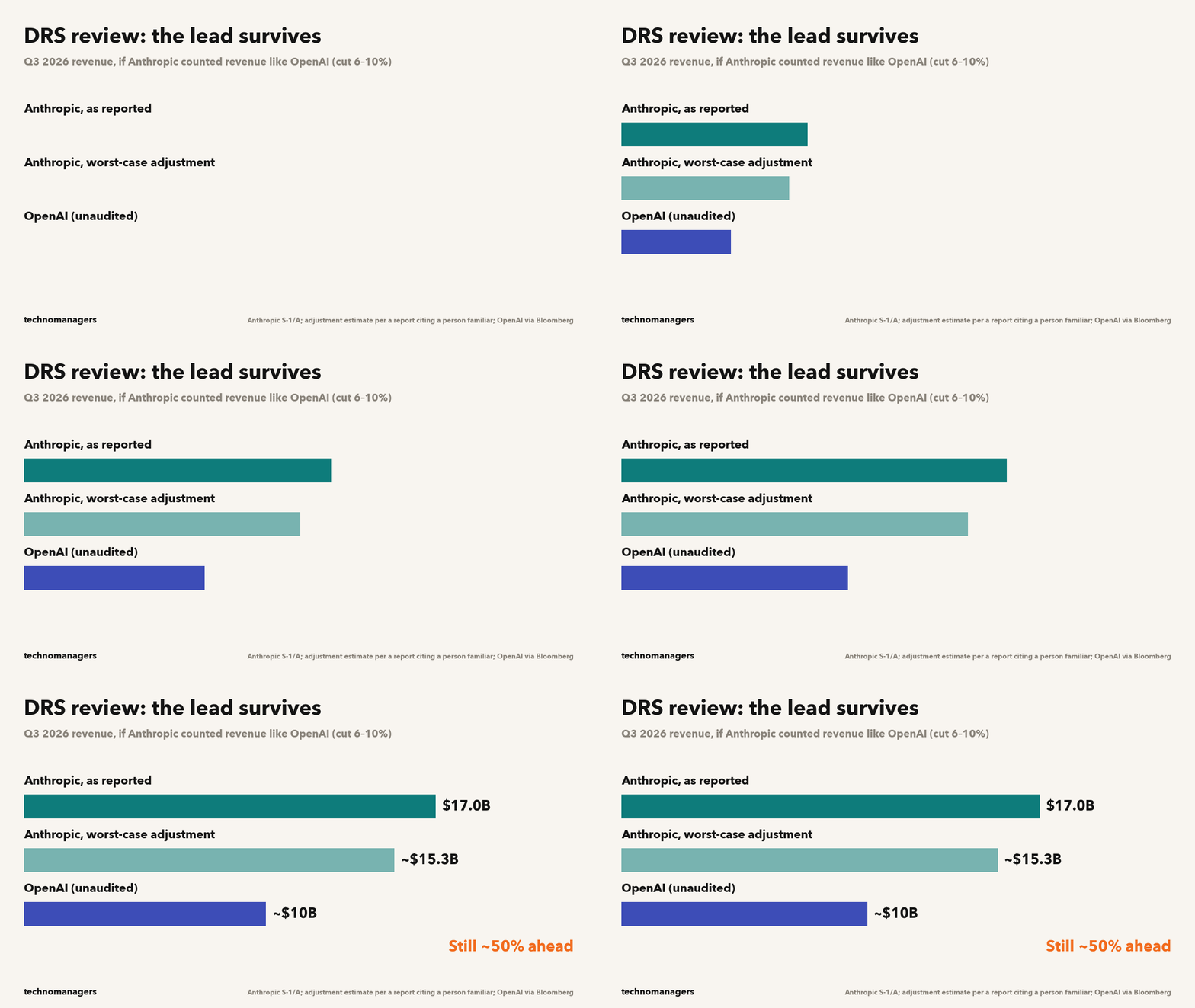
Decision: the lead narrows, but the call stands. $15.3 billion is still about 50% more than $10 billion.
Review 2: “One number is audited and the other isn’t.”
True. Anthropic’s number comes from an SEC filing. OpenAI’s comes from reporting on private investor documents. So treat the gap as roughly right, not exact.
Decision: umpire’s call. It cuts both ways.
Review 3: “Anthropic depends on a few big customers.”
Less than it used to. Early coverage of the filing said two customers made up nearly a quarter of Anthropic’s 2025 revenue. For the first nine months of 2026, analysts reading the filing say no single customer was above 10%, and the top five were about 25%. That’s still concentrated. It’s no longer a two-customer business.
Decision: not out, but one to watch.
Review 4: “Users still matter.”
They do, and this is the review OpenAI wins. Getting a billion people to choose your product every month is the hardest thing in tech. Google turned an audience like that into the most profitable business of the internet era. If ChatGPT’s ads work, today’s scoreboard could look very different by 2028.
Decision: overturned, for the long game. Anthropic is winning this season. The series is still open.
Why the series isn’t over
Both teams have a weak spot. Let’s do the maths on each.
Anthropic’s weak spot: a meter can be repriced overnight
On 17 November, OpenAI launched GPT-6.2 Astra at a list price 20% lower than GPT-6 Astra. Input tokens went from $10 to $8 per million.
Now imagine you’re Anthropic, and a big customer asks you to match that price. If you cut your price by 20%, that customer has to use 25% more just for your revenue to stay where it was. The maths is simple: 0.8 × 1.25 = 1.
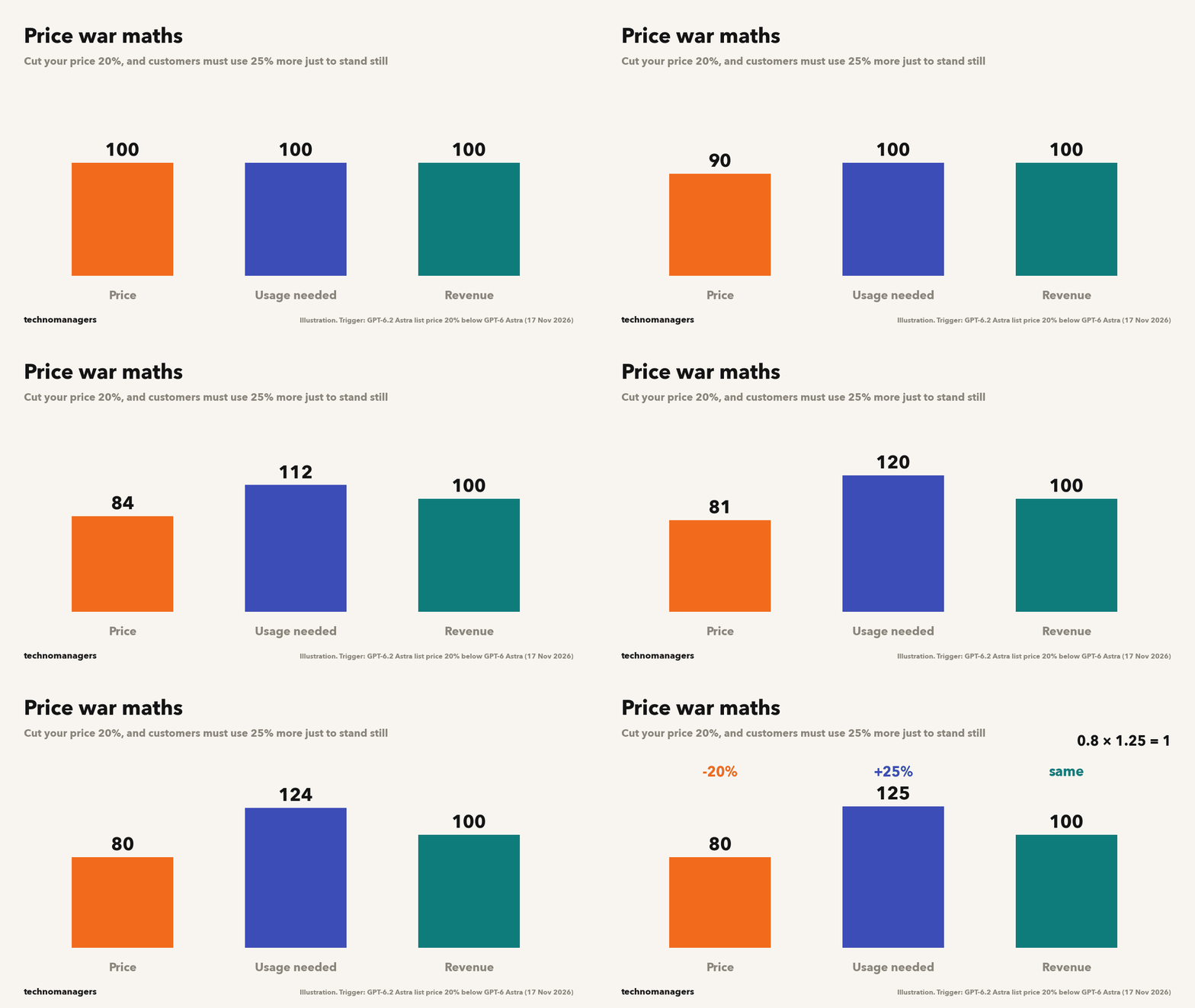
Usage often does grow when prices fall. That’s part of how you get to 900% retention. But price cuts from a rival don’t come with extra usage for you. They come with a customer asking whether to switch. And switching a model is often a settings change. Switching a billion people’s daily habit is not.
There’s a second problem, and it’s the one I think gets the least attention. A meter business has a fixed bill on the other side. Anthropic has signed up for hundreds of billions of dollars of computing capacity over the coming years. One reading of its amended filing puts the total near $900 billion. That’s like a restaurant signing a ten-year lease on a huge kitchen. If customers keep coming, it’s a great deal. If prices fall, the rent doesn’t.
And nearly half of Anthropic’s revenue comes through AWS, Google Cloud and Azure. Those are partners. They also sell rival models on the same shelf.
OpenAI’s weak spot: an audience is only worth what someone pays for it
Here’s a rough way to see the size of OpenAI’s bet.
In July to September, Meta made $64.6 billion from about 3.64 billion daily users. That’s roughly $18 per person per quarter, almost all of it from ads.
ChatGPT’s ads, at about $1 billion a year, work out to roughly 23 cents per monthly user per quarter.
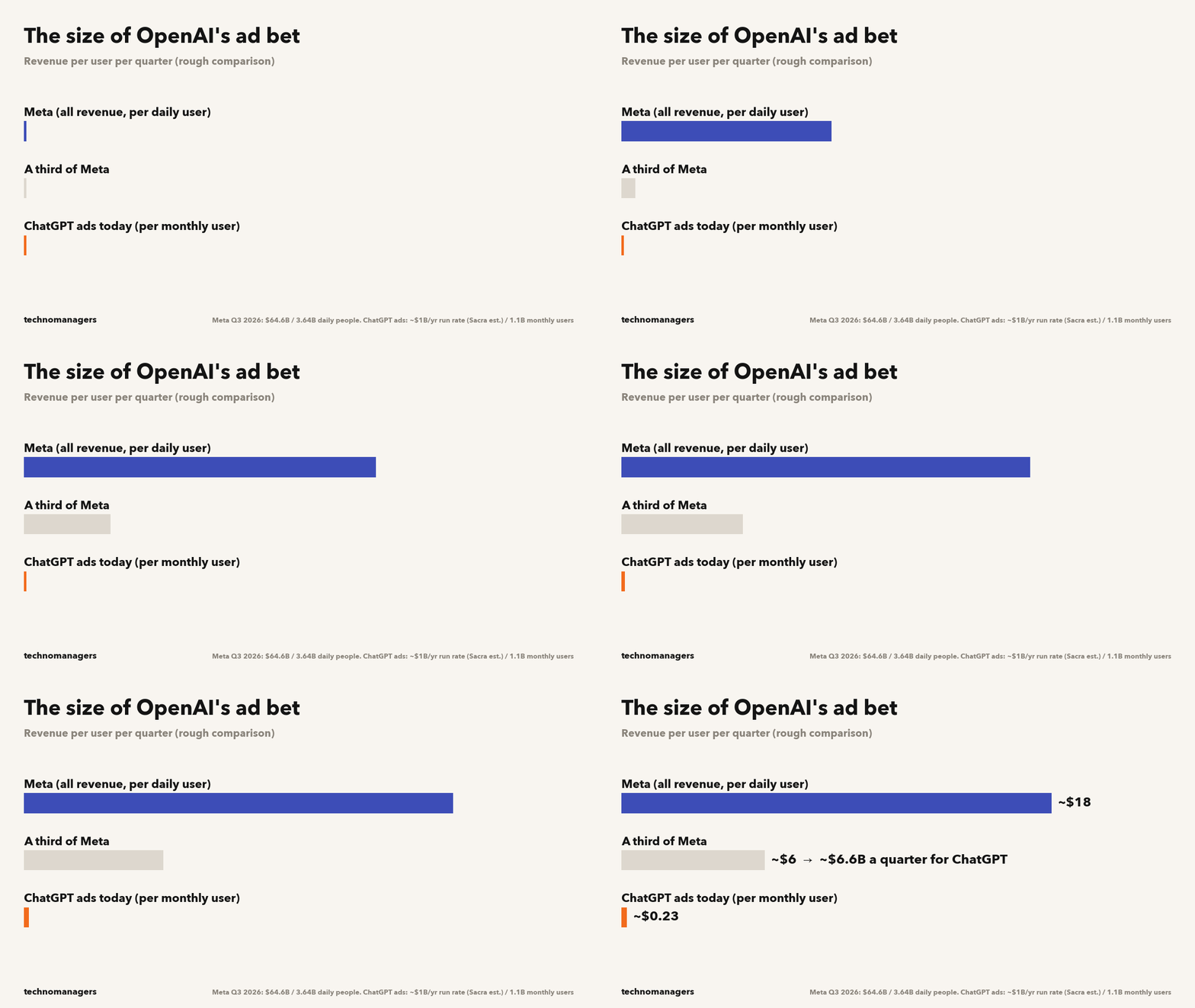
That’s not a fair fight. Meta has spent twenty years building its ad machine, and it counts daily users while ChatGPT counts monthly ones. But it shows you how much room there is. If ChatGPT earned even a third of what Meta earns per person, that would be about $6.6 billion a quarter in extra revenue. That alone would almost close today’s gap with Anthropic.
So OpenAI’s audience isn’t a weakness. It’s an unpaid cheque. The question is whether it gets cashed before the losses run out of runway, and before Gemini, which already ships inside Android, Chrome and Jio plans, takes the free users first.
My call
Here’s where I land.
The split between audience and meter won’t last. OpenAI is already moving toward selling to businesses. Anthropic will need an audience of its own to protect its meter from price wars. By the end of 2027, I expect these two business models to look a lot more alike than they do today.
So “who is winning?” has two answers.
This season: Anthropic. Even after the accounting adjustment, it earns more, from fewer and richer customers, and it spends far less to do it.
The long game: undecided. It depends on whether ChatGPT’s billion users turn into an ad business, and whether Anthropic’s meter survives a price war while that $900 billion bill comes due.
Three numbers will tell us which way it’s going when the next results come out:
Anthropic’s net revenue retention. If 900% drops sharply, the price war is biting.
ChatGPT’s ad revenue. If it moves from about $1 billion a year toward $5 billion, the audience is getting paid for.
OpenAI’s loss per dollar. It went from about $1.50 to $1.09. If it keeps falling, the audience strategy is working.
We’ll revisit this scoreboard when both companies report Q4.
What this means if you build AI products
You don’t have to be OpenAI or Anthropic to face this exact choice. Every AI product ends up as an audience or a meter, often without anyone deciding.
Here are three questions to take into your next roadmap review.
Who pays, and per what? If your honest answer is “users, eventually”, you’re running OpenAI’s playbook without OpenAI’s billion users. Name the unit you charge for. It could be a seat, a task, a resolved ticket or a token.
What happens to your revenue if a rival cuts prices 20% tomorrow? If the answer is “it drops 20%”, you’re selling a meter with nothing holding customers in place. What keeps them is the work they’ve saved in your product, the data you hold for them, and the tools you plug into.
Who owns your distribution? Anthropic gets nearly half its revenue through cloud marketplaces. If one app store, marketplace or partner brings you most of your customers, it can also take them away.
These are the questions that separate an AI feature from an AI business.
Want more AI strategy questions solved like this?
AI PM interviews increasingly ask questions like these. Here are three you could get next week:
“You’re the PM for ChatGPT. Ads now show in about 1 in 6 answers. How do you decide whether to expand them?”
“You’re pricing an AI support agent for an Indian D2C brand. Do you charge per seat, per chat or per resolved ticket?”
“A rival just cut its API price by 20%. You’re the PM for the API. What do you do this week?”
A real interview loop will throw a dozen more at you: AI product sense, RAG, evals, agent design, AI metrics, AI strategy and AI pricing.
Our AI Product Management Course + Interview Prep is built for exactly that:
✅ Real AI PM interview questions with full model answers
✅ End-to-end AI prototyping
✅ Hands-on advanced evals on Google Colab: open coding, axial coding, LLM judges and RAG evals
✅ 50+ video lectures and 25+ case studies from Google, Nvidia, Uber and more
✅ Lifetime access and a Certificate of Competency
PMs at Google, Microsoft, Coinbase and Indeed have rated it 4.9/5.
🎁 Use code NYE27 for 40% OFF → Enroll here
Want to build AI products live with a small group? The AI Product Manager & Builder Cohort runs for 12 weekends. Week 9 covers exactly this topic: moats, model selection and go-to-market, followed by a full mock interview. You build 10+ AI projects and present your capstone at Demo Day.
FAQ: OpenAI vs Anthropic
How many users does ChatGPT have compared with Claude?
Sensor Tower estimated in June 2026 that ChatGPT had more than 1.1 billion monthly users and Claude had about 245 million. OpenAI itself reported 900 million weekly users in February 2026.
Who makes more money, OpenAI or Anthropic?
In July to September 2026, Anthropic reported $17.0 billion in revenue. OpenAI reportedly made about $10 billion. Anthropic counts some cloud-marketplace sales before the partner’s cut, so the like-for-like gap is a bit smaller, but Anthropic is still ahead.
Is Anthropic profitable?
Not consistently yet. It made a $974 million operating profit in April to June 2026, then reported an operating loss of about $567 million in July to September.
Is OpenAI profitable?
No. OpenAI reportedly lost about $10.9 billion on an adjusted operating basis in July to September 2026, on about $10 billion of revenue.
How does Anthropic make money?
Mostly by usage. About 80% of its revenue in the first half of 2026 came from customers paying per token, mainly businesses building Claude into their own products. The other 20% came from subscriptions.
Why is Anthropic valued more than OpenAI?
Anthropic closed its first trading day at about $1.75 trillion. OpenAI’s last private valuation was $852 billion. Investors appear to be paying for Anthropic’s higher revenue, its fast-growing business customers and its much smaller losses.
Keep reading
Shailesh Sharma helps PMs and business leaders excel in Product, Strategy, and AI using First Principles Thinking. → AI PM Course · AI Product Manager & Builder Cohort
Sources
Users: Sensor Tower via TechCrunch, June 2026. Weekly users and paying subscribers: TechCrunch, February 2026
Anthropic Q3 2026 revenue ($17.0B): amended S-1, via OfficeChai
OpenAI Q3 2026 revenue and adjusted operating loss: Wall Street Journal documents, via Forbes and The Silicon Review
Anthropic operating profit, net revenue retention, compute commitments: Daloopa, Mostly Metrics, Hackernoon
IPO pricing and first-day close: Al Jazeera, Constellation Research
OpenAI $852B valuation: Yahoo Finance
Revenue mix (80% usage-based), customer counts: S-1 coverage by CNBC
Gross vs net accounting, 48% via cloud marketplaces: Finrep, The SaaS CFO
Customer concentration: OfficeChai, Daloopa
OpenAI consumer revenue share (estimates cited in): Egan et al., Harvard Business School working paper, October 2026
ChatGPT ads: Writesonic AI Ads Index; ad run-rate estimate: Sacra
Meta Q3 2026 revenue and daily users: Meta Q3 2026 results
GPT-6.2 Astra pricing: OpenAI API pricing, via Apidog