


Before this, find out our Recent Article -
Now let’s get back to our Article -
The global AI industry is currently in a state of extreme tension. To understand this, we need to look beyond the software.
Let’s break it down using the first principle thinking and starts form AI Stack
The AI stack
We should view AI not as a single tool, but as five dependent layers. Each layer must work for the next layer to function.
Hardware Layer: The physical silicon chips (GPUs and TPUs) that do the math. ( Bottom layer )
Cloud Infrastructure Layer: The data centres, power grids, and cooling systems where the chips live.
Data Layer: The massive datasets used to train and feed the models.
Model Layer: The AI itself, like GPT-4 or Gemini, which processes information.
Application Layer: The interface you interact with, such as a chatbot or a coding assistant. ( Top Layer )
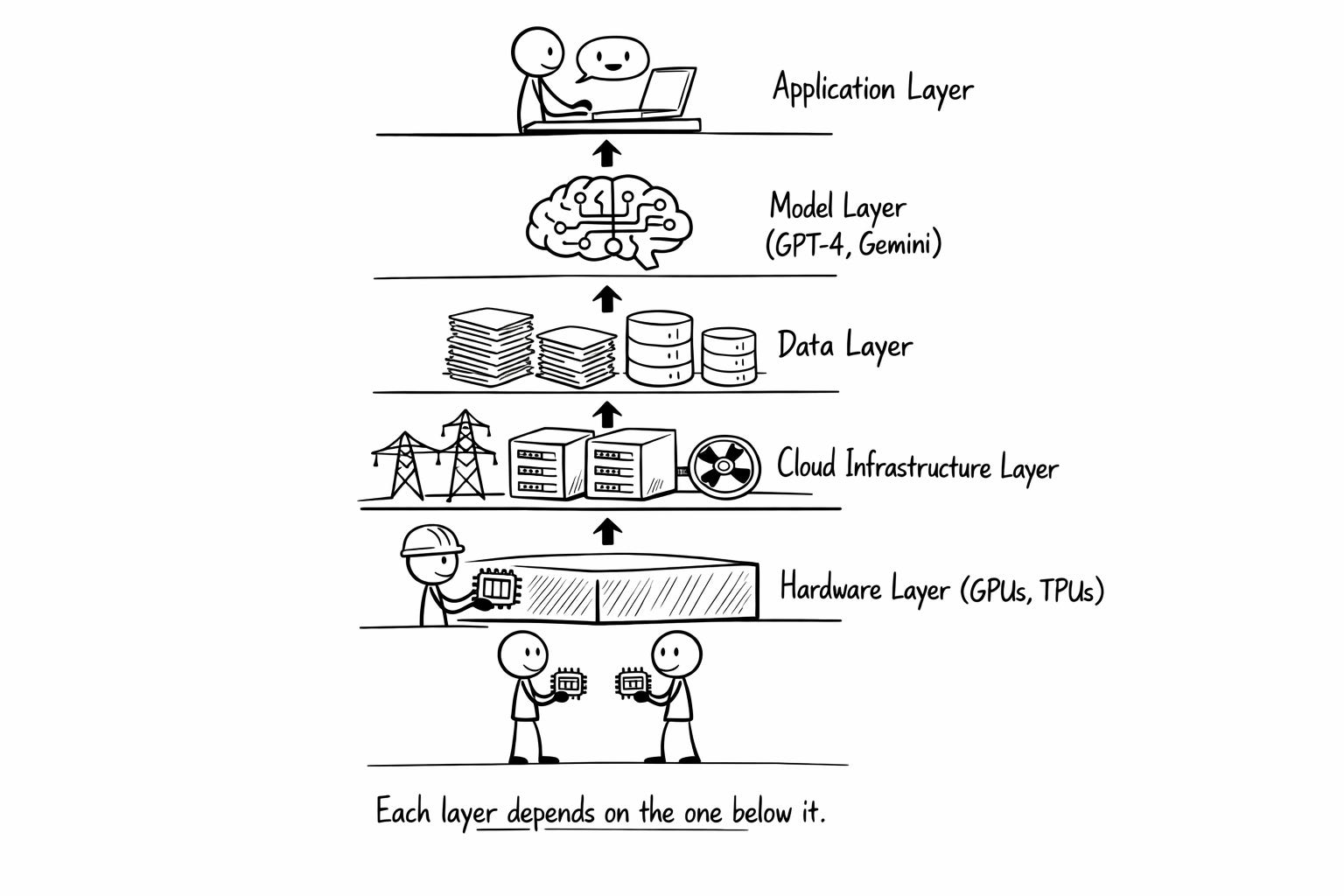
Where does TSMC sit?
TSMC sits at the base. If the Hardware Layer is blocked, the entire stack above it stops growing.
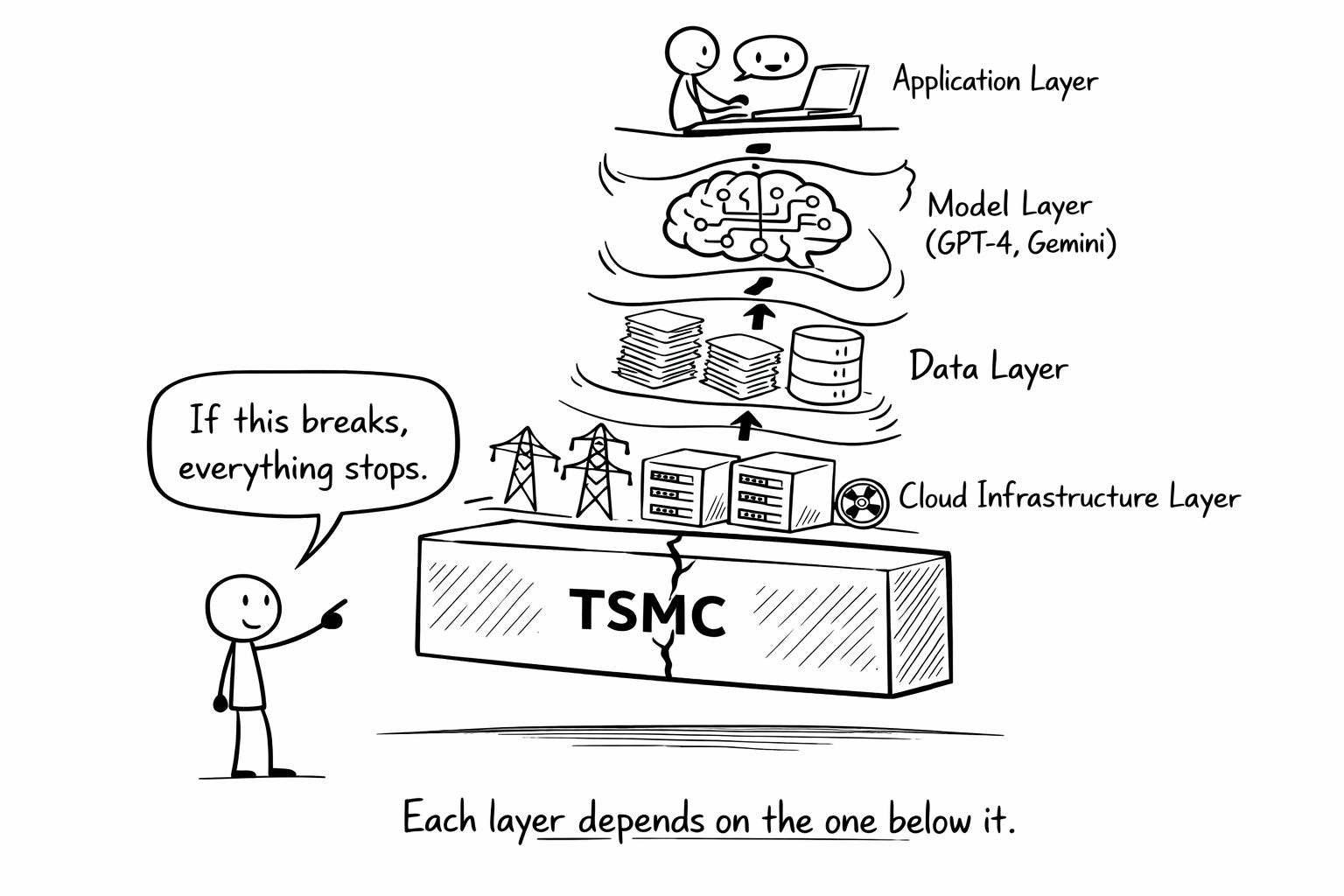
The confusion between Nvidia and TSMC
People confuse Nvidia with making chips. This is incorrect. NVIDIA is a fabless company. This means they are like architects: they design the most advanced blueprints for chips, but they do not own a single factory.
TSMC is a foundry. This means they do not design chips, they only manufacture them for others like Nvidia, Apple, and Google.
In the AI world, TSMC is the only company capable of making the most advanced chips at a massive scale. If you want to build a leading AI model today, your chips almost certainly come from a TSMC factory.
TSMC turns silicon into incredibly complex processors. They use a process called lithography to print billions of tiny circuits onto a single chip.
As AI grows, chips need to be smaller and more powerful. TSMC is currently the only company moving into 2nm (two-nanometer) production, which is the most advanced technology on earth. They also provide advanced packaging, which is the process of connecting multiple chips together so they can talk to each other at high speeds.
The strategic play
TSMC has a simple but powerful strategy: they are the world’s partner, not a competitor.
Because they do not sell their own chips or software, every tech giant feels safe giving TSMC their top-secret designs. This trust has created a monopoly where TSMC makes nearly 90% of all advanced AI chips.
The bottleneck
Right now, the AI industry is hitting a wall. The demand for AI chips is much higher than the supply. Tech companies like Microsoft and Meta are spending hundreds of billions of dollars to build AI, but they cannot get enough chips to fill their data centres.
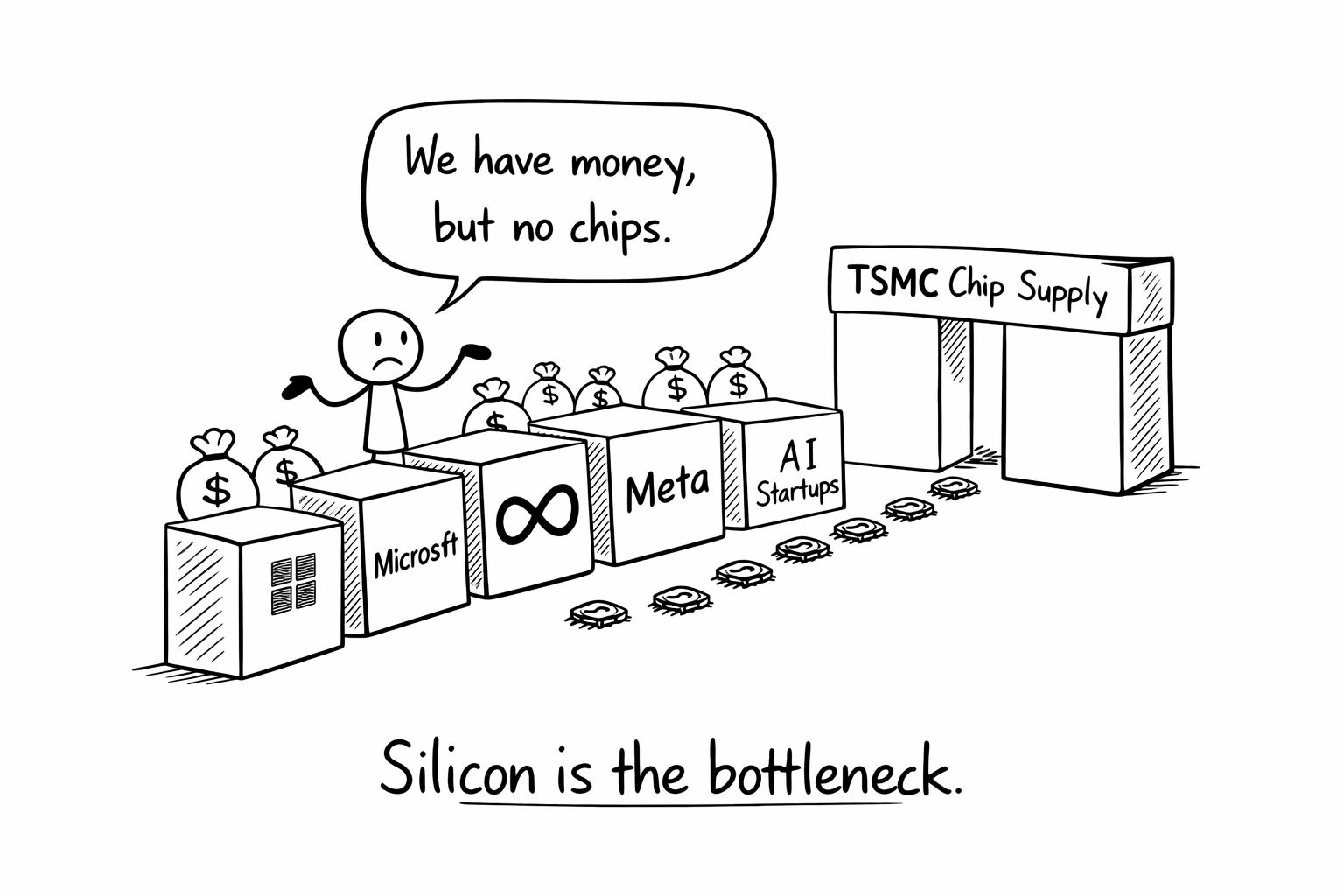
The problem is that building a new chip factory takes three to four years. This means the decisions TSMC made in 2023 are what we are living with today in 2026. We cannot fast-track the physics of making silicon instantly
TSMC was cautious with their spending a few years ago, and we are feeling that delay today. Silicon, not power or software, is currently the biggest limit on AI growth.
The risk
There are two main risks:
Economic risk: TSMC is afraid that if they spend too much money building factories and the AI boom ends, they will be left with expensive, empty buildings. To protect themselves, they are building slowly. This shifts the risk to their customers, who lose money because they don’t have enough chips to sell their services.
Geographic risk: Most of TSMC’s factories are in Taiwan (Closer to China). If something happens there, the global AI industry would stop instantly.
What can be the way forward?
The only way to fix this is competition. If companies like Intel or Samsung can become as good as TSMC, there will be more factories and more chips.
For the AI industry to reach its full potential, tech giants must help these competitors succeed.
Relying on one company is safe for now, but it creates a brake on how fast the world can innovate. The future of AI depends on moving from one supplier to many.
In the Recent Interview, Elon Musk said he is going to take a stab at this. His solution is the Tesla Terafab, a massive domestic semiconductor facility designed to handle the entire chip-making process under one roof.
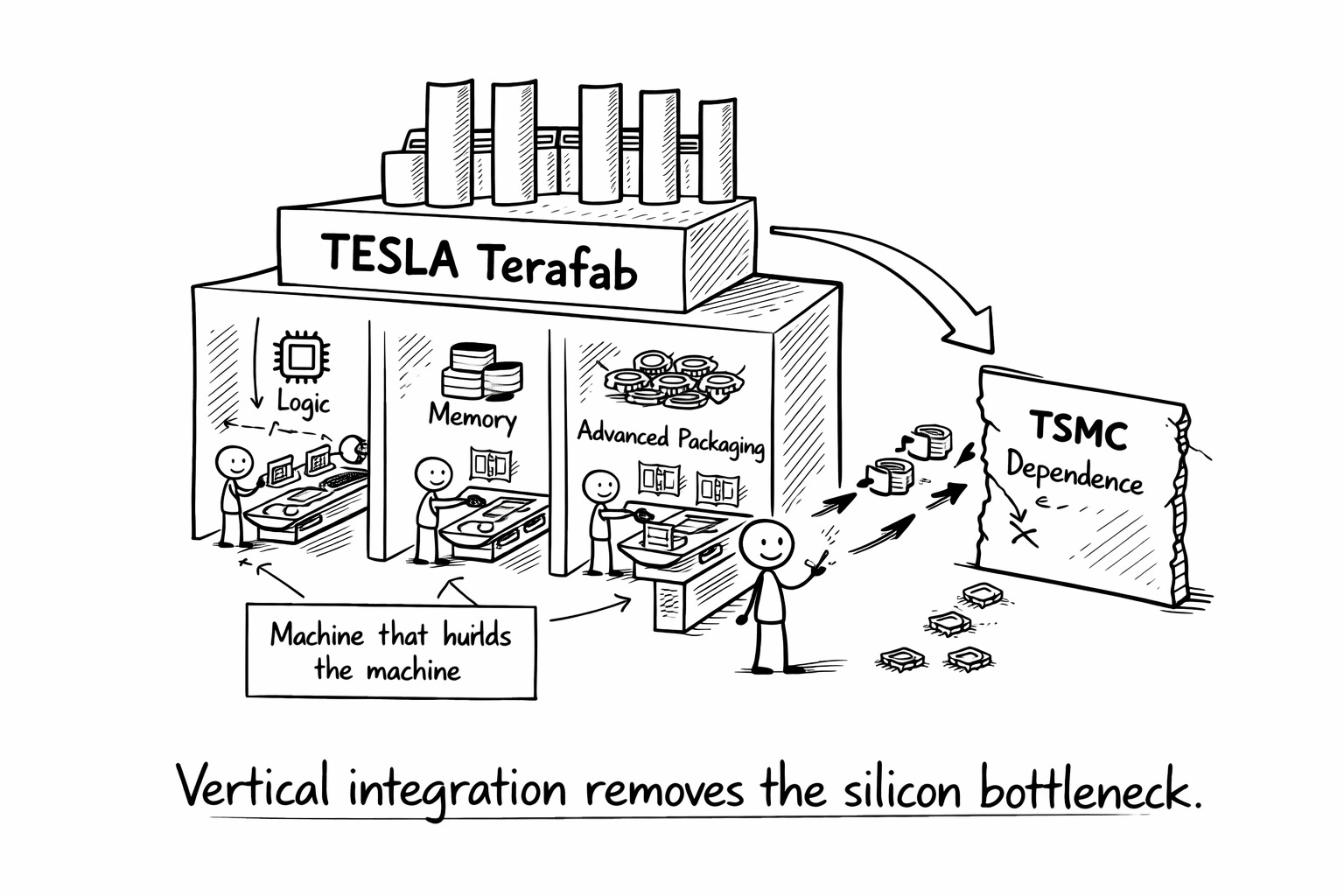
Unlike typical fabless companies (like Nvidia) that only design chips, the Terafab will integrate logic, memory, and advanced packaging in a single facility.
If you like this article, you will absolutely love our AI Product Management Course ( having real AI PM Interview Questions from Google, OpenAI, Anthropic etc) - 25+ Real Case studies as well
About Author
Shailesh Sharma! I help PMs and business leaders excel in Product, Strategy, and AI using First Principles Thinking. For more, check out my AI Product Management Course, PM Interview Mastery Course, Cracking Strategy, and other Resources